Knowledge and application of Good Agricultural Practices (GAP) among cucumber (Cucumis sativus L.) growers in Bharatpur metropolitan city, Nepal
DOI:
https://doi.org/10.26832/24566632.2025.1003011Keywords:
Cucumber, Farm waste management, Recommended variety, Post harvest practicesAbstract
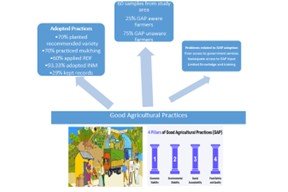
A study was conducted to determine the Good Agricultural Practices (GAPs) adopted by cucumber (Cucumis sativus L.) growers in Ward 27 of Bharatpur Metropolitan City, Chitwan, Nepal. For the collection of data, 60 cucumber growers were interviewed through a semi-structured questionnaire. Farmers were categorized as GAP aware farmers and GAP unaware farmers. The data was analyzed using descriptive statistical tools, such as t-test and binary logit regression analysis. The results revealed that only 25% of the farmers were aware of GAP. Although, majority of farmers were not aware of GAP, i.e., 75%, yet they managed to apply various good agricultural practices on their farms. 70% of farmers planted the recommended variety, 70% practiced mulching, and 60% applied the recommended dose of fertilizers (RDF). Likewise, almost all (93.33%) integrated organic nutrients alongside chemical fertilizers, whereas 81.7% applied irrigation water free from harmful contaminants. The results revealed that 65% farmers used PPE while handling chemical fertilizers and 61.7% adopted IPM. Very few, 29% of respondents kept the record, which was determined to be the least adopted among other practices. From the result of the binary logit regression analysis, none of the independent factors were found to be statistically affecting GAP awareness. Poor access to government services, followed by inadequate access to GAP input, were found to be the major problems related to GAP adoption. Limited knowledge and training, and limited market incentives were other major problems faced by farmers.
Downloads
References
Acharya, N., Bhusal, K., Adhikari, K. B., Acharya, P., Pandey, S., & Chapai, D. P. (2024). Awareness and Adoption Status of Good Agricultural Practices in Mandarin (Citrus reticulata Blanco.) among Farmers of Syangja, Nepal. International Journal of Horticulture, 14. https://doi.org/10.5376/ijh.2024.14.0003
Adhikari, J., & Thapa, R. (2023). Determinants of the adoption of different good agricultural practices (GAP) in the command area of PMAMP apple zone in Nepal: The case of Mustang district. Heliyon, 9(7). https://doi.org/10.1016/j.heliyon.2023.e17822
Bajgain, D., Tiwari, I., Joshi, H., Shah, K. K., & Shrestha, J. (2024). Good agricultural practices (GAP) adoption intensity and production constraints in apple orchards of western Nepal. Heliyon, 10(9), e30225. https://doi.org/10.1016/j.heliyon.2024.e30225
Baral, R., Kafle, B. P., Panday, D., Shrestha, J., & Min, D. (2021). Adoption of good agricultural practice to increase yield and profit of ginger farming in Nepal. Journal of Horticultural Research, 29(1), 55-66.
Chhetri, B., & Ghimire, S. (2023). Gender differentiated impacts of climate change on agriculture in Nepal: A review. Innovations in Agriculture, 6, e32852. https://doi.org/10.25081/ia.2023-021
Cochran, W.G. (1977). Sampling Techniques. 3rd ed. New York: John Wiley & Sons.
FAO. (2004). Good Agricultural Practices - a working concept. Retrieved from Food and Agriculture Organization of the United Nations. Accessed from: https://www.fao.org/4/ag856e/ag856e00.pdf
FAO. (2016). A scheme and training manual on good agricultural practices (GAP) for fruits and vegetables. Retrieved from Food and Agriculture Organization of the United Nations. Accessed from: https://www.fao.org/3/i6677e/i6677e.pdf
Joshi, A., Kalauni, D., & Tiwari, U. (2019). Determinants of awareness of good agricultural practices (GAP) among banana growers in Chitwan, Nepal. Journal of Agriculture and Food Research, 1, 100010. https://doi.org/10.1016/j.jafr.2019.100010
Kharel, M., Raut, N., & Dahal, B. M. (2023). An assessment of good agriculture practices for safe and sustainable vegetable production in mid-hills of Nepal. Journal of Agriculture and Food Research, 11, 100518. https://doi.org/10.1016/j.jafr.2023.100518
Mim, M. K., & Islam, M. M. (2022). Identification of the discrepancy between farmers’ practices and good agricultural practices in crop husbandry. New Countryside, 2(1), 1–15. https://doi.org/10.55121/nc.v1i2.30
MOAD (2015). Agriculture Development Strategy (ADS) 2015 to 2035. Government of Nepal, Ministry of Agricultural Development. Kathmandu, Nepal. Accessed from: http://faolex.fao.org/docs/pdf/nep171433.pdf
Ojha, B., Regmi, B., & Bhattarai, D. (2024). Citrus growers' knowledge, attitudes, and implementation towards Good Agricultural Practices (GAPs) in Palpa, Nepal. Archives of Agriculture and Environmental Science, 9(3), 481-489. https://doi.org/10.26832/24566632.2024.0903011
Rijal, J. P., Regmi, R., Ghimire, R., Puri, K. D., Gyawaly, S., & Poudel, S. (2018). Farmers’ knowledge on pesticide safety and pest management practices: A case study of vegetable growers in Chitwan, Nepal. Agriculture, 8(16). https://doi.org/10.3390/agriculture8010016
Sareen, S. (2016). A scheme and training manual on good agricultural practices. Accessed from: https://openknowledge.fao.org/handle/20.500.14283/i6677en
Sedhai, S., Panth, B. P., Dulal, P. R., Adhikari, G., & Dhungana, S. (2022). Good agricultural practices in mandarin (Citrus reticulata Blanco): Perception and factors affecting awareness among farmers in Gulmi, Nepal. Archives of Agriculture and Environmental Science, 7(2), 142–149. https://doi.org/10.26832/24566632.2022.070201
Downloads
Published
How to Cite
Issue
Section
License
Copyright (c) 2025 Agriculture and Environmental Science Academy

This work is licensed under a Creative Commons Attribution-NonCommercial 4.0 International License.