Comparative study of various botanical and chemical pesticides against red pumpkin beetle (Aulacophora foveicollis) in summer squash at Bhojpur, Nepal
DOI:
https://doi.org/10.26832/24566632.2025.1003017Keywords:
Crop damage, Deltamethrin, Pesticides, Red Pumpkin BeetleAbstract
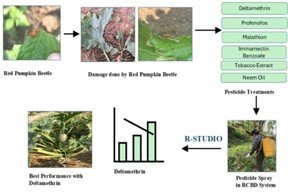
The red pumpkin beetle (Aulacophora foveicollis) is an invasive pest of summer squash (Cucurbita pepo) that damages seedlings, skeletonize leaves and flower buds, ultimately reducing yield. This study, conducted in Bhojpur, Nepal, examined the effectiveness of selected pesticides for the control of Red Pumpkin Beetle (RPB). A Randomized Complete Block Design (RCBD) was used with seven treatments; each replicated three times. It assessed the effectiveness of Deltamethrin, Profenofos, Malathion, Emmamectin benzoate, Neem oil, Tobacco extract, and water spray. Data on beetle population and leaf damage severity were collected before spray and at 1, 3, 6, and 10 days after spray (DAS), then analyzed using ANOVA and DMRT. Results indicated that Deltamethrin emerged as the most effective, reducing beetle population to 0.71 beetles/plant and leaf damage to 9.46%. Profenofos demonstrated similar efficacy with 0.90 beetles/plant and 13.06% damage. Malathion and Emmamectin benzoate were moderately effective, while Neem oil and Tobacco extract were least effective but better than water spray, which recorded 3.96 beetles/plant and 48.91% damage. All pesticides reduced beetle populations compared to control, but Deltamethrin and Profenofos were most effective and statistically similar. These findings emphasize the importance of selecting appropriate pesticides and applying correct dosages for effective management of Red Pumpkin Beetle.
Downloads
References
Atreya, K., Kattel, K., Pandit, S., Chaudhary, P., & Sipkhan, P. (2022). Understanding farmers’ knowledge, attitudes and practices of pesticide use in Nepal: synthesis of a systematic literature review. Archives of Agriculture and Environmental Science, 7(2), 278–287. https://doi.org/10.26832/24566632.2022.0702018
Diver, S., & Hinman, T. (2008). Cucumber Beetles: Organic and biorational integrated pest management. National Sustainable Agriculture Information Service, 20. Retrieved from https://www.researchgate.net/publication/237632132_Cucumber_Beetles_Organic_and_Biorational_Integrated_Pest_Management
Kallathuru, K. R., Preetha, G., Srinivasan, M. R., Kavitha, M., & Parameswari, E. (2023). Acute Toxicity of Commonly used Insecticides to Red Pumpkin Beetle, Aulacophora foveicollis. International Journal of Environment and Climate Change, 13(10), 3660–3664. https://doi.org/10.9734/ijecc/2023/v13i103036
Nath, D., & Ray, D. C. (2012). Traditional management of red pumpkin beetle, Raphidopalpa foveicollis Lucas in Cachar district, Assam. Indian Journal of Traditional Knowledge, 11(2), 346–350.
Parajuli, S., Shrestha, B., Dulal, P. R., Sapkota, B., Gautam, S., & Pandey, S. (2020). Efficacy of various insecticides against major insect pests of summer squash (Cucurbita pepo) in Dhading District, Nepal. Science Heritage Journal, 4(1), 35–42. https://doi.org/10.26480/gws.01.2020.35.42
Rahman, M. M. (2018). Evaluation of different traps and some non-chemical options against the infestation of fruit fly and red pumpkin beetle on ridge gourd. Retrieved from https://saulibrary.edu.bd/daatj/public/uploads/12-04894_11.pdf
Rai, M., Pandey, S., & Kumar, S. (2008). Cucurbit research in India: a retrospect. Retrieved from https://www.semanticscholar.org/paper/Cucurbit-research-in-India%3A-a-retrospect.-Rai-Pandey/edea793a35011ac2287fa25aa83981aa2bb4a063
Rashid, M. A., Khan, M. A., Arif, M. J., & Javed, N. (2014). Red pumpkin beetle, Aulacophora foveicollis Lucas; A review of host susceptibility and management practices. Academic Journal of Entomology, 7(1), 38–54. https://doi.org/10.5829/idosi.aje.2014.7.1.1112
Regmi, S., & Paudel, M. (2020). A review on host preference, damage severity and integrated pest management of red pumpkin beetle. Environmental Contaminants Reviews, 3(1), 16–20. https://doi.org/10.26480/ecr.01.2020.16.20
Rehan Aslam, M., Rawalpindi, U., Khadija Javed, P., Humayun Javed, P., Tayyib Ahmad, P., Ajmal Khan Kassi, P., Correspondence Ajmal Khan Kassi, P., Javed, K., Javed, H., Ahmad, T., & Khan Kassi, A. (2017). Varietal resistance of pumpkin (Cucurbita pepo L.) Germplasms against red pumpkin beetle Aulacophora foveicollis L. in Pothwar region. ~ 7 ~ Journal of Entomology and Zoology Studies, 5(1), 7–12.
Rouphael, Y., & Colla, G. (2005). Growth, yield, fruit quality and nutrient uptake of hydroponically cultivated zucchini squash as affected by irrigation systems and growing seasons. Scientia Horticulturae, 105(2), 177–195. https://doi.org/10.1016/j.scienta.2005.01.025
Sarker, D., Atikur Rahman, M., Mohasin Hussain Khan, M., & Hemayet Jahan, S. M. (2022). Seasonal incidence and damage potentiality of the Aulacophora (Coleoptera: Chrysomelidae) species in cucurbits from the southern part of Bangladesh. International Journal of Innovative Research, 7(2), 8–12.
Sharma, A., Rana, C., & Shiwani, K. (2016). Important Insect Pests of Cucurbits and Their Management. Handbook of Cucurbits, 347–380. https://doi.org/10.1201/b19233-36
Ullah, M., I.-H., & Khan, S. A. (2022). Varietal preference and efficacy of various chemicals against red pumpkin beetle (Aulacophora foveicollis L.) (Coleoptera: Chrysomelidae) in different cucumber (Cucumis sativus) cultivars. Acta Entomology and Zoology, 3(2), 134–140. https://doi.org/10.33545/27080013.2022.v3.i2b.87
Vodnala, R. (2016). Efficacy of certain insecticides to red pumpkin beetle, Aulacophora foveicollis on cucumber, Cucumis sativus. Retrieved from https://www.researchgate.net/publication/324476804
Yaligar, R., Badari Prasad, P., Shrihari, H., Hurali, S., Jyothi, R., & Krishi Vigyana Kendra, S. (2022). Evaluation of Bio-Efficacy and Phytotoxicity of Flubendiamide 90 + Deltamethrin 60-150 SC (15% W/V) against Pest Complex in Cucumber. Biological Forum-An International Journal, 14(1), 883.
Downloads
Published
How to Cite
Issue
Section
License
Copyright (c) 2025 Agriculture and Environmental Science Academy

This work is licensed under a Creative Commons Attribution-NonCommercial 4.0 International License.