Human-wolf conflicts in the buffer zone of Sagarmatha National Park: Patterns of livestock predation, community perceptions and mitigation strategies
DOI:
https://doi.org/10.26832/24566632.2026.110106Keywords:
Human-wildlife conflict, Mitigation, Sagarmatha, Wolf depredationAbstract
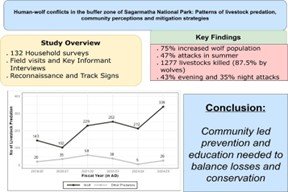
In the buffer zone of Sagarmatha National Park, Nepal, this study assessed the status of human–wolf conflict by documenting livestock depredation patterns, exploring community perceptions, and reviewing locally applied mitigation measures. Information was gathered through reconnaissance and key-informant consultations, field visits to reported conflict locations (supported by signs such as tracks, scat, and carcass remains), and household interviews using open-ended questionnaires with 132 respondents from Ward 4 and Ward 5 (66 per ward). Reported conflict was widespread: 75% of respondents perceived an increasing trend in wolf population over the last five years, and 41.7% described wolf attacks as frequent. Annual livestock depredation records from 2019 to 2025 indicated that wolves were the principal predator, accounting for 1,277 incidents (approximately 87.5% of all recorded depredations). The highest number of cases occurred in 2024/25 (339), while the lowest number was recorded in 2020/21 (102). Among respondents who identified seasonal patterns (n = 77), attacks were reported most frequently during the summer (June–August; 47%) and occurred primarily in the evening (42%) and at night (35%). Perceptions were predominantly negative, driven by livestock losses (68.2%) and concerns for human safety (27.3%). Fencing, sensor lights, and fox lights were used by some households, but many reported no preventive measures and generally viewed existing options as ineffective. Education and direct encounters with wolves were significantly associated with perceptions and support for wolf conservation. Targeted, community-led prevention and risk-communication efforts aligned with local depredation patterns could reduce losses while maintaining support for wolf conservation.
Downloads
References
Ambarli, H. (2019). Analysis of wolf–human conflicts: Implications for damage mitigation measures. European Journal of Wildlife Research, 65(6), 81.
Aryal, S. (2022). Status of Human-Wildlife Conflict in Manahari Buffer Zone Area of Parsa National Park: A Geospatial Approach to Assess the Conflict (Doctoral dissertation, Thesis submitted for the partial fulfillment of the award of M. Sc. in Natural Resource Management and Rural Development, KAFCOL, Tribhuvan University, Kathmandu, Nepal).
Balestrini, R., Polesello, S., & Sacchi, E. (2014). Chemistry and isotopic composition of precipitation and surface waters in Khumbu valley (Nepal Himalaya): N dynamics of high elevation basins. Science of the Total Environment, 485, 681-692.
Bangs, E. E., Fritts, S. H., Fontaine, J. A., Smith, D. W., Murphy, K. M., Mack, C. M., & Niemeyer, C. C. (1998). Status of gray wolf restoration in Montana, Idaho, and Wyoming. Wildlife Society Bulletin, 26(4), 785-798.
Bhattarai, D., Devkota, A., & Sharma, G. B. (2025). Determinants and perceptions of women’s participation in community forest management: Evidence from Western Nepal. Archives of Agriculture and Environmental Science, 10(4), 615-624. https://doi.org/10.26832/24566632.2025.100409
Chapron, G., Kaczensky, P., Linnell, J. D., Von Arx, M., Huber, D., Andrén, H., & Boitani, L. (2014). Recovery of large carnivores in Europe’s modern human-dominated landscapes. Science, 346(6216), 1517-1519. https://doi.org/10.1126/science.1257553
Chetri, M., Odden, M., & Wegge, P. (2017). Snow leopard and Himalayan wolf: food habits and prey selection in the Central Himalayas, Nepal. PloS one, 12(2), e0170549. https://doi.org/10.1371/journal.pone.0170549
Chetri, M., Odden, M., Devineau, O., McCarthy, T., & Wegge, P. (2020). Multiple factors influence local perceptions of snow leopards and Himalayan wolves in the central Himalayas, Nepal. PeerJ, 8, e10108. https://doi.org/10.7717/peerj.10108
Dahal, R. P., Kafle, S., Khanal, K., KC, S., Subedi, M., Ojha, P., & Din, H. U. (2025). Agroforestry and traditional knowledge: Lessons from indigenous practices in South Asian Countries: A review. Archives of Agriculture and Environmental Science, 10(1), 189-196. https://doi.org/10.26832/24566632.2025.1001027
Devkota, A., Karki, B., Magar, L. K., & Lamichhane, P. (2025a). Assessing the impact of canopy opening in regeneration status of tropical Terai forest of Nepal. Trees, Forests and People, 100904. https://doi.org/10.1016/j.tfp.2025.100904
Devkota, A., Upadhyay, I. K., & Wagle, B. (2025b). Value chain analysis of Taxus (Yew) species and its affecting factors in Makwanpur district, Nepal. Archives of Agriculture and Environmental Science, 10(4), 677-686. https://doi.org/10.26832/24566632.2025.1004017
Dhungana, R., Ram, B., Savini, T., Dhakal, M., Sagar, B., & Bahadur, J. (2019). Livestock depredation by leopards around Chitwan National Park, Nepal. Mammalian Biology, 96, 7–13. https://doi.org/10.1016/j.mambio.2019.03.006
Din, J. U., Hameed, S., Shah, K. A., Khan, M. A., Khan, S., Ali, M., & Nawaz, M. A. (2013). Abundance of canids and human canid conflict in the Hindu Kush Mountain range of Pakistan. Wildlife Biology in Practice, 9(2), 20-29.
Farrington, J. D., & Tsering, D. (2020). Snow leopard distribution in the Chang Tang region of Tibet, China. Global Ecology and Conservation, 23(4), e01044. https://doi.org/10.1016/j.gecco.2020.e01044
Ghimire, A., Paudel, S., & Devkota, A. (2022). Silvicultural Systems in the Restoration of Normal Forest: A Review. Forestry: Journal of Institute of Forestry, Nepal, 19(01), 64-72. https://doi.org/10.3126/forestry.v19i01.55706
Gupta, A. (2024). Analyzing Land Use/Land Cover Dynamics in Mountain Tourism Areas: A Case Study of the Core and Buffer Zones of Sagarmatha and Khaptad National Parks, Nepal. Sustainability, 16(23), 10670.
Joshi, H. C., Ojha, P., Khadka, S., & Adhikari, S. (2022). An Assessment of Human-Wildlife Conflict in Basanta Corridor: a Case Study from Kailari Rural Municipality, Nepal. Indonesian Journal of Social and Environmental Issues (IJSEI), 3(3), 213-222. https://doi.org/10.47540/ijsei.v3i3.635
Khadka, S., Ojha, P., Yadav, V. K., Rijal, P., Joshi, H., & Acharya, K. R. (2023). Public Perception and Institutional Involvement in Urban Forestry Development in Dhangadhi Sub-Metropolitan City, Sudurpaschim Province, Nepal. Forestry: Journal of Institute of Forestry, Nepal, 20(1), 95-111. https://doi.org/10.3126/forestry.v20i1.64340
Mech, L. D., & Boitani, L. (2010). Wolves: Ecology, behavior, and conservation. University of Chicago Press.
Pal, R., Panwar, A., Goyal, S.P., & Sathyakumar, S. (2022). Space Use by Woolly Wolf Canis lupus chanco in Gangotri National Park, Western Himalaya, India. Frontier in Ecology and Evolution, 9: 782339. https://doi.org/10.3389/fevo.2021.782339
Raza, M., Namgail, T., & Rawat, G. S. (2024). Livestock Depredation by Large Carnivores in Kargil, Indian Trans-Himalaya: Patterns and People's Perceptions. Indian Journal of Ecology, 51(4), 727-731.
Ojha, P., Acharya, K. R., Subedi, A., & Regmi, S. (2023). Impact of silviculture system on regeneration status and species diversity: reflection from far-western lowland, Nepal. Banko Janakari, 33(2), 24-37. https://doi.org/10.3126/banko.v33i2.58280
Oli, M. K., Taylor, I. R., & Rogers, M. E. (1994). Snow leopard Panthera uncia predation of livestock: an assessment of local perceptions in the Annapurna Conservation Area, Nepal. Biological Conservation, 68(1), 63-68.
Redpath, S. M., Young, J., Evely, A., Adams, W. M., Sutherland, W. J., Whitehouse, A., ... & Gutierrez, R. J. (2013). Understanding and managing conservation conflicts. Trends in Ecology & Evolution, 28(2), 100-109.
Shrestha, B., Aihartza, J., & Kindlmann, P. (2018). Diet and prey selection by snow leopards in the Nepalese Himalayas. PLoS One, 13(12), e0206310. https://doi.org/10.1371/journal.pone.0206310
SNP. (2016). Sagarmatha national park and its buffer zone management plan 2016-2020. Sagarmatha National Park (SNP).
Subedi, A., & Bashyal, B. (2022). Medicinal properties and uses of Aegle marmelos (Bel) plant: A review. Asian Journal of Pharmacognosy, 6(1), 10-20.
Subedi, A., Ojha, P., Poudel, U., & Yadav, S. K. (2025). Effectiveness of salt licking sites for wild animals in Bardia National Park, Nepal. Archives of Agriculture and Environmental Science, 10(4), 644-651. https://doi.org/10.26832/24566632.2025.1004012
Subedi, A., Shrestha, P., & Ojha, P. (2022c). Status, Distribution, and Threats of Red Panda (Ailurus fulgens Cuvier, 1825) in Nepal. Indonesian Journal of Social and Environmental Issues (IJSEI), 3(3), 233-240. https://doi.org/10.47540/ijsei.v3i3.688
Subedi, P. B., Ojha, P., Adhikari, A., Acharya, S., & Acharya, S. (2022a). Mapping of major land use Land cover dynamics and its driving factors: A case study of Nepalgunj Sub-Metropolitan City, Banke, Nepal. Indonesian Journal of Social and Environmental Issues (IJSEI), 3(1), 67-80. https://doi.org/10.47540/ijsei.v3i1.468
Subedi, P. B., Ojha, P., Mahara, S., & Gautam, D. (2022b). Assessment of rate and drivers of deforestation and forest degradation in the lower-tropical region: a case of Punarbas Municipality, Nepal. Our Nature, 20(1), 27-40. https://doi.org/10.3126/on.v20i1.44789
Treves, A., & Karanth, K. U. (2003). Human‐carnivore conflict and perspectives on carnivore management worldwide. Conservation Biology, 17(6), 1491-1499.
Suryawanshi, K. R., Bhatnagar, Y. V., Redpath, S., & Mishra, C. (2013). People, predators and perceptions: patterns of livestock depredation by snow leopards and wolves. Journal of Applied Ecology, 50(3), 550-560. https://doi.org/10.1111/1365-2664.12061
Werhahn, G., Senn, H., Ghazali, M., Karmacharya, D., Sherchan, A. M., Joshi, J., & Macdonald, D. W. (2018). The unique genetic adaptation of the Himalayan wolf to high-altitudes and consequences for conservation. Global Ecology and Conservation, 16, e00455.
Werhahn, G., Kusi, N., Li, X., Chen, C., Zhi, L., & Raquel, L. (2019). Himalayan wolf foraging ecology and the importance of wild prey. Global Ecology and Conservation, 20. https://doi.org/10.1016/j.gecco.2019.e00780
White, P. C., Jennings, N. V., Renwick, A. R., & Barker, N. H. (2005). Questionnaires in ecology: a review of past use and recommendations for best practice. Journal of Applied Ecology, 42(3), 421-430.
Downloads
Published
How to Cite
Issue
Section
License
Copyright (c) 2026 Agriculture and Environmental Science Academy

This work is licensed under a Creative Commons Attribution-NonCommercial 4.0 International License.