Assessing the economic and environmental footprint of retail-level food loss: Evidence from Gauradaha Municipality, Nepal
DOI:
https://doi.org/10.26832/24566632.2026.1102010Keywords:
Carbon footprint, Postharvest handling, Postharvest loss, Water footprint, SustainabilityAbstract
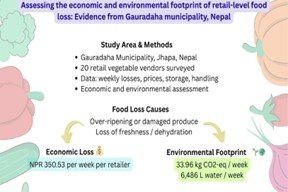
Food loss in vegetable markets creates economic losses and environmental pressure, especially in countries like Nepal where market infrastructure is still limited. This study examines the economic and environmental impacts of food loss in the retail vegetable market of Gauradaha Municipality, Jhapa district, Nepal. Primary data were collected from surveys of 20 vegetable vendors, supported by secondary data. The extent and causes of postharvest losses were analyzed, and economic losses were calculated using prevailing market prices. Environmental impacts were estimated using carbon and water footprint approaches based on life cycle assessment (LCA) methods. The results show that retailers experience an average economic loss of NPR 350.53 per week, representing approximately 5% of their income. Each retailer also faced an average environmental burden of 33.96 kg CO2-equivalent and a water footprint of 6,486.35 liters per week due to unsold and spoiled produce. The main causes of loss include over-ripening, loss of freshness, inadequate storage facilities, and insufficient packaging. The results suggest that practical measures such as improved storage, careful handling, and better packaging could help to reduce these losses. Reducing these inefficiencies could improve
vendor income and lower environmental impacts, showing the importance of linking economic and sustainability aspects in local market systems.
Downloads
References
Adams, K. P., Lee, J. A., Piltch, E., & Jimenez, E. Y. (2019). An introduction to economic analysis of food security and nutrition interventions. Journal of the Academy of Nutrition and Dietetics, 119(5), 856–864. https://doi.org/10.1016/j.jand.2018.11.015
Eriksson, M., Strid, I., & Hansson, P. A. (2012). Food losses in six Swedish retail stores: Wastage of fruit and vegetables in relation to quantities delivered. Resources, Conservation and Recycling, 68, 14–20. https://doi.org/10.1016/j.resconrec.2012.08.001
Food and Agriculture Organization (2011). Global food losses and food waste: Extent, causes and prevention. https://www.fao.org/3/mb060e/mb060e00.htm
Gautam, D., & Bhattarai, S. (2006). Post-harvest losses of fruits and vegetables in Nepal: A critical review. Journal of Horticulture, 15(2), 78–85.
Gustavsson, J., Cederberg, C., Sonesson, U., Van Otterdijk, R., & Meybeck, A. (2011). Global food losses and food waste. Food and Agriculture Organization of the United Nations. https://www.fao.org/docrep/014/mb060e/mb060e00.pdf
Ministry of Food Processing Industries, India. (2007). Present status and future prospects of Indian food processing industries. http://mofpi.nic.in/ContentPage.aspx?CategoryId=122
Subrahmanyam, K. V. (1986). Post-harvest losses in horticultural crops: An appraisal. (No. 41; pp. 339–343). Agricultural Station India.
United Nations. (2019). Sustainable consumption and production. https://www.un.org/sustainabledevelopment/sustainable-consumption-production/
Downloads
Published
How to Cite
Issue
Section
License
Copyright (c) 2026 Agriculture and Environmental Science Academy

This work is licensed under a Creative Commons Attribution-NonCommercial 4.0 International License.