Assessment of different freshwater mussel species suitability for image pearl production
DOI:
https://doi.org/10.26832/24566632.2026.1103010Keywords:
Freshwater mussels, Image pearl, Luster, Nacre layer, Paraffin-based imagesAbstract
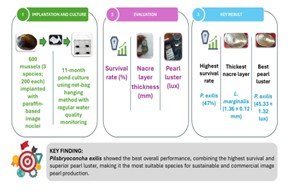
This study was designed to discover the most suitable freshwater mussel species for image pearl production under controlled culture condition. A total of 600 mussels were used for transplantation and for each species 200 mussels were allocated. Three species of freshwater mussel as Lamellidens marginalis, Lamellidens corrianus, and Pilsbryoconcha exilis were collected, acclimatized and then implanted with paraffin-based image nuclei. The operated mussels were cultured in freshwater pond for 11 months maintaining regular water quality monitoring with net-bag hanging method. Fertilizers were applied for plankton production. At the end of the culture period, survival rate of mussels, nacre layer thickness, and luster of pearl were assessed to evaluate the mussels and pearls. The highest survival rate (47%) and superior luster quality were recorded in Pilsbryoconcha exilis, followed by L. corrianus (42%) and L. marginalis (40.5%). Nacre layer thickness was 1.36±0.12 mm for L. marginalis, 0.84±0.09 mm for L. corrianus, and 1.04±0.09 mm for P. exilis among the species. Luster of pearl was 34.89±0.70 lux for L. marginalis, 37.86±0.67 lux for L. corrianus, and 45.33±1.32 lux for P. exilis. While L. marginalis deposits the thickest nacre, its inferior luster and lower survival make it less commercially viable; conversely, P. exilis achieves the highest survival and brightest luster which is key traits for marketable image pearls demonstrating that pearl quality is not governed by nacre thickness alone, but by a species-specific trade-off that positions P. exilis as the most efficient candidate for sustainable, income-generating freshwater image pearl farming.Downloads
References
Abbott, R.T. (1972). Kingdom of the seashell. Hamlyn Publishing Group Ltd, London, pp 256.
Agudo-Padrón, A. I. (2016). Brief report: Experimental production of freshwater cultured pearls in Santa Catarina State/SC, Central Southern Brazil Region. Ellipsaria, 18, 32–35.
Agudo-Padrón, A.I. (2015). Mollusc aquaculture and malacological research in Santa Catarina State (Central Southern Brazil Region): A brief synthetic critical review. Brazilian Journal of Biological Sciences, 2, 377–380. https://bjbs.com.br/index.php/bjbs/article/view/206/143
Akamatsu, S. L., Zansheng, T., Moses, T. M., & Scarratt, K. (2001). The current status of Chinese freshwater cultured pearls. Gems and Gemology, 96-113. https://doi.org/10.5741/GEMS.37.2.96
Alagarswami, K. (1987). Perspectives in pearl culture. Contributions in Marine Sciences, felicitation, 37-49.
Bai, Z., Wang, G., Liu, X., & Li, J. (2014). The status and development trend of freshwater pearl seed industry in China. Journal of Shanghai Ocean University, 23(6), 874–881. https://doi.org/10.1002/9781119120759.ch3_1
Bosshart, G., Ho, H., Jobbins, E., & Scarratt, K. (1993). undefined. The Journal of Gemmology, 23(6), 326-332. https://doi.org/10.15506/jog.1993.23.6.326
Chen, X., Liu X., Bai Z., Zhao L., & Li, J. (2017). HcTyr and HcTyp-1 of Hyriopsis cumingii, novel tyrosinase and tyrosinase-related protein genes involved in nacre color formationhttps. Comparative Biochemistry and Physiology Part B: Biochemistry and Molecular Biology, https://doi.org/10.1016/j.cbpb.2016.11.005
Dan, H., Mazid, M. A., & Hussain, M. G. (2001). Freshwater pearl culture: Principles and techniques. Bangladesh Fisheries Research Institute.
Fernandez, M. K. (2013). Transplants of western pearl shell mussels to unoccupied streams on Willapa National Wildlife Refuge, southwestern Washington. Journal of Fish and Wildlife Management, 4(2), 316–325. https://doi.org/10.3996/062012-JFWM-052
Fiske D., & Shepherd J. (2007). Continuity and change in Chinese freshwater pearl culture. Gems & Gemology, 43, 138–145.
George, C. D. (1966). The cultured pearl, its history and development to the present day. Australian Gemmologist, 8, 10–26.
Gogoi S., & Mandal, S.C. (2011). Present status and future prospects of freshwater pearl production in India. World Aquaculture, 25, 21–22.
Janakiram (1997). Freshwater pearl culture in India. Naga, The WorldFish Center Quarterly, 20(3/4), 12–17. https://worldfishcenter.org/publication/freshwater-pearl-culture-india
Lasso, C.A., Martınez-Escarbassiere, R., Capelo, J.C., Morales-Betancourt, M.A., & Sanchez-Maya, A. (2009). Lista de los moluscos (Gastropoda-Bivalvia) dulceacuıcolas y estuarinos de la cuenca del Orinoco (Venezuela). Biota Colombiana 10, 63–74. https://revistas.humboldt.org.co/index.php/biota/article/view/217/216
Lasso, C.A., Morales-Betancourt, M.A., Vera-Ardila, M., & Linares, E.L. (2018). Moluscos dulceacuıcolas de Colombia. Serie Editorial Recursos Hidrobiologicos y Pesqueros Continentales de Colombia, 326 pp. Bogota, Colombia: Instituto de Investigacion de Recursos Biologicos Alexander von Humboldt. https://doi.org/10.21068/a2018n03
Li, J., & Li, Y. (2009). Aquaculture in China—Freshwater pearl culture. Journal of the World Aquaculture Society, 40(1), 60–62. https://doi.org/10.1002/9781119120759.ch3_1
Natarajan, N., & Susithira, R. (2015). Physico-chemical Characteristics of Water Quality for Culturing the Freshwater Mussel Lamellidens marginalis in Pond and Laboratory. IOSR Journal of Pharmacy and Biological Sciences. 10(6),11-14. https://doi.org/10.9790/3008-10621114
Rathor, V. S. (2017). Induced designer pearl production in freshwater mussel Lamellidens corrianus. Journal of Science and Technological Researches, 1(4), 16–19. http://jstr.org.in/downloads/pub/v1/i4/4.pdf
10.19136/book.73
Southgate P., Strack E., Hart A., Wada K.T., Montefore M., & Cari~no M. (2011). Exploitation and culture of major commercial species. In: Southgate P.C., Lucas J.S. (eds) The Pearl Oyster: Biology and Culture, pp. 303–356. Elsevier Science, Amsterdam, The Netherlands. https://doi.org/10.1016/B978-0-444-52976-3.00009-7
Southgate, P. C., Strack, E., Hart, A., Wada, K. T., Monteforte, M., Cariño, M., Langy, S., Lo, C., Acosta-Salmón, H., & Wang, A. (2008). Exploitation and culture of major commercial species. In The pearl oyster (pp. 303–356). Elsevier. https://doi.org/10.1016/B978-0-444-52976-3.00009-7
Suryawanshi, A. V., & Kulkarni, A. N. (2015). Nacre secretion with respect to temperature in freshwater bivalve Parreysia corrugata from Nanded region, Maharashtra. International Journal of Pure and Applied Bioscience, 3(4), 33–36. https://www.ijpab.com/form/2015%20Volume%203,%20issue%204/IJPAB-2015-3-4-33-36.pdf
Sweaney, J. L., & Latendresse, J.R. (1984). Freshwater pearls of North America. Gems & Gemology 20: 125–140. https://www.gia.edu/gems-gemology/fall-1984-pearls-sweaney
Tanu, M. B., Barman, A. C., Siddique, M. F., Sku, S., Hossen, M. N., Lupa, S. T., & Mahmud, Y. (2021a). Determination of suitable size of shell image for better quality image pearl through inoculation in native mussel (Lamellidens marginalis). IOSR Journal of Pharmacy and Biological Sciences, 16(6), 44–47. https://doi.org/10.9790/3008-1606024447
Tanu, M. B., Barman, A. C., Siddique, M. F., Sku, S., Hossen, M. N., Rayhan, A., & Mahmud, Y. (2021b). Determining suitable size of paraffin image for image pearl production in freshwater mussel (Lamellidens marginalis) in Bangladesh. International Journal of Fisheries and Aquatic Studies, 9(6), 222–226. https://doi.org/10.22271/fish.2021.v9.i6c.2605
Zhu, C., Southgate, P.C., & Li, T., (2018). Production of pearls. In: Smaal, A.C., Ferreira, J.G., Grant, J., Petersen, J.K., Strand, Ø. (eds) Goods and Services of Marine Bivalves, pp. 73–94. Springer Open, Switzerland. https://link.springer.com/chapter/10.1007/978-3-319-96776-9_5
Downloads
Published
How to Cite
Issue
Section
License
Copyright (c) 2026 Agriculture and Environmental Science Academy

This work is licensed under a Creative Commons Attribution-NonCommercial 4.0 International License.