Effects of fish meal replacement on production and economics of tilapia monoculture systems in ponds
DOI:
https://doi.org/10.26832/24566632.2026.1103014Keywords:
Feed efficiency, Fish meal replacement, Greenhouse gas emissions, Monosex tilapia, Sustainable aquacultureAbstract
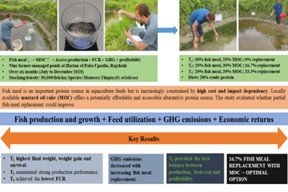
The effects of partially replacing fish meal with locally available mustard oil cake (MOC) were evaluated on production, feed utilization, greenhouse gas (GHG) emissions, and economic returns of monosex tilapia (Oreochromis niloticus) cultured in nine farmer-managed ponds at Harian of Paba Upazila, Rajshahi, Bangladesh. The study addressed rising fish meal cost, import dependency and the need for affordable, locally sourced, climate-smart feed alternatives. Three isonitrogenous diets (28% crude protein) were tested in a randomized complete block design with three replicates: T1 (30% fish meal, 25% MOC; 0% replacement), T2 (25% fish meal, 30% MOC; 16.7% replacement), and T3 (20% fish meal, 35% MOC; 33.3% replacement). Fish were stocked at 50,000 ha-1 across treatments. Fish meal replacement significantly (p<0.05) affected water quality, growth, feed utilization, yield, GHG emissions, and profitability. Methane emissions declined from 0.000027 ± 0.0000003 Gg year⁻¹ in T1 to 0.000024 ± 0.0000005 Gg year⁻¹ in T3, while N₂O-N emissions decreased from 0.0163 ± 0.00015 to 0.0136 ± 0.00012 Gg year⁻¹. The highest final weight (246.18 ± 3.93 g), weight gain (224.90 ± 3.69 g), and survival (89.05 ± 2.89%) attained in T1, followed by T2, whereas T3 exhibited lowest FCR (1.68 ± 0.05). Although T1 produced highest gross return (1,315,452 ± 53,736), T2 generated greatest net profit (BDT 579,678.33/$ 4734.90 ± 100,210 ha⁻¹) and cost–benefit ratio (0.89 ± 0.15). Thus, 16.7% fish meal replacement with MOC elevates production, profitability, and lower GHG emissions for sustainable tilapia farming in Bangladesh.Downloads
References
Abd El-Hack, M. E., El-Saadony, M. T., Nader, M. M., Salem, H. M., El-Tahan, A. M., Soliman, S. M., & Khafaga, A. F. (2022). Effect of environmental factors on growth performance of Nile tilapia (Oreochromis niloticus). International Journal of Biometeorology, 66(11), 2183–2194.https://doi.org/10.1007/s00484-022-02347-6
Abdel-Latif, H. M. R., Abdel-Tawwab, M., Dawood, M. A. O., Menanteau-Ledouble, S., & El-Matbouli, M. (2022). Recent advances in the application of plant protein sources in aquafeeds for tilapia: Impacts on growth performance, feed utilization, health, and sustainability. Aquaculture International, 30, 1889–1915. https://doi.org/10.1007/s10499-022-00862-1
Afram, F., Agbo, N. W., Adjei-Boateng, D., & Egna, H. (2021). Effects of feeding strategies on growth performance and economic returns on the production of Nile tilapia (Oreochromis niloticus) in fertilized ponds. Aquaculture Studies, 21(2), 63–73. https://doi.org/10.4194/2618-6381-v21_2_03
Ayyat, M. S., Ayyat, A. M. N., Abdel-Rahman, M. S., & Al-Sagheer, A. A. (2023). Appraisal of leaf protein concentrate derived from sugar beet and carrot as a novel fish meal substitute for juvenile Nile tilapia (Oreochromis niloticus). Animal Feed Science and Technology, 304, 115833. https://doi.org/10.1016/j.anifeedsci.2023.115833
Badran, A. A., Magouz, F. I., Zaineldin, A. I., Abdo, S. E., Amer, A. A., Gewaily, M. S., & Dawood, M. A. O. (2024). Using a blend of oilseed meals in the diets of Nile tilapia (Oreochromis niloticus): Effects on the growth performance, feed utilization, intestinal health, growth, and metabolic-related genes. BMC Veterinary Research, 20, 529. https://doi.org/10.1186/s12917-024-04373-5
Boonmee, T., Deevong, P., Rinthong, P. O., & Yuangsoi, B. (2024). Improvement of nutritive value of soybean meal by microbial hydrolysis with Bacillus subtilis Hs-2 for use as a raw material in Nile tilapia (Oreochromis niloticus) diets. Aquaculture Reports, 35, Article 101943. https://doi.org/10.1016/j.aqrep.2024.101943
Dey, B. K., Verdegem, M. C. J., Nederlof, M. A. J., Beddow, J. M., Masagounder, K., Mas-Muñoz, J., & Schrama, J. W. (2024). Effect of temperature on the digestibility of non-starch polysaccharide-rich ingredients in Nile tilapia (Oreochromis niloticus). Aquaculture Reports, 39, Article 102426. https://doi.org/10.1016/j.aqrep.2024.102426
DoF, Department of Fisheries. (2024). Yearbook of fisheries statistics of Bangladesh 2023–24. Ministry of Fisheries and Livestock, Government of the People’s Republic of Bangladesh.
El-Dakar, A. Y., Elgamal, A. A., Amer, M. A. B., Mohammed, A. S., & Abdel-Aziz, M. F. (2023). Evaluation of fermented soybean meal by Bacillus subtilis as an alternative to fishmeal on the growth and physiological status of Nile tilapia (Oreochromis niloticus) fingerlings. Heliyon, 9(9), Article e19602. https://doi.org/10.1016/j.heliyon.2023.e19602
El-Sayed, A.F. M. (2020). Tilapia culture (2nd ed.). Academic Press. https://doi.org/10.1016/C2017-0-00284-0
FAO, Food and Agriculture Organization of the United Nations. (2024). The state of world fisheries and aquaculture 2024: Blue transformation in action. FAO. https://doi.org/10.4060/cd0683en
Ferdoushi, Z., Rasid, M. H., Patwary, Z. P., Sarkar, T. H., & Akter, M. I. (2021). Monitoring and assessing the physico-chemical water properties and planktonic communities in tilapia nursing pond. International Journal of Fisheries and Aquatic Studies, 9(1), 23–27. https://doi.org/10.22271/fish.2021.v9.i1a.2383
Hu, Z., Lee, J. W., Chandran, K., Kim, S., & Khanal, S. K. (2012). Nitrous oxide emissions from aquaculture: A review. Environmental Science & Technology, 46(12), 6470–6480. https://doi.org/10.1021/es300110x
Hua, K. (2021). A meta-analysis of the effects of replacing fishmeal with plant protein on the growth performance and feed utilization of aquaculture species. Reviews in Aquaculture, 13(3), 1719–1739. https://doi.org/10.1111/raq.12546
Islam, M. M., Kundu, G. K., & Khan, M. I. (2020). Aquaculture: A faster growing greenhouse gas emission sector in Bangladesh. Journal of Ecology and Development, 35(3), 1–15.
Khalil, H. S., Momoh, T., Al-Kenawy, D., Yossa, R., Badreldin, A. M., Roem, A., Schrama, J. W., & Verdegem, M. C. J. (2022). Nitrogen retention, nutrient digestibility and growth efficiency of Nile tilapia (Oreochromis niloticus) fed dietary lysine and reared in fertilized ponds. Aquaculture Nutrition, 2022, Article 3949449. https://doi.org/10.1111/anu.13365
Lesschen, J. P., van den Berg, M., Westhoek, H. J., Witzke, H. P., & Oenema, O. (2011). Greenhouse gas emission profiles of European livestock sectors. Animal Feed Science and Technology, 166–167, 16–28. https://doi.org/10.1016/j.anifeedsci.2011.04.058
Limbu, S. M., Shoko, A. P., Ulotu, E. E., Luvanga, S. A., Munyi, F. M., John, J. O., & Opiyo, M. A. (2022). Black soldier fly (Hermetia illucens, L.) larvae meal improves growth performance, feed efficiency and economic returns of Nile tilapia (Oreochromis niloticus, L.) fry. Aquaculture, Fish and Fisheries, 2(3), 167–178. https://doi.org/10.1002/aff2.48
Luba, K. R., Rashid, H., Islam, M. S., Akter, M., Khatun, R., Zaman, M., & Jahangir, M. M. R. (2026). Assessing the impacts of feed and species composition on greenhouse gas emission from freshwater aquaculture systems in Bangladesh. Environmental Science: Advances, 5(4), 1130–1140. https://doi.org/10.1039/D5VA00215J
MacLeod, M. J., Hasan, M. R., Robb, D. H. F., & Mamun-Ur-Rashid, M. (2020). Quantifying greenhouse gas emissions from global aquaculture. Scientific Reports, 10, 11679. https://doi.org/10.1038/s41598-020-68231-8
Magbanua, T. O., & Ragaza, J. A. (2024). Selected dietary plant-based proteins for growth and health response of Nile tilapia Oreochromis niloticus. Aquaculture and Fisheries, 9(1), 3–19. https://doi.org/10.1016/j.aaf.2022.04.001
Maundu, A., Munguti, J., Sharma, R., Kasozi, N., Liti, D., Muthoka, M., Kirimi, J., & Mutiso, J. (2024). Apparent protein digestibility and growth performance of Nile tilapia (Oreochromis niloticus L.) fed on sunflower and cotton seed meal as substitutes for freshwater shrimp meal (Caridina nilotica). Aquaculture Research, Article 2713506. https://doi.org/10.1155/2024/2713506
Mmanda, F. P., Lundh, T., Haldén, A. N., Mtolera, M. S. P., Kitula, R., & Lindberg, J. E. (2020). Replacing fish meal with locally available feed ingredients to reduce feed costs in cultured Nile tilapia (Oreochromis niloticus). Livestock Research for Rural Development, 32(11), Article 178. https://www.lrrd.org/lrrd32/11/torbj32178.html
Munguti, J. M., Tanga, C. M., Kiiru, P., Gicheha, M. G., &Osuga, I. M., et al. (2024). Partial replacement of fishmeal with black soldier fly larvae meal in Nile tilapia diets improves performance and profitability in earthen pond. Scientific African, 24, e02222. https://doi.org/10.1016/j.sciaf.2024.e02222
Myhre, G., Shindell, D., Bréon, F.-M., Collins, W., Fuglestvedt, J., Huang, J., Koch, D., Lamarque, J.F., Lee, D., Mendoza, B., Nakajima, T., Robock, A., Stephens, G., Takemura, T., & Zhang, H. (2013). Anthropogenic and natural radiative forcing. In T. F. Stocker et al. (Eds.), Climate change 2013: The physical science basis: Contribution of Working Group I to the Fifth Assessment Report of the Intergovernmental Panel on Climate Change (pp. 659–740). Cambridge University Press. https://doi.org/10.1017/CBO9781107415324.018
Nasrin, S., Rahman, M. H., Awal, M. R., Das, M., Hossain, M. S., & Sarker, F. (2021). Effect of feeding frequency on the growth of GIFT (Oreochromis niloticus). International Journal of Fisheries and Aquatic Studies, 9(2), 98–107. https://doi.org/10.22271/fish.2021.v9.i2b.2446
Ogola, M., Owiti, D. O., & Ominde, J. (2020). Growth performance of Nile tilapia (Oreochromis niloticus) fingerlings fed on soybean (Glycine max) compared to dagaa (Rastrineobola argentea) meal with diet supplement of maize bran. Journal of Fisheries Research, 4(1), 14–20. https://doi.org/10.35841/fisheries-research.4.1.14-20
Ouko, K. O., Mboya, J. B., Mukhebi, A. W., Obiero, K. O., Ogello, E. O., Munguti, J. M., & Tanga, C. M. (2024). Effect of replacing fish meal with black soldier fly larvae meal on growth performance and economic efficiency of Nile tilapia. Fundamental and Applied Agriculture, 9(1), 1–9. https://doi.org/10.5455/faa.154509
Pervin, M. A. A., Ema, N. S., Akter, R., Jahan, H., & Hossain, Z. (2020). Growth performance of Nile tilapia (Oreochromis niloticus) by substituting fish meal with soybean meal in the diet. Journal of Bangladesh Agricultural University, 18(1), 152–156. https://doi.org/10.5455/JBAU.94736
Phinyo, M., Pumma, S., Thinjan, P., Wangkahart, E., & Soonthornchai, W. (2024). Effects of dietary fermented soybean meal with Thua nao starter on the growth performance, body composition, and disease resistance against Aeromonas hydrophila of Nile tilapia (Oreochromis niloticus). Aquaculture Reports, 34, Article 101890. https://doi.org/10.1016/j.aqrep.2023.101890
Rahman, M. H., Alam, M. A., Flura, Moniruzzaman, M., Sultana, S., Talukdar, A., & Islam, M. R. (2023). Effects of substituting plant-based protein sources for fish meal in the diet of Nile tilapia (Oreochromis niloticus). Archives of Agriculture and Environmental Science, 8(3), 333–338. https://doi.org/10.26832/24566632.2023.080309
Rapatsa, M. M., & Moyo, N. A. G. (2022). A review and meta-analysis of the effects of replacing fishmeal with insect meals on growth of tilapias and sharp tooth catfish. Aquaculture Nutrition, 2022, Article 9367587. https://doi.org/10.1155/2022/9367587.
Reda, R. M., Maricchiolo, G., Quero, G. M., Basili, M., Aarestrup, F. M., Pansera, L., Mirto, S., Abd El-Fattah, A. H., Alagawany, M., & Abdel Rahman, A. N. (2022). Rice protein concentrate as a fish meal substitute in Oreochromis niloticus: Effects on immune response, intestinal cytokines, Aeromonas veronii resistance, and gut microbiota composition. Fish & Shellfish Immunology, 126, 237–250. https://doi.org/10.1016/j.fsi.2022.05.048
Rosentreter, J., Borges, A., Deemer, B., Holgerson, M., Liu, S., Song, C., Melack, J., Raymond, P., Duarte, C., Allen, G., Olefeldt, D., Poulter, B., Battin, T., & Eyre, B. (2021). Half of global methane emissions come from highly variable aquatic ecosystem sources. Nature Geoscience, 14(4), 225-230. https://doi.org/10.1038/s41561-021-00715-2.
Sallam, E. A., Matter, A. F., Mohammed, L. S., Azam, A. E., Shehab, A., & Soliman, M. M. (2021). Replacing fish meal with rapeseed meal: Potential impact on the growth performance, profitability measures, serum biomarkers, antioxidant status, intestinal morphometric analysis, and water quality of Oreochromis niloticus and Sarotherodon galilaeus fingerlings. Veterinary Research Communications, 45(4), 223–241. https://doi.org/10.1007/s11259-021-09803-5
Sarker, P. K., Kapuscinski, A. R., McKuin, B., Fitzgerald, D. S., Nash, H. M., & Greenwood, C. (2020). Microalgae-blend tilapia feed eliminates fishmeal and fish oil, improves growth, and is cost viable. Scientific Reports, 10, Article 19328. https://doi.org/10.1038/s41598-020-75289-x
Siddique, M. A. B., Mahalder, B., Haque, M. M., & Ahammad, A. K. S. (2025). Impact of climatic and water quality parameters on tilapia (Oreochromis niloticus) brood fish growth: Integrating ARIMA and ARIMAX for precise modeling and forecasting. PLOS ONE, 20(3), Article e0313846. https://doi.org/10.1371/journal.pone.0313846
Soltan, N. M., Soaudy, M. R., Abdella, M. M., & Hassaan, M. S. (2023). Partial dietary fishmeal replacement with mixture of plant protein sources supplemented with exogenous enzymes modify growth performance, digestibility, intestinal morphology, haemato-biochemical and immune responses for Nile tilapia, Oreochromis niloticus. Animal Feed Science and Technology, 299, 115642. https://doi.org/10.1016/j.anifeedsci.2023.115642
Suárez-Puerto, B., Delgadillo-Díaz, M., Sánchez-Solís, M. J., & Gullian-Klanian, M. (2021). Analysis of the cost-effectiveness and growth of Nile tilapia (Oreochromis niloticus) in biofloc and green water technologies during two seasons. Aquaculture, 538, 736534. https://doi.org/10.1016/j.aquaculture.2021.736534
Wachira, M. N., Osuga, I. M., Munguti, J. M., Ambula, M. K., Subramanian, S., & Tanga, C. M. (2021). Efficiency and improved profitability of insect-based aqua feeds for farming Nile tilapia fish (Oreochromis niloticus L.). Animals, 11(9), Article 2599. https://doi.org/10.3390/ani11092599
Wang, Z., Dong, W.X., Qiao, F., Du, Z.Y., & Zhang, M.L. (2024). Comparison of Pediococcus pentosaceus YC64-fermented soybean meal and raw soybean meal in diets for Nile tilapia: Growth performance, feed utilization, and intestine health. Aquaculture Reports, 38, Article 102321. https://doi.org/10.1016/j.aqrep.2024.102321
Wuertz, S., Pahl, C. H., & Kloas, W. (2022). Influence of substrates on the quality of Hermetia meal for fish meal substitution in Nile tilapia Oreochromis niloticus. Water, 14(19), 2953. https://doi.org/10.3390/w14192953
Yossa, R., Greiling, A. M., Basiita, R. K., Sakala, M. E., Baumgartner, W. A., Taylor, A., & Gatlin, D. M. III. (2021). Replacing fishmeal with a single cell protein feedstuff in Nile tilapia Oreochromis niloticus diets. Animal Feed Science and Technology, 281, 115089. https://doi.org/10.1016/j.anifeedsci.2021.115089
Zhang, L., Wang, X., Huang, L., Wang, C., Gao, Y., Peng, S., & Piao, S. (2024). Inventory of methane and nitrous oxide emissions from freshwater aquaculture in China. Communications Earth & Environment, 5(1), Article 531. https://doi.org/10.1038/s43247-024-01744-8
Downloads
Published
How to Cite
Issue
Section
License
Copyright (c) 2026 Agriculture and Environmental Science Academy

This work is licensed under a Creative Commons Attribution-NonCommercial 4.0 International License.