Whitefly distribution and cassava mosaic disease occurrence in cassava fields of The Gambia
DOI:
https://doi.org/10.26832/24566632.2026.1103016Keywords:
Bemisia tabaci, Cassava mosaic disease, Vector transmission, Whitefly abundanceAbstract
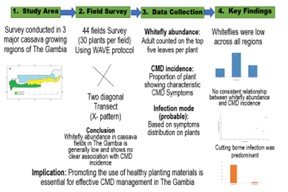
The whitefly Bemisia tabaci is a major insect vector associated with the transmission of cassava mosaic begomoviruses causing cassava mosaic disease (CMD) in Africa. However, information on whitefly populations associated with cassava fields in The Gambia remains limited. This study aimed to investigate the whitefly abundance and its association with CMD incidence in major cassava growing regions of The Gambia. Field surveys were conducted in 44 cassava fields across the West Coast Region (WCR), Lower River Region (LRR), and North Bank Region (NBR) following the harmonized West and Central African Virus Epidemiology protocol. Whiteflies were counted on the top five leaves of sampled cassava plants, while CMD incidence was determined based on the proportion of plants showing characteristic symptoms. Whitefly populations were generally low across surveyed regions, with an overall mean abundance of 21.1 whiteflies per plant. The highest mean whitefly abundance was recorded in LRR (36,6), followed by the NBR (19) and WCR (14). Despite widespread CMD occurrence, no consistent association was observed between regional whitefly abundance and CMD incidence. Assessment of probable infection pathways based on symptom distribution showed 94.5% of CMD affected plants exhibited symptom patterns consistent with cutting borne infection, while 5.5% showed patterns consistent with whitefly-transmitted infection. The findings suggest that infected cassava planting materials may currently contribute more substantially to CMD dissemination than whitefly-mediated spread in the surveyed areas. This study provides baseline information on whitefly abundance and CMD occurrence in cassava fields of The Gambia and supports future vector surveillance and disease management strategies.Downloads
References
Asiimwe, P., Ecaat, J., Otim, M., Gerling, D., Kyamanywa, S., & Legg, J. (2007). Life‐table analysis of mortality factors affecting populations of Bemisia tabaci on cassava in Uganda. Entomologia Experimentalis et Applicata, 122(1), 37-44. https://doi.org/10.1111/j.1570-7458.2006.00487.x.
Barrow, L., Mbenga, I., & Aubee, E. (2026). Farmers’ knowledge, awareness, and planting material practices related to cassava mosaic disease in The Gambia. International Journal of Life Science and Agriculture Research, 5(8), 601–606. https://doi.org/10.55677/ijlsar/V05I08Y2026-03
Chikoti, P. C., Mulenga, R. M., Tembo, M., & Sseruwagi, P. (2019). Cassava mosaic disease: A review of a threat to cassava production in Zambia. Journal of Plant Pathology, 101(3), 467–477. https://doi.org/10.1007/s42161-019-00255-0
Chikoti, P.C., Ndunguru, J., Melis, R., Tairo, F., Shanahan, P. and Sseruwagi, P. (2013) Cassava Mosaic Disease and Associated Viruses in Zambia: Occurrence and Distribution. International Journal of Pest Management, 59, 63-72. https://doi.org/10.1080/09670874.2012.752887
FAO, Food and Agriculture Organization of the United Nations. (2013). Save and grow cassava: A guide to sustainable production intensification. FAO. https://www.fao.org/4/i3278e/i3278e00.pdf
Gold, C. (1994). The effects of cropping systems on cassava whiteflies in Colombia: implications for control of African cassava mosaic virus disease. African Crop Science Journal, 2(4), 423-436. https://hdl.handle.net/10568/97394
Jarvis, A., Ramirez-Villegas, J., Campo, B. V. H., & Navarro-Racines, C. (2012). Is cassava the answer to African climate change adaptation? Tropical Plant Biology, 5(1), 9–29. https://doi.org/10.1007/s12042-012-9096-7
Kouakou, B. S. M., Yoboué, A. A. N., Pita, J. S., Mutuku, J. M., Otron, D. H., Kouassi, N. K., Kouassi, K. M., Vanié-Léabo, L. P. L., Ndougonna, C., Zouzou, M., et al. (2024). Gradual emergence of East African cassava mosaic Cameroon virus in cassava farms in Côte d’Ivoire. Agronomy, 14(3), 418. https://doi.org/10.3390/agronomy14030418
Legg, J. P., & Fauquet, C. M. (2004). Cassava mosaic geminiviruses in Africa. Plant Molecular Biology, 56(4), 585–599. https://doi.org/10.1007/s11103-004-1651-7
Legg, J., Gerling, D., & Neuenschwander, P. (2003). Biological control of whiteflies in sub-Saharan Africa. In Biological control in IPM systems in Africa (pp. 87–100). CAB International. https://hdl.handle.net/10568/98004
Mivedor, A. S., Dansou-Kodjo, K. A., Adjata, D. K., & Pita, J. S. (2020). Identification and incidence of cassava mosaic begomoviruses in Togo. Asian Journal of Plant Pathology, 14, 11–20. https://doi.org/10.3923/ajppaj.2020.11.20
Njoroge, M. K., Mutisya, D. L., Miano, D. W., & Kilalo, D. C. (2017). Whitefly species efficiency in transmitting cassava mosaic and cassava brown streak virus diseases. Cogent Biology, 3, 1311499. https://doi.org/10.1080/23312025.2017.1311499
Soro, M. S., Tiendrébéogo, F., Pita, J. S., Traoré, E. T., Somé, K., Tibiri, E. B., Néya, J. B., Mutuku, J. M., Simporé, J., & Koné, D. (2021). Epidemiological assessment of cassava mosaic disease in Burkina Faso. Plant Pathology, 70(9), 2207–2216. https://doi.org/10.1111/ppa.13459
Sseruwagi, P., Sserubombwe, W. S., Legg, J., Ndunguru, J., & Thresh, J. M. (2004). Methods of surveying the incidence and severity of cassava mosaic disease and whitefly vector populations on cassava in Africa: A review. Virus Research, 100(1), 129–142. https://doi.org/10.1016/j.virusres.2003.12.021
Thresh, J. M., & Cooter, R. J. (2005). Strategies for controlling cassava mosaic virus disease in Africa. Plant Pathology, 54(5), 587–614. https://doi.org/10.1111/j.1365-3059.2005.01282.x
World Bank Group. (2021). Climate knowledge portal: The Gambia climate data historical records. World Bank. https://climateknowledgeportal.worldbank.org
Downloads
Published
How to Cite
Issue
Section
License
Copyright (c) 2026 Agriculture and Environmental Science Academy

This work is licensed under a Creative Commons Attribution-NonCommercial 4.0 International License.