Effect of different concentrations of gibberellic acid and naphthalene acetic acid on growth, yield and post harvest quality of tomato
DOI:
https://doi.org/10.26832/24566632.2026.1103015Keywords:
Gibberellic acid, Growth and yield attributes, Postharvest quality, Recommended doseAbstract
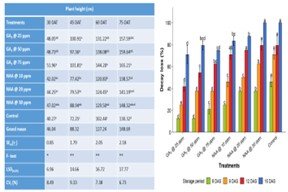
A field experiment was carried out in Rukum West, Nepal, from March to June 2025 in order to assess the impact of various concentrations of gibberellic acid (GA3) and naphthalene acetic acid (NAA) on the growth, yield, fruit quality, and postharvest quality of "Monoprecos" tomato. The experiment was conducted using a randomized complete block design (RCBD) with seven treatments and three replications. Plant height, flowering traits, fruit length, fruit diameter, fruit yield, total soluble solids (TSS), titratable acidity (TA), pH, physiological loss in weight (PLW), and decay loss of tomato were recorded during the experiment. GA3 @ 75 ppm treatment produced the maximum plant height (165.21 cm) of tomato, whereas GA3 @ 50 ppm recorded the highest number of flowers per plant (104.29), fruit length (4.42 cm), and fruit yield (24.07 mt ha⁻¹) of tomato. NAA @ 30 ppm treatment produced the highest number of flowers per cluster (10.34) and fruit diameter (4.94 cm) of tomato. GA3 @ 50 ppm also recorded higher TSS (4.88 °Brix) and pH, while titratable acidity was highest in the control. After 12 days of storage, GA3 @ 50 ppm showed lower PLW (11.92%), whereas GA3 @ 25 ppm recorded the lowest decay loss (70.83%). Therefore, GA3 @ 50 ppm can be recommended as an optimum concentration for growth, yield, and postharvest quality of tomato in the mid-hill region of Nepal.Downloads
References
AITC, Agriculture Information and Training Center. (2024). Krishi tatha pashupanchhi diary 2081 [Agriculture and livestock diary 2081]. Government of Nepal, Ministry of Agriculture and Livestock Development. https://aitc.gov.np/content/174/krishi-dairy2081/
Başak, H., Çakırer Seyrek, G., Horzum, Ö., & Demir , K. (2025). Impact of GA3 Application at Different Times and Methods on Tomato Growth and Fruit shelf life. Turkish Journal of Agricultural and Natural Sciences , 12(3), 613-626. https://doi.org/10.30910/turkjans.1667623
Bhattarai, B. R., Rijal, L., Bhattarai, A., & Khanal, P. (2025). Effect of foliar application of plant growth regulators on growth, flowering and yield of tomato (Lycopersicon esculentum L.) under protected condition. Journal of Jayaprithvi Multiple Campus, 1(1), 145–155. https://doi.org/10.3126/jjmc2.v1i1.81452
Chen, X., Liu, Y., Zhang, X., Zhen, B., Han, Y., & Zhang, R.-X. (2023). PpARF6 acts as an integrator of auxin and ethylene signaling to promote fruit ripening in peach. Horticulture Research, 10(9), uhad158. https://doi.org/10.1093/hr/uhad158
Chowdhury, R. S., Kumar, V., Bhattacharya, S., Mallick, P., Ghosh, A., Bhattacharjee, S., & Kothari, S. K. (2023). Effect of gibberellic acid (GA₃) on vegetative and reproductive growth and yield characters of cucumber (Cucumis sativus) under Costal Region of West Bengal, India. International Journal of Plant & Soil Science , 35(21), 90-96. https://doi.org/10.9734/ijpss/2023/v35i213949
Ferigolo, L. F., Vicente, M. H., Correa, J. P. O., Barrera-Rojas, C. H., Silva, E. M., Silva, G. F. F., Carvalho, A., Jr., Peres, L. E. P., Ambrosano, G. B., Margarido, G. R. A., Sablowski, R., & Nogueira, F. T. S. (2023). Gibberellin and miRNA156-targeted SlSBP genes synergistically regulate tomato floral meristem determinacy and ovary patterning. Development, 150(21), 201961. https://doi.org/10.1242/dev.201961
Guo, T., Gull, S., Ali, M. M., Yousef, A. F., Ercisli, S., Kalaji, H. M., Telesiński, A., Auriga, A., Wróbel, J., Radwan, N. S., & Ghareeb, R. Y. (2022). Heat stress mitigation in tomato (Solanum lycopersicum L.) through foliar application of gibberellic acid. Scientific Reports, 12, 11324. https://doi.org/10.1038/s41598-022-15590-z
Hassan, J., Sultana, H., Gomasta, J., & Kayesh, E. (2024). Substitution of chemical fertilization using PGRs evident in growth and yield of tomato. Journal of Science and Technology Research, 6(1), 53–64. https://doi.org/10.3329/jscitr.v6i1.77375
Jerca, I. O., Cîmpeanu, S. M., Teodorescu, R. I., Drăghici, E., Nițu, O. A., Sannan, S., & Arshad, A. (2024). A comprehensive assessment of the morphological development of inflorescence, yield potential, and growth attributes of summer-grown greenhouse cherry tomatoes. Agronomy 14(3), 556. https://doi.org/10.3390/agronomy14030556
Jha, R. K., Thapa, R., & Shrestha, A. K. (2022). Effect of GA3 and NAA on tomato production under protected cultivation in Kaski, Nepal. Journal of Agriculture and Food Research, 10, 100450. https://doi.org/10.1016/j.jafr.2022.100450
Kavitha, G., Kerketta, A., Topno, S. E., & Bahadur, V. (2023). Effect of plant growth regulators on cherry tomato (Solanum lycopersicum var. cerasiforme). International Journal of Environment and Climate Change, 13(8), 581-586. https://doi.org/ 10.9734/ijecc/2023/v13i81986
Khadka, B., & Sapkota, B. (2025). Effect of calcium chloride and gibberellic acid as post-harvest treatments on quality and shelf life of tomato (Solanum lycopersicum L. var. Srijana) in Chitwan, Nepal. Archives of Agriculture and Environmental Science, 10(4), 608–614. https://doi.org/10.26832/24566632.2025.100408
Khan, M. N., & Nabi, G. (2023). Role of auxin in vegetative growth, flowering, yield and fruit quality of horticultural crops: A review. Pure and Applied Biology, 12(2), 1234–1241. https://doi.org/10.19045/bspab.2023.120126
Kumar, U., Kavyashree, Yadav, R. K., Pramila, Neeraj, Dharminder, & Kishor, K. (2025). Optimizing tomato yield through bioregulator application for flower and fruit drop reduction in the North Agroclimatic Zone of Bihar. Agriculture Association of Textile Chemical and Critical Reviews Journal, 13(02), 348-352. https://doi.org/10.21276/AATCCReview.2025.13.02.347
Latimer, G. W., Jr. (Ed.). (2023). Official methods of analysis of AOAC International (22nd ed.). Oxford University Press. https://doi.org/10.1093/9780197610145.001.0001
Luo, J., Wang, X., Pang, W., & Jiang, J. (2024). GA3-Induced SlXTH19 Expression Enhances Cell Wall Remodeling and Plant Height in Tomatoes. Plants, 13(24), 3578. https://doi.org/10.3390/plants13243578
MoALD, Ministry of Agriculture and Livestock Development. (2024). Statistical information on Nepalese agriculture 2079/80. Government of Nepal. Retrieved from www.moald.gov.np
Motlhalamme, T., Kaningini, A. G., Raletsena, M. V., Thema, F. T., Mohale, K. C., & Maaza, M. (2025). Tomato lycopene, total flavonoids, vitamin C content and mineral composition as affected by biosynthesized calcium carbonate nanoparticles foliar application. Journal of Food Composition and Analysis, 139, 107173. https://doi.org/10.1016/j.jfca.2024.107173
Paikra, P. S., Ramteke, V., & Kerketta, A. (2022). Effect of plant growth regulators on seed yield and seed quality traits in tomato (Solanum lycopersicum L.) cv. Kashi Adarsh. International Journal of Plant & Soil Science, 34(24), 749-755. https://doi.org/10.9734/IJPSS/2022/v34i242696
Pandit, N. R., Choudhary, D., Maharjan, S., Dhakal, K. H., & Vista, S. P. (2022). Optimum rate and deep placement of nitrogen fertilizer improves nitrogen use efficiency and tomato yield in Nepal. Soil system, 6(3), 72. https://doi.org/10.3390/soilsystems6030072
Park, M.-H., & Malka, S. K. (2022). Gibberellin delays metabolic shift during tomato ripening by inducing auxin signaling. Frontiers in Plant Science, 13, 1045761 https://doi.org/10.3389/fpls.2022.1045761
Poonia, S., Choudhary, S., Moond, S. K., Ram, M., & Kuri, R. (2024). Effect of PGRs on growth, reproductive efficiency, and quality of tomato (Solanum lycopersicum L.) in arid regions. Current Horticulture, 12(1), 81-85. http://dx.doi.org/10.5958/2455-7560.2024.00014.2
Rebollo, K. M. B., & Rosales, R. J. G. (2023). Effect of exogenous application of gibberellin on growth, fruit yield and quality of tomato. Idesia (Arica), 41(4), 15-20. https://doi.org/10.4067/S0718-34292023000400015
Shi, B., Felipo-Benavent, A., Cerutti, G., Galvan-Ampudia, C., Jilli, L., Brunoud, G., Mutterer, J., Vallet, E., Sakvarelidze-Achard, L., Davière, J.-M., Navarro-Galiano, A., Walia, A., Lazary, S., Legrand, J., Weinstain, R., Jones, A. M., Prat, S., Achard, P., & Vernoux, T. (2024). A quantitative gibberellin signaling biosensor reveals a role for gibberellins in internode specification at the shoot apical meristem. Nature Communications, 15, 3895. https://doi.org/10.1038/s41467-024-48116-4
Shoaib, S., Iqbal, R. K., Ashraf, H., Younis, U., Rasool, M. A., Ansari, M. J., Alarfaj, A. A., & Alharbi, S. A. (2025). Mitigating effect of γ-aminobutyric acid and gibberellic acid on tomato plant cultivated in Pb-polluted soil. Scientific Reports, 15, 12469. https://doi.org/10.1038/s41598-025-96450-4
Wang, T., Zhang, J., Zhang, S., Gong, Y., Wang, N., Zhang, Z., & Chen, X. (2024). Auxin responsive factor MdARF17 promotes ethylene synthesis in apple fruits by activating MdERF003 expression. Plant Cell Reports, 43, 213. https://doi.org/10.1007/s00299-024-03293-w
Yang, H., Li, J., Li, X., Wu, R., Zhang, X., Fan, X., Li, G., Gong, H., Yin, X., & Zhang, A. (2023). The mechanism of gibberellins treatment suppressing kiwifruit postharvest ripening processes by transcriptome analysis. Postharvest Biology and Technology, 198, 112223. https://doi.org/10.1016/j.postharvbio.2022.112223
Downloads
Published
How to Cite
Issue
Section
License
Copyright (c) 2026 Agriculture and Environmental Science Academy

This work is licensed under a Creative Commons Attribution-NonCommercial 4.0 International License.