Evaluation of two white maize varieties under varying planting spacing in Teesta River Basin, Rangpur, Bangladesh
DOI:
https://doi.org/10.26832/24566632.2026.1103017Keywords:
Biological yield, Grain yield, Harvest index, Planting space, White maize varietyAbstract
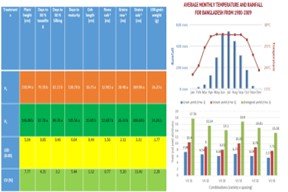
This study investigated the effects of plantation spacing on maize growth, yield and yield attributes of two white maize varieties viz., V1(PSC-121) and V2 (KS- 510) and three planting spacing viz., 50 cm × 25 cm, 60 cm × 25 cm and 70 cm × 25 cm. The taller plant (230 cm), longer cob (16.75 cm), maximum number of rows cob-1(12.90), number of grains row-1 (28.47), number of total grains cob-1(369.96), 100-grains weight (26.20 g), grain yield (6.66 t ha-1), stover weight (9.15 t ha-1), biological yield (15.81 t ha-1) and harvest index (42.20 %) were recorded in variety PSC-121 compared to variety KS-510. The longest cob (16.68 cm), highest number of grains cob-1(379.20) and highest 100-grain weight (27.05 g) ware observed in the planting spacing of 70 cm × 25 cm but showed the lowest grain yield (5.81 t ha-1), stover yield (7.88 t ha-1) and biological yield (13.69 t ha-1). In contrasts, planting spacing 50 cm × 25 cm resulted the highest grain yield (7.07 t ha-1), stover yield (10.21 t ha-1) and biological yield (17.28 t ha-1). In regard to interaction effect of variety and spacing, highest grain yield (7.37 t ha-1), maximum stover yield (10.40 t ha-1) and biological yield (17.77 t ha-1) were found at the planting spacing 50 cm × 25 cm with variety PSC-121. The lowest values of these parameters were recorded in the widest planting spacing (70 cm × 25 cm) with variety KS-510. Therefore, the optimal planting spacing 50 cm × 25 cm and variety PSC-121 produced highest grain yield 7.37 t ha-1 in sandy soil.Downloads
References
Ahamed, S. (2020). Growth and yield attributes of a white maize genotype sauwmopmdt273 under different planting configurations. MS Thesis, Sher-e-Bangla Agricultural University, Dhaka. https://saulibrary.edu.bd/daatj/public/uploads/Done%2013-05297.pdf
Aldrich, S.R., Scott, W.O. & Leng, E.R., (1978). Modern corn production. 2nd edition. A & L Publications, Illinois.
BARI (Bangladesh Agricultural Research Institute) (2014). Krishi Projukti Hatboi (Handbook on Agro Technology), Gazipur-1707, Bangladesh, 6th edition, pp-54.
BBS (Bangladesh Bureau of Statistics) (2015). Yearbook of Agricultural Statistics. Ministry of Planning. Govt. of the People’s Republic of Bangladesh, April, 2016.
BBS (Bangladesh Bureau of Statistics) (2017). Yearbook of Agricultural Statistics. Statistics and Information Division (SID), Ministry of Planning. Govt. of the People’s Republic of Bangladesh, April, 2018.
Biswas, M. M. I., Ullah, M. J., Begum, H., & Laila, L. (2024). Yield performance of some white maize varieties in response to planting spacings at Sher-e-Bangla Agricultural University Farm in Bangladesh. Asian Plant Research Journal, 12(3), 12-26. https://doi.org/10.9734/APRJ/2024/v12i3249
Chayanont, N., Jenweerawat, S., Chaugool, J., Tudsri, S., Chaisan, T., & Chotchutima, S. (2021). Plant spacing and variety of field corn (Zea mays L.) affecting yield, yield components and silage quality. Walailak Journal of Science & Technology, 18(6), 1. https://doi.org/10.48048/wjst.2021.9038
Chen, X., Cui, Z., Fan, M., Vitousek, P., Zhao, M., Ma, W., Wang, Z., Zhang, W., Yan, X., Yang, J., Deng, X., Gao, Q., Zhang, Q., Guo, S., Ren, J., Li, S., Ye, Y., Wang, Z., Huang, J., Tang, Q., Sun, Y., Peng, X., Zhang, J., He, M., Zhu, Y., Xue, J., Wang, G., WU, L., An, N., Wu, L., MA, L., Zhang, W., & Zhang, F. (2014). Producing more grain without environmental costs. Nature, 514, 486–489 (2014). https://doi.org/10.1038/nature13609
Cox, W. J. (1997). Corn silage and grain yield response to plant densities. Journal Production Agriculture, 10, 405-410. https://doi.org/10.2134/jpa1997.0405
Dass, S., Kumar, A., Jat, S. L., Parihar, C. M., Singh, A. K., Chikkappa, G. K., & Jat, M. L. (2012). Maize holds potential for diversification and livelihood security. Indian Journal Agronomy (Special Issue) 57: 86-91. https://www.researchgate.net/publication/257602610_Maize_holds_potential_for_diversification_and_livelihood_security
Eskandarnejada, S., Khorasani, S., Bakhtiaric, S., & Heidarian A. R. (2013). Effect of row spacing and plant density on yield and yield components of sweet corn (Zea mays L.). Journal of Crop Science, l3(1), 81-88.
FAO (Food and Agriculture Organization). (2015). Production report of agricultural crop 2010. http://faostat.fao.org/site/339/default.aspx
Gomez, K. A., & Gomez, A. A. (1984). Statistical Procedures for Agricultural Research. 2nd Ed. John Willey & Sons, Inc. New York. 641.
Gonzalo, M., Vyn, T.J., Hollan, J.B. & Mclntyre, L.M., (2006). Mapping density response in maize: A direct approach for testing genotype and treatment interactions. Genetics, 173: 331-348. https://doi.org/10.1534/genetics.105.045757
Hashemi, A.M., Herbert, S.J., & Putnam, D.H. (2005). Yield response of corn to crowding stress. Agronomy Journal, 97, 839-846. https://doi.org/10.2134/agronj2003.0241
Mia, F., Hussain, A. S. M. I., Mia, S., & Hassan, M. Z. (2020). Effect of variety and spacing on the resource use efficiency of maize. Journal of Experimental Biosciences, 11(2), 35-48.
Mosisa, W., Hadji, T., Mandefro, N. & Abera, D. (2002). Maize production trends and research in Ethiopia. In: N. Manderfo, D. Tanner & S. Afriyie (eds.). Proceeding of the second National Maize Workshop of Ethiopia. 12-16 November 2001, Addis Ababa, Ethiopia.
Nuss, E. T., & Tanumihardjo, S. A. (2010). Maize: a paramount staple crop in the context of global nutrition. Comprehensive Reviews Food Science Food Safety. 9: 417–436, https://doi.org/10.1111/1541-4337.12898
Palwal, R.L. (2000). Introduction to maize and its importance: Tropical maize: Improvement and production. Pp 1-3. In: Plant production and protection series No. 28. FAO, Rome.
Ray, D. K., Mueller, N. D., West, P. C., & Foley, J. A. (2014). Yield trends are insufficient to double global crop production by 2050. PLoS ONE, 8, e66428, 2013. https://doi.org/10.1371/journal.pone.0066428
Sibonginkosi, N., Mzwandile, M., & Tamado, T. (2019). Effect of plant density on growth and yield of maize [Zea mays (L.)] hybrids at Luyengo, Middleveld of Eswatini. Asian Plant Research Journal, 3(3-4), 1-9. https://doi.org/10.9734/APRJ/2019/v3i3-430066
Simachew, K. (2020). Effect of inter and intra row spacing on yield and yield components of hybrid maize (Zea mays L.) Varieties at North Mecha District, In West Gojjam Administrative Zione, Northwestern Ethiopia (Doctoral dissertation).
Stranger, T. F., & Lauer, J. G. (2006). Optimum plant populations of Bt. and non-Bt. corn in Wisconsin. Agronomy Journal, 98: 914-921. https://doi.org/10.2134/agronj2005.0144
Tajul, M. I., Alam, M. M. Hossain, S. M. M. Naher, K. Rafii, M. Y. and Latif M. A. (2013). Influence of plant population and nitrogen fertilizer at various levels on growth and growth efficiency of maize. The Scientific World Journal, 1-9, https://doi.org/10.1155/2013/193018
Ullah, M. J., Islam, M. M., Fatima, K., Mahmud, M. S., Akter, S., Rahman, J., & Quamruzzaman, M. (2016). Comparing modern varieties of white maize with landraces in Bangladesh: phenotypic traits and plant characters. Journal Experimental Bioscience, 8 (1), 27-40.
Widdicombe, W.D., & Thelen K.D. (2002). Row width and plant density effects on corn grain production in the northern corn belt. Agronomy Journal, 94, 1020-1023. https://doi.org/10.2134/agronj2002.1020
Xu, W., Liu, C., Wang, K., Xie, R., Ming, B., Wang, Y., & Hou, P. (2017). Adjusting maize plant density to different climatic conditions across a large longitudinal distance in China. Field Crops Research, 212, 126-134. https://doi.org/10.1016/j.fcr.2017.05.006
Yousaf, N., Raouf, A., M.S., Kamel, S., & Amer, S. (2007). Investigating the influence of varying row spacing and planting density on growth characteristics, agronomic and yield traits, quality of grain and nutrient uptake patterns of diverse maize (Zea mays L.) hybrids. Journal of Agriculture and Biology, 8, 120-123.
Zamir, M. S. I., Ahmad, A. H., Javeed, H. M. R., & Latif, T. (2011). Growth and yield behaviour of two maize hybrids (Zea mays L.) towards different plant spacing. Cercetări Agronomiceîn Moldova. 14 (2), 33-40.
Downloads
Published
How to Cite
Issue
Section
License
Copyright (c) 2026 Agriculture and Environmental Science Academy

This work is licensed under a Creative Commons Attribution-NonCommercial 4.0 International License.