Identification of high-performing wheat landraces using morphological characterization and multi-trait genotype-ideotype distance index
DOI:
https://doi.org/10.26832/24566632.2026.1103018Keywords:
FAI-BLUP index, MGIDI, Multi-trait selection, Smith Hazel index, Wheat landracesAbstract
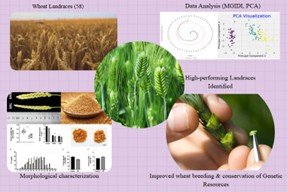
Wheat landraces are an invaluable source of germplasm for developing climate-resilient and high-yielding cultivars. To characterize morphological diversity and select superior wheat landraces using the Multi-Trait Genotype-Ideotype Distance Index (MGIDI) to maximize genetic gain and productivity, 58 wheat landraces from across Nepal were studied in a randomized complete block design for 12 qualitative and 19 quantitative traits at Khumaltar, Nepal. We analyzed quantitative traits using linear mixed models to estimate broad-sense heritability and Best Linear Unbiased Predictors (BLUPs). MGIDI at 15% selection intensity was computed based on the Euclidean distance of each landrace from an ideal ideotype for multi-trait selection, and the results were compared with FAI-BLUP and two Smith-Hazel indices. Significantly high Shannon-Weaver diversity was observed in qualitative traits, guiding selection. Pronounced genotypic differences and high broad-sense heritability (h2 = 0.89-1.00; p<0.001) were observed for most quantitative traits. Factor analysis revealed six factors explaining 80.34% of the total variation. MGIDI successfully identified nine elite landraces with desirable gains, with maximum selection gains obtained for spike length (30.12%) and grain yield (15.57%). MGIDI showed a perfect coincidence index (CI=100%) with FAI-BLUP but substantially lower coincidences with Smith Hazel indices. Four genotypes, G41 (NGRC-7819), G34 (NGRC-7615), G22 (NGRC-6554), and G31 (NGRC-7586), were selected concurrently in the study across all four indices and are recommended for further study. Overall, the findings highlight MGIDI as an effective, reliable, and data-driven approach for selecting and leveraging wheat germplasm to develop climate-resilient varieties to ensure food security.Downloads
References
Bizari, E. H., Val, B. H. P., Pereira, E. D. M., Mauro, A. O. D., & Unêda-Trevisoli, S. H. (2017). Selection indices for agronomic traits in segregating populations of soybean. Revista Ciência Agronômica, 48(1), 110-117. https://doi.org/10.5935/1806-6690.20170012
Bugbee, B., & Koerner, G. (1997). Yield comparisons and unique characteristics of the dwarf wheat cultivar ‘USU-Apogee’. Advances in Space Research, 20(10), 1891-1894. https://doi.org/10.1016/S0273-1177(97)00856-9
Buntaran, H., Piepho, H. P., Schmidt, P., Rydén, J., Halling, M., & Forkman, J. (2020). Cross‐validation of stagewise mixed‐model analysis of Swedish variety trials with winter wheat and spring barley. Crop Science, 60(5), 2221-2240. https://doi.org/10.1002/csc2.20177
Céron-Rojas, J. J., & Crossa, J. (2018). Linear selection indices in modern plant breeding (p. 256). Springer Nature. https://doi.org/10.1007/978-3-319-91223-3
Chapagain, S., Kandel, B. P., Shrestha, S., Poudel, A., & Yadav, S. P. S. (2025). Identifying superior finger millet (Eleusine coracana L.) landraces using the multi-trait genotype-ideotype distance index (MGIDI). Cogent Food & Agriculture, 11(1), 2592358. https://doi.org/10.1080/23311932.2025.2592358
Coutinho, G., Pio, R., Machado de Souza, F. B., da Hora Farias, D., Bruzi, A. T., & Sales Guimarães, P. H. (2019). Multivariate Analysis and Selection Indices to Identify Superior Quince Cultivars for Cultivation in the Tropics. HortScience, 54(8), 1324–1329. https://doi.org/10.21273/HORTSCI14004-19
Donald, C.M. (1968). The breeding of crop ideotypes. Euphytica 17, 385–403. https://doi.org/10.1007/BF00056241
Dreisigacker, S., Zhang, P., Warburton, M. L., Skovmand, B., Hoisington, D., & Melchinger, A. E. (2005). Genetic diversity among and within CIMMYT wheat landrace accessions investigated with SSRs and implications for plant genetic resources management. Crop Science, 45(2), 653-661. https://doi.org/10.2135/cropsci2005.0653
Dubcovsky, J., & Dvorak, J. (2007). Genome plasticity a key factor in the success of polyploid wheat under domestication. Science, 316(5833), 1862-1866. https://doi.org/ 10.1126/science.1143986
Entringer, G. C., Vettorazzi, J. C. F., Santos, E. A., Pereira, M. G., & Viana, A. P. (2016). Genetic gain estimates and selection of S1 progenies based on selection indices and REML/BLUP in super sweet corn. Australian Journal of Crop Science, 10(3), 411–417. https://search.informit.org/doi/10.3316/informit.089585770035022
FAOSTAT (2026). Food and Agriculture Organization of the United Nations. Rome, URL: http://faostat.fao.org
Farhad, M., Tripathi, S. B., Singh, R. P., Joshi, A. K., Bhati, P. K., Vishwakarma, M. K., ... & Kumar, U. (2022). Multi‐trait selection of bread wheat ideotypes for adaptation to early sown conditions. Crop Science, 62(1), 67-82. https://doi.org/10.1002/csc2.20628
Fellahi, Z. E. A., Boubellouta, T., Hannachi, A., Belguet, H., Louahdi, N., Benmahammed, A., & Rebouh, N. Y. (2024). Exploitation of the genetic variability of diverse metric traits of durum wheat (Triticum turgidum L. ssp. durum Desf.) cultivars for local adaptation to semi-arid regions of Algeria. Plants, 13(7), 934. https://doi.org/10.3390/plants13070934
Graham, M. H. (2003). Confronting multicollinearity in ecological multiple regression. Ecology, 84(11), 2809-2815. https://doi.org/10.1890/02-3114
Gupta, P. K., Balyan, H. S., Sharma, S., & Kumar, R. (2020). Genetics of yield, abiotic stress tolerance and biofortification in wheat (Triticum aestivum L.). Theoretical and Applied Genetics, 133(5), 1569-1602. https://doi.org/10.1007/s00122-020-03583-3
Gurcan, K., Demirel, F., Tekin, M., Demirel, S., & Akar, T. (2017). Molecular and agro-morphological characterization of ancient wheat landraces of turkey. BMC Plant Biology 17 (Suppl 1), 171 (2017). https://doi.org/10.1186/s12870-017-1133-0
Hamblin, J., & Zimmermann, M. J. D. O. (1986). Breeding common bean for yield in mixtures. Plant Breeding Reviews, 4, 245-272. https://doi.org/10.1002/9781118061015
Haque, M. S., Saha, N. R., Islam, M. T., Islam, M. M., Kwon, S. J., Roy, S. K., & Woo, S. H. (2021). Screening for drought tolerance in wheat genotypes by morphological and SSR markers. Journal of Crop Science and Biotechnology, 24(1), 27-39. https://doi.org/10.1007/s12892-020-00036-7
Hazel, L. N. (1943). The genetic basis for constructing selection indexes. Genetics, 28(6), 476-490. https://doi.org/10.1093/genetics/28.6.476
Heun, M., Schafer-Pregl, R., Klawan, D., Castagna, R., Accerbi, M., Borghi, B., & Salamini, F. (1997). Site of einkorn wheat domestication identified by DNA fingerprinting. Science, 278(5341), 1312-1314. https://doi.org 10.1126/science.278.5341.1312
Hickey, L. T., N. Hafeez, A., Robinson, H., Jackson, S. A., Leal-Bertioli, S. C., Tester, M., & Wulff, B. B. (2019). Breeding crops to feed 10 billion. Nature Biotechnology, 37(7), 744-754. https://doi.org/10.1038/s41587-019-0152-9
Karkee, A., Mainali, R.P., Ghimire, K.H., Thapa, P., Joshi, B.K., Subedi, S., & Shrestha, J. (2023). Characterization of Nepalese bread wheat landraces based on morpho-phenological and agronomic traits. Yuzuncu Yil University Journal of Agricultural Sciences 33(2), 269–280. https://doi.org/10.29133/yyutbd.1205181
Khan, M., Bukhari, A., Dar, Z. and Rizvi, S. (2013) Status and strategies in breeding for rust resistance in wheat. Agricultural Sciences, 4, 292-301. https://doi.org/10.4236/as.2013.46042
Lyu, J., Zhang, S., Dong, Y., He, W., Zhang, J., Deng, X., ... & Wang, W. (2013). Analysis of elite variety tag SNPs reveals an important allele in upland rice. Nature Communications, 4(1), 2138. https://doi.org/10.1038/ncomms3138
Nalley, L., Dixon, B., Chaminuka, P., Naledzani, Z., & Coale, M.J. (2018). The role of public wheat breeding in reducing food insecurity in South Africa. PLoS ONE 13(12), e0209598. https://doi.org/10.1371/journal.pone.0209598
Norman, P. E., Agre, P. A., Asiedu, R., & Asfaw, A. (2022). Multiple-trait selection in white Guinea Yam (Dioscorea rotundata) genotypes. Plants, 11(21), 3003. https://doi.org/10.3390/plants11213003
Olivoto, T., & Lúcio, A. D. C. (2020). metan: An R package for multi‐environment trial analysis. Methods in Ecology and Evolution, 11(6), 783-789. https://doi.org/10.1111/2041-210X.13384
Olivoto, T., Lúcio, A. D., da Silva, J. A., Marchioro, V. S., de Souza, V. Q., & Jost, E. (2019a). Mean performance and stability in multi‐environment trials I: combining features of AMMI and BLUP techniques. Agronomy Journal, 111(6), 2949-2960. https://doi.org/10.2134/agronj2019.03.0220
Olivoto, T., Lúcio, A. D., da Silva, J. A., Sari, B. G., & Diel, M. I. (2019b). Mean performance and stability in multi‐environment trials II: Selection based on multiple traits. Agronomy Journal, 111(6), 2961-2969. https://doi.org/10.2134/agronj2019.03.0221
Olivoto, T., Nardino, M. (2021). MGIDI: Toward an effective multivariate selection in biological experiments, Bioinformatics, Volume 37, Issue 10, May 2021, Pages 1383–1389, https://doi.org/10.1093/bioinformatics/btaa981
Özkan, H., Willcox, G., Graner, A., Salamini, F., & Kilian, B. (2011). Geographic distribution and domestication of wild emmer wheat (Triticum dicoccoides). Genetic Resources and Crop Evolution, 58(1), 11-53. https://doi.org/10.1007/s10722-010-9581-5
Paramasivam, V. K., Swaminathan, M., Muthurajan, R., Natarajan, S., Manickam, S., Mandal, P., & Chakrapani, B. (2025). Comparison of traditional selection indices and the Multi-Trait Genotype Ideotype Distance Index (MGIDI) for improving rice (Oryza sativa L) cultivars. Plant Science Today, 12, 1-9. https://doi.org/10.14719/pst.5475
Rahmati, M., & Karimizadeh, R. (2025). Selection of bread wheat genotypes based on multi-trait selection index (MGIDI and SIIG). Plant Productions, 48(2), 189-205. https://doi.org/10.22055/ppd.2025.48230.2221
Reitz, L. P., & Salmon, S. C. (1968). Origin, history, and use of Norin 10 wheat. Crop Science, 8(6), 686-689. https://doi.org/10.2135/cropsci1968.0011183X000800060014x
Rocha, J. R. D. A. S. D. C., Machado, J. C., & Carneiro, P. C. S. (2018). Multitrait index based on factor analysis and ideotype‐design: Proposal and application on elephant grass breeding for bioenergy. GCB Bioenergy, 10(1), 52-60. https://doi.org/10.1111/gcbb.12443
Royo, C., & Briceño-Félix, G. A. (2011). Spanish wheat pool. The world wheat book, 2, 121-154.
Shannon, C. E., & Weaver, W. (1949). The mathematical theory of Communication. University of Illinois press.
Shewry, P. R. (2009). Wheat, Journal of Experimental Botany. 60, 6, 1537–1553, https://doi.org/10.1093/jxb/erp058
Smith, H. F. (1936). A discriminant function for plant selection. Annals of Eugenics, 7(3), 240-250. https://doi.org/10.1111/j.1469-1809.1936.tb02143.x
Downloads
Published
How to Cite
Issue
Section
License
Copyright (c) 2026 Agriculture and Environmental Science Academy

This work is licensed under a Creative Commons Attribution-NonCommercial 4.0 International License.