Effects of additive supplementation on the nutritional quality of rice bran fermented with rumen liquor for use as poultry feed
DOI:
https://doi.org/10.26832/24566632.2026.1103019Keywords:
Fermentation efficiency, Microbial fermentation, Molasses additive, Nutritional qualityAbstract
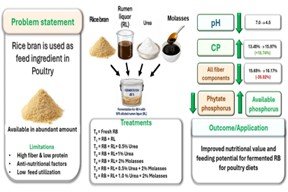
Rice bran (RB) is one of the most abundant agro-industrial by-products and used as an energy-rich ingredient in poultry diets. Its high fiber and some anti-nutritional substances limits nutrient digestibility and utilization by chickens, thereby reducing overall production efficiency. This study aimed to improve the nutritional quality of RB through fermentation. The RB was fermented for 48h using 50% rumen liquor (RL) supplemented with urea and molasses as an additive. The treatments (n=3) were; T0: Unfermented RB, T1: RB+RL, T2: RB+RL+0.5% urea, T3: RB+RL+1% urea, T4: RB+RL+2% molasses, T5: RB+RL+0.5% urea+2% molasses, and T6: RB+RL+1% urea+2% molasses. Fresh and fermented RB was analyzed for nutritional composition. The pH decreased after fermentation in case of all the treatments. The crude protein (CP) increased linearly (p<0.05) from 13.45% in the control (T0) to 15.97% in T6, representing an 18.74% increase after fermentation, which was the highest value among the treatments. On the other hand, crude fiber (CF) decreased from 15.65% in the control (T0) to 10.17% in T6, representing 35.02% decrease. Other fiber components, neutral detergent fiber (NDF), acid detergent fiber (ADF), acid detergent lignin (ADL), cellulose and hemicellulose also decreased significantly (p<0.05) after fermentation. Ether extract (EE) showed significant (p<0.05) differences among treatments. Phytate phosphorus decreased and available phosphorus increased after fermentation with addition of highest levels of additive supplementation. The decrease in fiber components coupled with increase in CP and phosphorus availability may improve the nutritional value as well as feeding potential of fermented RB for poultry diets.Downloads
References
Ahmad, A., Anjum, A. A., Rabbani, M., Ashraf, K., Awais, M. M., Ahmad, N., Asif, A. & Sana, S. (2019). Effect of fermented rice bran on growth performance and bioavailability of phosphorus in broiler chickens. Indian Journal of Animal Research, 53(3), 361–365. https://doi.org/10.18805/ijar.v0iOF.8002
Alam, M. A., Khan, M. S. R., & Islam, K. M. S. (2023). Effect of feeding fermented rice bran by rumen liquor on the growth performance of broiler chickens. Asian Journal of Dairy and Food Research, 42(1), 26–30. https://doi.org/10.18805/ajdfr.DRF-273
AOAC. (2005). Official Methods of Analysis (18th edition) Association of Official Analytical, Chemists International, Maryland. 2005; USA.
Ardiansyah, D. & Hartinah, I. (2018). Improvement of the nutritive quality of Sargassum powder through Aspergillus niger, Saccharomyces cerevisiae, and Lactobacillus spp. fermentations. AACL Bioflux, 11(3), 753-764. https://www.cabidigitallibrary.org/doi/pdf/10.5555/20183236741
Aro, S. O., & Aletor, V. A. (2012). Proximate composition and amino acid profile of differently fermented cassava tuber wastes collected from a cassava starch producing factory in Nigeria. Livestock Research for Rural Development, 24(3), 102-106. https://www.lrrd.org/lrrd24/3/aro24040.htm
Aschenbach, J. R., Penner, G., B., Stumpff, F., & Gäbel, G. (2011). Ruminant nutrition symposium: Role of fermentation acid absorption in the regulation of ruminal pH. Journal of animal science, 89(4), 1092-1107. https://doi.org/10.2527/jas.2010-3301
Azrinnahar, M., Islam, N., Shuvo, A. A. S., Kabir, A. K. M. A. & Islam, K. M. S. (2021). Effect of feeding fermented (Saccharomyces cerevisiae) de-oiled rice bran in broiler growth and bone mineralization. Journal of the Saudi Society of Agricultural Sciences, 20(7), 476–481. https://doi.org/10.1016/j.jssas.2021.05.006
Baytok, E., Aksu, T., Karsli, M., & Muruz, H. (2005). The effects of formic acid, molasses and inoculant as silage additives on corn silage composition and ruminal fermentation characteristics in sheep. Turkish Journal of Veterinary & Animal Sciences, 29(2), 469-671.
Bollinedi, H., Singh, A. K., Singh, N., Gopala, K. S., Bhowmick, P. K., Vinod, K. K., Nagarajan, M., & Ellur R.K. (2021). Genetic and genomic approaches to address rapid rancidity of rice bran. Critical Reviews in Food Science and Nutrition, 61(1), 75–84. https://doi.org/10.1080/10408398.2020.1718598
Bravo, D., Meschy, F., Bogaert, C., & Sauvant, D. (2000). Ruminal phosphorus availability from several feedstuffs measured by the nylon bag technique. Reproduction Nutrition Development, 40(2), 149-162. https://doi.org/10.1051/rnd:2000126
Chibisa, G. E., Beauchemin, K. A., & Penner, G. B. (2016). Relative contribution of ruminal buffering systems to pH regulation in feedlot cattle fed either low or high-forage diets. Animal, 10(7), 1164-1172. https://doi.org/10.1017/S1751731115002888
Chuang, W. Y., Lin, L. J., Shih, H. D., Shy, Y. M., Chang, S. C., & Lee, T. T. (2021). The Potential Utilization of High-Fiber Agricultural By-Products as Monogastric Animal Feed and Feed Additives: A Review. Animals, 11(7), 2098. https://doi.org/10.3390/ani11072098
Clark, M., & Tilman, D. (2017). Comparative Analysis of Environmental Impacts of Agricultural Production Systems, Agricultural Input Efficiency, and Food Choice. Environmental Research Letters, 12(6), 064016. https://doi.org/10. 1088/ 1748-9326/ aa6cd5
Debi, M. R. & Ivy, M. B. K. (2024). A review of the effects of using fermented agro-industrial byproducts for non-ruminants. Bangladesh Journal of Animal Science, 53 (4): 121 - 134. https://doi.org/10.3329/bjas.v53i4.78845
Debi, M. R., Islam, K. M. S., & Saha, B. K. (2024). Fermentation Time and Environmental Conditions Changes Nutritional Composition of Fermented Rice and Wheat Bran. Indian Journal of Animal Nutrition, 41(3). https://epubs.icar.org.in/index.php/IJAN/article/view/150698
Debi, M. R., Khandokar, J. U., Saha, B. K., & Debnath, T. (2026). Enhancing Phosphorus Bioavailability in Rice Bran and Wheat Bran Through Fermentation with Rumen Liquor. Archives of Agriculture and Environmental Science, 11(3), (Accepted)
Debi, M. R., Wichert, B. A., & Liesegang, A. (2019). Method development to reduce the fiber content of wheat bran and rice bran through anaerobic fermentation with rumen liquor for use in poultry feed. Asian-Australasian Journal of Animal Science, 32(3), 395-404. https://doi.org/10.5713/ajas.18.0446
Debi, M. R., Wichert, B. A., & Liesegang, A. (2022a). Anaerobic fermentation of rice bran with rumen liquor for reducing their fiber components to use as chicken feed. Heliyon, 8(4), e09275. https://doi.org/10.1016/j.heliyon.2022.e09275
Debi, M. R., Wichert, B. A., Wolf, P., & Liesegang, A. (2022b). Effect of a two-step fermentation method with rumen liquor on protein quality of wheat bran and rice bran to use as poultry feed. Heliyon, 8(12), e11921. https://doi.org/10.1016/j.heliyon.2022.e11921
DePeters, E. J., & George, L. W. (2014). Rumen transfaunation. Immunology Letters, 162(2, Part A), 69-76. https://doi.org/10.1016/j.imlet.2014.05.009
Dersjant-Li, Y., Awati, A., Schulze, H., & Partridge, G. (2015). Phytase in non-ruminant animal nutrition: a critical review on phytase activities in the gastrointestinal tract and influencing factors. Journal of the Science of Food and Agriculture, 95(5), 878-896. https://doi.org/10.1002/jsfa.6998
Devi, R., Veliveli, V., L., & Devi, S., S. (2021). Nutritional Composition of Rice Bran and Its Potentials in the Development of Nutraceuticals Rich Products. Journal of Pharmacognosy and Phytochemistry, 10(2), 470–473. https://www.phytojournal.com/archives/view-pdf/13842/10-2-53
Dijkstra, J., Ellis, J., L., Kebreab, E., et al. (2012). Ruminal pH regulation and nutritional consequences of low pH. Animal Feed Science and Technology, 172, 22–33. https://doi.org/10.1016/j.anifeedsci.2011.12.005
Durand, M., & Komisarczuk, S. (1988). Influence of Major Minerals on Rumen Microbiota. The Journal of Nutrition, 118(2), 249-260. https://doi.org/10.1093/jn/118.2.249
Ellis, L. C., & Tillman, A. D. (1961). Utilization of Phytin Phosphorus in Wheat Bran by Sheep. Journal of Animal Science, 20(3), 606-607. https://doi.org/10.2527/jas1961.203606x
Fiske, C. H., & Subbarow, Y. (1925). The colorimetric determination of phosphorous. Journal of Biological Chemistry, 66(2), 375-400. https://doi.org/10.1016/S0021-9258(18)84756-1
Fukagawa, N., K., Ziska, L., H. (2019). Rice: Importance for global nutrition. Journal of Nutritional Science and Vitaminology, 65, S2-S3.
Haese, E., Lengowski, M., Gräter, E., Föll, A., Möhring, J., Steingass, H., Schollenberger, M., & Rodehutscord, M. (2017). Ruminal phytate degradation of maize grain and rapeseed meal in vitro and as affected by phytate content in donor animal diets and inorganic phosphorus in the buffer. Journal of Animal Physiology and Animal Nutrition, 101(5), 868-880. https://doi.org/10.1111/jpn.12500
Haese, E., Müller, K., Steingass, H., Schollenberger, M., & Rodehutscord, M. (2014). Effects of mineral and rapeseed phosphorus supplementation on phytate degradation in dairy cows. Archives of Animal Nutrition, 68(6), 478-491. https://doi.org/10.1080/1745039X.2014.968702
Heo, S., Kim, T., Na, H. E., Lee, G., Park, J. H., Park, H. J., et al. (2022). Safety assessment systems for microbial starters derived from fermented foods. Journal of Microbiology and Biotechnology, 32(10), 1219–1225. https://doi.org/10.4014/jmb.2207.07047
Heuzé, V., & Tran, G. (2015). Rice Bran and Other Rice By-Products. Feedipedia, a programme by INRAE, CIRAD, AFZ and FAO. https://www.feedipedia.org/node/750
Islam, K. M. S., Elsabagh, M., Lv, R., Dang, H. L., Sugino, T., & Obitsu, T. (2022). Anaerobic fermentation of rice bran using rumen liquor for desirable chemical changes as animal feed. Journal of Advance Veterinary and Animal Research, 9(4), 728-735. https://doi.org/10.5455/javar.2022.i642
Islam, S., Bijoy, M. A., Rahman. M. A., Chowdhury, R. & Islam, K. M. S. (2026). Fermentation Efficiency of Rice Bran, Rice Polish, and De‐Oiled Rice Bran for Nutritional Upgrading and Bioethanol Production. Food Science & Nutrition, 14(1), e71382. https://doi.org/10.1002/fsn3.71382
Jannathulla, R., Dayal, J. S., Vasanthakumar, D., Ambasankar, K., & Muralidhar M. (2017). Effect of fermentation methods on amino acids, fiber fractions and anti-nutritional factors in different plant protein sources and essential amino acid index for Penaeus vannamei Boone. Indian Journal of Fisheries, 60(2), 40–47. http://doi.org/10.21077/ijf.2017.64.2.60341-07
Jazi, V., Boldaj, F., Dastari, B., Hashemi, S. R., & Ashayerizadeh, A. (2017). Effects of fermented cottonseed meal on the growth performance, gastrointestinal microflora population and small intestinal morphology in broiler chickens. British Poultry Science, 58(4), 402-408. https://doi.org/10.1080/00071668.2017.1315051
Kalita, P., Ahmad, A. B., & Sen, S. (2023). High value compounds and bioactivity of rice bran, rice bran protein: A review. Recent Advances in Food, Nutrition & Agriculture, 14(1): 26-40. https://doi.org/10.2174/2772574X14666221227151558
Kang, H.K., Kim, J.H., & Kim, C.H. (2018). Effect of dietary supplementation with fermented rice bran on the growth performance, blood parameters and intestinal microflora of broiler chickens. European Poultry Science, 79, 1-11. https://doi.org/10.1399/eps.2015.112
Liza, R. I., Ismita, J., Islam, K. M. S., Chowdhury, R., Debi, M. R., & Joy, N. R. (2022). Effect of Feeding Yeast (Saccharomyces cerevisiae) Fermented Rice Bran with Urea on the Performance of Broiler. Journal of the Bangladesh Agricultural University, 20(1), 57-63. https://doi.org/10.5455/JBAU.130284
Lopez, D., Vázquez‐Armijo, J. F., López‐Villalobos, N., Lee‐Rangel, H. A., Salem, A. Z. M., Borquez‐Gastelum, J. L., & Rojo‐Rubio, R. (2016). In vitro gas production of foliage from three browse tree species treated with different dose levels of exogenous fibrolytic enzymes. Journal of Animal Physiology and Animal Nutrition, 100(5), 920-928. https://doi.org/10.1111/jpn.12467
Lukkananukool, A., Srikijkasemwat, K., Promnaret, A., Aung, M., & Kyawt, Y. Y. (2019). Fermented juice of epiphytic lactic acid bacteria and molasses addition on the fermentation characteristics and nutrient compositions of sorghum silage. Advances in Animal and Veterinary Sciences, 4(4), 668673. https://doi.org/10.17582/journal.aavs/2019/7.8.668.673
Manlapig, J. J. D., Matsui, H. (2025). Production and Utilization of Fermented Rice Bran as Animal Feed. Animal Science Journal, 96, e70037. https://doi.org/10.1111/asj.70037
Manzoor, A., Pandey, V. K., Dar, A. H., Fayaz, U., Dash, K. K., Shams, R., Ahmad, S., Bashir, I., Fayaz, J., Singh, P., Khan, S., A. & Ganaie, T., A. (2023). Rice bran: nutritional, phytochemical, and pharmacological profile and its contribution to human health promotion. Food Chemistry Advances, 2, 100296. https://doi.org/10.1016/j.focha.2023.100296
Mohidem, N. A., Hashim, N., & Shamsudin, R. (2022). Rice for food security: Revisiting its production, diversity, rice milling process and nutrient content. Agriculture, 12(6), 741. https://doi.org/10.3390/agriculture12060741
Navales, R. A. S., Tokach, M. D., DeRouchey, J. M., Gaffield, K. N., Woodworth, J. C., Goodband, R. D., Gebhardt, J. T., Euken, R. M., & Dekkers, J. C. M. (2025). Technologies and practices to improve feed and nutrient utilization by pigs. Journal of Animal Science, 103. https://doi.org/10.1093/jas/skaf043
Nidhishree, A. S., Menezes, R. A., Venkatachalam, H. (2024). Rice bran as a sustainable source for value added materials: Review, Discover Materials, 4 (1), 93. https://doi.org/10.1007/s43939-024-00159-6
Pitta, D. W., Pinchak, W. E., Dowd, S. E., Osterstock, J., Gontcharova, V., Youn, E., & Malinowski, D. P. (2010). Rumen bacterial diversity dynamics associated with changing from Bermuda grass hay to grazed winter wheat diets. Microbial ecology, 59, 511-522. https://doi.org/10.1007/s00248-009-9609-6
Pujaningsih, R. (2004). Fermentation of rice bran to increase phosphorous availability by using rumen liquor. Journal of Agriculture and Rural Development in the Tropics and Subtropics, Supplement, 334-341.
Qui, N.H. & Linh, N.T. (2025). Nutritive and therapeutic value of fermented rice bran as a feed additive for enhancing performance and health in chickens. Open Veterinary Journal, 15(8), 3439-3447. https://doi.org/10.5455/OVJ.2025.v15.i8.7
Santra, A., Chaturvedi, O. H., Tripathi, M. K., Kumar, R., & Karim, S. A. (2003). Effect of dietary sodium bicarbonate supplementation on fermentation characteristics and ciliate protozoal population in rumen of lambs. Small Ruminant Research, 47(3), 203-212. https://doi.org/10.1016/S0921-4488(02)00241-9
Sechler, S. R., Mullenix, M. K., Holland, C. M., & Muntifering, R. B. (2017). Fiber digestion kinetics and protein degradability characteristics of stockpiled Tifton 85 bermudagrass. Journal of Animal Science, 95(9), 3922-3931. https://doi.org/10.2527/jas2017.1600
Sen, S., Chakraborty, R., Kalita, P. (2020). Rice-not just a staple food: A comprehensive review on its phytochemicals and therapeutic potential. Trends in Food Science and Technology, 97, 265-285. https://doi.org/10.1016/j.tifs.2020.01.022
Shah, A. M., Zhang, H. Shahid, M. et al. (2025). The Vital Roles of Agricultural Crop Residues and Agro-Industrial By-Products to Support Sustainable Livestock Productivity in Subtropical Regions. Animals, 15(8). 1184. https://doi.org/10.3390/ani15081184
Shen, J., Liu, Z., Yu, Z., & Zhu, W. (2017). Monensin and Nisin Affect Rumen Fermentation and Microbiota Differently In Vitro [Original Research]. Frontiers in Microbiology, 8(1111), 1-13. https://doi.org/10.3389/fmicb.2017.01111
Shi, H., Zhang, M., Wang, W., & Devahastin, S. (2020). Solid-state fermentation with probiotics and mixed yeast on properties of okara. Food Bioscience, 36, 100610. https://doi.org/10.1016/j.fbio.2020.100610
Shuvo, A. A. S., Rahman, M. S., Al-Mamum, M., & Islam, K. M. S. (2022). Cholesterol reduction and feed efficiency enhancement in broiler through the inclusion of nutritionally improved fermented rice bran. Journal of Applied Poultry Research, 31, 100226. https://doi.org/10.1016/j.japr.2021.100226
Singh, P. K. (2008). Significance of phytic acid and supplemental phytase in chicken nutrition: a review. World's Poultry Science Journal, 64, 553-580. https://doi.org/10.1017/S0043933908000202
Su, W., Jiang, Z., Wang, C., Xu, B., Lu, Z., Wang, F., et al. (2022). Dynamics of defatted rice bran in physicochemical characteristics, microbiota and metabolic functions during two-stage co-fermentation. International Journal of Food Microbiology, 362(3), 109489–109501. https://doi.org/10.1016/j.ijfoodmicro.2021.109489
Supriyati, T., Haryati, T., Susanti, T., & Susana, I. W. R. (2015). Nutritional value of rice bran fermented by Bacillua amyloliquefaciens and humic substances and its utilisation as a feed ingredient for broiler chicken. Asian-Australasian Journal of Animal Science, 28 (2), 231-238. https://doi.org/10.5713/ajas.14.0039
Terefe, Z. K., Omwamba, M., & Nduko, J. M. (2022). Effect of microbial fermentation on nutritional and antinutritional contents of cassava leaf. Journal of Food Safety, 42(3), e12969. https://doi.org/10.1111/jfs.12969
Ullah, H., Islam, K. M. S., Shuvo, A.A. S., Rahman, M. M., Alam, M. S., Dickhofer, U., & Grashorn, M. A. (2021). Effects of feeding rumen liquor fermented rice bran on performance of broiler chicken. Animal Nutrition and Feed Technology, 21, 177–186. https://doi.org/10.5958/0974-181X.2021.000147
USDA, Foreign Agricultural Service. (2025). World Agricultural Production Report. https:// www.fas.usda.gov/data/production/commodity/0422110
Wallace, R. J., & Chesson, A. (Eds.). (2008). Biotechnology in animal feeds and animal feeding. John Wiley & Sons.
Wang, Y., Weijiang Z., Bo Xu, c., Wen, Y. (2024). Comparison of rice bran characteristics fermented by mono- or di-strain probiotics based on omics technology. Food Science and Technology, 209, 116763. https://doi.org/10.1016/j.lwt.2024.116763
Weiss, C. P., Gentry, W. W., Cole, N. A., McCollum, F. T., & Jennings, J. S. (2017). Effects of feeding condensed distiller's solubles and crude glycerin alone or in combination on finishing beef cattle performance, carcass characteristics, and in vitro fermentation. Journal of Animal Science, 95(2), 922-929. https://doi.org/10.2527/jas.2016.0941
Woyengo, T. A., & Nyachoti, C. M. (2013). Review: Anti-nutritional effects of phytic acid in diets for pigs and poultry – current knowledge and directions for future research. Canadian Journal of Animal Science, 93(1), 9-21. https://doi.org/10.4141/cjas2012-017
Yunus, F., Nadeem, M., & Rashid, F. (2015). Single-cell protein production through microbial conversion of lignocellulosic residue (Wheat bran) for animal feed. Journal of the Institute of Brewing, 121, 553 -557. https://doi.org/10.1002/jib.251
Downloads
Published
How to Cite
Issue
Section
License
Copyright (c) 2026 Agriculture and Environmental Science Academy

This work is licensed under a Creative Commons Attribution-NonCommercial 4.0 International License.