Yield performance and growth variability of elephant foot yam (Amorphophallus paeoniifolius L.) genotypes under coastal saline conditions of Bangladesh
DOI:
https://doi.org/10.26832/24566632.2026.110302Keywords:
Genetic variability, Growth characteristics, Therapeutic properties, Yield attributesAbstract
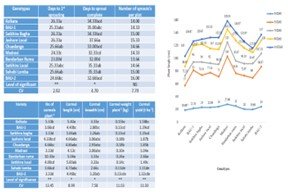
A field experiments was conducted at a field in Kharnia, Dumuria upazilla of Khulna district in Bangladesh to evaluate elephant foot yam (Amorphophallus paeoniifolius L.) genotypes on the basis of their growth and yield characteristics. Ten elephant foot yam genotypes viz. Kolkata, BAU-1, Satkhira Bagha, Jashore Local, Chuadanga, Madrasi, Bandarban Ruma, Satkhira Local, Sahebi Lomba and BAU-2 was taken in a randomized block design with three replications. Data were recorded on different growth parameters and yield. The growth and yield components of elephant foot yam varied significantly (p<0.05) among the varieties except number of plants per plot. Results revealed that less time was required for sprouting (23.00 day) in Bandarban Ruma genotype of elephant foot yam. The highest number of sprouting (16.00) was found in BAU-2. The highest plant height (158.33 cm) was recorded in Madrasi genotype. The maximum number of leaf was recorded (49.66) in Jashore Local genotype. The maximum corm length was observed in Sahebi Lomba (22.40 cm) and corm breadth in Madrasi (24.33 cm) genotypes. The highest corm yield was recorded from Madrasi (40.13 ton/ha). The maximum number of cormels were found in Bandarban Ruma (10.33) and cormel yield was also found the highest in Bandarban Ruma (2.66 ton/ha) genotypes of elephant foot yam. Therefore, it could be concluded that among different genotypes, Madrasi genotype produced highest yield and Madrasi genotype of elephant foot yam may be selected for commercial cultivation in Khulna region of Bangladesh.Downloads
References
Abraham, L. N., Kamala, S., Sreekumar, J., & Makeshkumar, T. (2021). Optimization of parameters to improve transformation efficiency of elephant foot yam (Amorphophallus paeoniifolius (Dennst.) Nicolson. 3 Biotech, 272. https://doi.org/ 10.1007/s13205-021-02824-6
Bansode, V., Singh Chauhan, V.B., Pati, K., Shekhar Mahanand, S., & Nedunchezhiyan, M. (2019). Studies on standardization and Physic-chemical Characteristics of Elephant Foot Yam (Amorphophallus paeoniifolius). Papad International Journal of current Microbiology and Applied, 8(5), 950-955. https://doi.org/10.20546/ijcmas.2019.805.110
BBS. (2025). Bangladesh Bureau of Statistics. Yearbook Year book of Agricultural statistics of Bangladesh. Pp 295. Accessed from: www.bbs.gov.bd
Chakraborty, S., Gand our, A. K., Ghosh, P., & Naskar, S. (2015). Studies on system of cultivation and plant spacing on cormel productionof elephant foot yam. The Bioscan 10, 191-194. https://doi.org/10.9735/bi/2025/v21i103610
Chattopadhyay, A., & Nath, R. (2007). Medicinal importance of some well-known and unexploited roots and tubers. Agriculture update. Hind Agri-Horticultural Society, 2, 80-82. https://doi.org/10.1007/as11101-025-10194-7
Das, P.K., Sen, H.,.Banerjee, N. C., & P.K. Panda. (1997). Biomass Production and growth rate at different phenophases of elephant foot yam as influenced by chemical treatments. Indian Journal of Agricultural Research, 31, 115-121.
Hathan, B. S. (2016). Development and quality evaluation of ready to eat product from elephant foot yam tuber (Amorphophallus spp.). LWT-Food Science and Technology, 1-9. https://doi.org/10.1016/j.lwt.2015.07.047
Hossain, M. S., Choudhury, M. S. H., Rahman, M. H., Hoque, M. I., & Amin, M. A. (2014). Effect of planting material on the growth and yield of elephant foot yam. Journal of Agroforestry and Environment, 8, 109-113. https://jagroforenviron.com/wp-content/uploads/2018/09/25.-Effect-of-planting-material-on-the-growth-and-yield-of-elephant-foot-yam-MS-Hossain.pdf
Jaganathan, D., Byju, G., Koundinya, A. V. V., Prakash, P., & Immanuel, S. (2021). Improved Technologies for Elephant foot yam cultivation. https://www.researchgate.net/publication/343334860_Improved_Technologies_of_Elephant_foot_yam
Kamalkumaran, P. R.,Velmurugan, M., Anand, M., & Arumugam, T. (2020). Site specific nutrient management in elephant foot yam Amorphophallus paeoniifolius (Dennst. Nicolson). International Journal of Chemical Studies, 8(6), 252-255. https://doi.org/10.22271/chemi.2020.v8.i6d.10777
Kandekar, U. Y., Abhang, T. R., Pujari,R. R., & Khandelwal, K. R. (2021). Exploration of elephant foot yam (Amorphpphallus paeoniifolius) starch:an alternative natural disintegrant for pharmaceutical application. Indian Journal of Pharmaceutical Application and Research, 55(1), 209-219. https://doi.org/10.5530/ijper.55.1s.52
Kumar, J. S., Sunitha, S., Sreekumar, J., Mamatha, K., Das, B., Sengupta, S., ... & Srikanth, B. (2023). Weed management strategies in elephant foot yam (Amorphophallus paeoniifolius) under different agro environments in India. The Indian Journal of Agricultural Sciences, 1314-1319. https://doi.org/10.56093/ijas.v93i12.139365
Laxminarayana, K. (2021). Effect of lime, inorganic and organic sources on soil quality and yield and proximate composition of elephant foot yam- black gram system in alfisols commun. Soil Science and Plant Analysis, 52(6), 635-650. https://doi.org/10.1080/00103624.2020.1862162
Meena, M. A., Singh, J. P., Saharan, S. K., & Solanki, P. S. (2017). Effect of planting geometry on growth,yield and quality of elephant foot yam. Journal of Pharmacognosy and Phytochemistry, 669-673. https://doi.org/10.59797/ijpp.v59i1.4528
Misra, P. K., Singh, P. N., Singh, S. N., & Kumar, P. (2016). Assessment of elephant foot yam (Amorphophallus paeoniifolius L.)–an efficient intercrop under guava (Psidium guajava L.) orchard for Purvanchal District of Uttar Pradesh. Journal of Pharmacognosy and Phytochemistry, 316-320.
Mukherjee, A., Immanuel, S., Prakash, P., Jaganathan, D., & Sivakumar, P.S. (2020). Root and tuber crops: Lifesaving tuber crops. Kerala karshakan E-journal, 7(12), 27-33.
Nath, R., Kundu, C. K., Majumder, A., Gunri, S., Biswas, T., Islam, S. J., ... & Sen, H. (2007). Seed corm production of elephant foot yam through mini corm setts in rainfed lateride ecosystem for Eastern. Journal of Root Crops,33, 30-37.
Nedunchezhiyan, M., Misra, R. S., & Shivalingaswamy, T. M. (2002). Elephant foot yam (Amorphophallus paeoniifolius (D.) Nicolson as an intercrop in banana and papaya. Orissa Horticultural Society, 30(1), 80-82.
Nedunchezhiyan, M., Ravi, V., Byju, G., & George, J. (2017). Organic source of nutrients effect on growth, yield and quality of elephant foot yam. Indian journal pf Agricultural Science, 87(8), 32-64.
Prathap, M., Diby, J., & Singh, M. A. (2017). Influence of corm size and Spacing on the growth and yield of elephant foot yam. International Journal of Tropical Agriculture, 35, 757-762.
Rahman, M. S., & Hajong, P. (2022). Profitability and resource use efficiency of elephant foot yam production in selected areas of south western Bangladesh: Profitability and resource use efficiency of elephant. Farm Economy, 147-159. https://fe.baea.org.bd/index.php/home/article/view/13
Ravi, V., Ravindran, C. S., Suja, G., George, J., Nedunzhiyan, M., Byju, G., & Naskar, S. K. (2011). Crop physiology of elephant foot yam (Amorphophallus paeoniifolius (Dennst. Nicolson). Advances in Horticultural Science, 51-63.
Sahoo, B. I. S. W. A. N. A. T. H., Nedunchezhiyan, M., & Acharyya, P. I. N. A. K. I. (2015). Productivity potential of elephant foot yam (Amorphophallus paeoniifolius (Dennst.) Nicolson) in alfisols as influenced by fertility levels. The Bioscan, 1255-7.
Salam, P. K., Singh, B., Ram, D. S., & Patel, R. K. (2016). Effect of spacing and size of planting material on elephant foot yam grown as intercrop in coconut garden. Journal of Root Crops, 42(2), 62-65.
Sankaran, M., Singh, N. P., Prakash, J., Santhosh, B., & Nedunchezhiyan, M. (2011). Production of seed corms through cormels in Elephant foot yam [Amorphophallus paeoniifolius (Dennst.) Nicolson]. Journal of root crops, 37, 86-87. https://ojs338.isrc.in/index.php/jrc/article/view/14
Santosa, E., Sugiyama, N., Nakta, M., & Lee, O.N. (2006). Growth and corm production of amorphophallus at different shading levels in Indonesia. Japanese Journal of Tropical Agriculture, 50(2), 87-91.
Singh, A., & Singh, B. K. (2019). Effect of corm size and depth of corm planting on growth, yield and quality of elephant foot yam in Gangetic plain. International Journal of Current Microbiology and Applied Sciences, 8, 706-713.
Singh, A., Chaurasiya, A., & Mitra, S. (2016). Assessment of nutritional composition in elephant foot yam (Amorphophallus paeoniifolius Dennst-Nicolson) cultivars. International Journal of Food Studies. https://doi.org/10.7455/ijfs/5.2.2016.a3
Suja, G., Sundaresan, S., John, K. S., Sreekumar, J., & Misra, R. S. (2012). Higher yield, profit and soil quality from organic farming of elephant foot yam. Agronomy for Sustainable Development, 755-764. https://doi.org/10.1007/s13593-011-0058-5
Utomo, J. S., & Ginting, E. (2021). Physico-chemical characteristics of elephant foot yam (Amorphophallus campanulatus) germplasm. In IOP Conference Series: Earth and Environmental Science. In IOP Conference Series: Earth and Environmental Science (p. 012044). Java: IOP Publishing. https://doi.org/10.1088/1755-1315/803/1/012044
Zala, R.G. R., Singh, N., & Ruchika, C. (2021). Character association studies for yield and it's attributing traits in elephant foot yam [Amorphophallus npaeoniifolius (Dennst.) Nicolaon]. Nicolson, 128.
Downloads
Published
How to Cite
Issue
Section
License
Copyright (c) 2026 Agriculture and Environmental Science Academy

This work is licensed under a Creative Commons Attribution-NonCommercial 4.0 International License.