Women's participation in the aquaculture sector and its socio-economic impacts in Sadar Union of Badalgachi Upazila, Naogaon, Bangladesh
DOI:
https://doi.org/10.26832/24566632.2026.1103020Keywords:
Decision-making, Fish Culture, Food Security, Gender Equality, LivelihoodAbstract
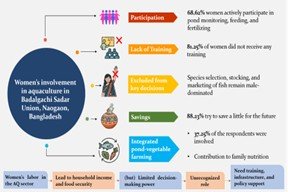
The aim of this study was to explore women's involvement in aquaculture activities and their role in family economy, decision-making, and food security in Sadar Union of Badalgachi Upazila, Naogaon, Bangladesh. Data were collected through face-to-face interviews with 51 women (out of approximately 200 fish-culturist families) using a pretested structured questionnaire through KoBo Toolbox. The data was analyzed descriptively in MS EXCEL. The findings showed that most of the respondents were housewives (62.74%) and had less than secondary education (54.91%). Nearly 68.62% of women were actively engaged in pond monitoring, feeding, and fertilizing, and 31.38% were not, mainly due to lack of knowledge or training (81.25%). Despite their labor, they were not involved in important decision-making, including species selection, stocking, and marketing, which were taken by the male members of the family. While 60-62.5% of women received a small profit, 64.86% were unable to spend the money independently; still, 88.23% were tried to save for their future family needs. Women's involvement also contributed to diversified household nutrition, with average fish consumption of 333.55g/person/week, and partly through integrated farming (fish-vegetable) by 37.25% of the respondents. The findings suggest that women are not just occasional laborers but also an unpaid and unacknowledged second labor force, who play an essential role in the income, food security, and household resilience. The invisible role of women can be converted into economic empowerment by providing targeted training, supportive policies, and improving local infrastructure for the benefit of the households and the aquaculture industry in rural Bangladesh.Downloads
References
Adam, R. I., Njogu, L. G., Ouko, K. O., Rajaratnam, S., Adeleke, L., Ogunya, L., & Fregene, B. (2025a). Unveiling gender dynamics and disparities in the aquaculture value chain: evidence from Ogun and Delta States, Nigeria. Aquaculture International, 33(5), 343. https://doi.org/10.1007/s10499-025-01966-1
Adam, R. I., Rajaratnam, S., Sufian, F. D., & Njogu, L. (2025b). Measuring women's empowerment in aquaculture in northwestern Bangladesh using a project level women's empowerment in fisheries index (pro-WEFI). PLOS ONE, 20(1), e0314284. https://doi.org/10.1371/journal.pone.0314284
Adam, R., Lam, R. D., Lozano Lazo, D. P., McDougall, C., Rajaratnam, S., Ouko, K., Pasani, C., Forsythe, L., & Rossignoli, C. M. (2024). Using a sustainable food systems framework to examine gender equality and women's empowerment in aquatic food systems. Frontiers in Sustainable Food Systems, 8, 1327798. https://doi.org/10.3389/fsufs.2024.1327798
Ali, H., Belton, B., Haque, M. M., Hernandez, R., Murshed-e-Jahan, K., Ignowski, L., & Reardon, T. (2026). Wholesalers and the transformation of the “hidden middle” of the aquaculture value chain in Bangladesh: H. Ali et al. Food Security, 18(1), 53-76. https://doi.org/10.1007/s12571-025-01605-w
Aryal, U. R., Sanjel, S., Kafle, O. P., Chhetri, M. R., Shrestha, Y. M., & Dhami, D. B. (2023). Use of smart mobile and web application Kobotoolbox/Kobocollect for community health diagnosis: sharing experience from the remote area of Nepal. Journal of Karnali Academy of Health Sciences, 6(3), 54-58. https://doi.org/10.61814/jkahs.v6i3.834
BBS. (2022). Facts and figures: Men and women in Bangladesh. Statistics and Informatics Division, Ministry of Planning, Government of the People's Republic of Bangladesh. https://bbs.gov.bd/pages/static-pages/6922e073933eb65569e27220
Bidisha, S. H., Faruk, A., & Mahmood, T. (2022). How are women faring in the Bangladeshi labour market? Evidence from labour force survey data. South Asia Economic Journal, 23(2), 201–227. https://doi.org/10.1177/13915614221108564
Chakma, K., & Ruba, U. B. (2021). Role of Bangladeshi women in diverse agricultural production: A review. European Journal of Agriculture and Food Sciences, 3(3), 1-5. https://doi.org/10.24018/ejfood.2021.3.3.284
Chambon, M., Miñarro, S., Alvarez Fernandez, S., Porcher, V., Reyes-Garcia, V., Tonalli Drouet, H., & Ziveri, P. (2023). A synthesis of women's participation in small-scale fisheries management: Why women's voices matter. Reviews in Fish Biology and Fisheries, 34(1), 43–63. https://doi.org/10.1007/s11160-023-09806-2
Choudhury, A., Leeuwis, C., Van Der Burg, M., McDougall, C., & Adam, R. (2025). Shifting the aquaculture regime toward gender equity? Case studies of women's entrepreneurial niche innovations in Bangladesh. Gender, Technology and Development, 29, 345–369. https://doi.org/10.1080/09718524.2025.2516122
Dizon, T. J. R., Saito, N., Reñosa, M., Bravo, T. A., Silvestre, C. J., Endoma, V., Guevarra, J. R., Quiambao, B., & Nishizono, A. (2022). Experiences in Using KoBo Collect and KoBo Toolbox in a Cross-Sectional Dog Population and Rabies Knowledge and Practices Household Survey in the Philippines. Studies in health technology and informatics, 290, 1082-1083. https://doi.org/10.3233/shti220278
DoF. (2023). Yearbook of fisheries statistics of Bangladesh, 2022–2023. Ministry of Fisheries and Livestock, Government of Bangladesh. https://fisheries.gov.bd/pages/downloads/6922dab5dbfbab28ce055da5
Elias, M., Zaremba, H., Tavenner, K., Ragasa, C., Valencia, A. M. P., Choudhury, A., & de Haan, N. (2024). Towards gender equality in forestry, livestock, fisheries and aquaculture. Global Food Security, 41, 100761. https://doi.org/10.1016/j.gfs.2024.100761
FAO. (2022). The state of world fisheries and aquaculture 2022: Towards blue transformation. FAO. https://doi.org/10.4060/cc0461en
Gopal, N., Hapke, H. M., Kusakabe, K., Rajaratnam, S., & Williams, M. J. (2020). Expanding the horizons for women in fisheries and aquaculture. Gender, Technology and Development, 24(1), 1–9. https://doi.org/10.1080/09718524.2020.1736353
Haobijam, J. W., & Ghosh, S. (2023). Integrated fish farming and its influence on farm livelihoods in Manipur, India. Aquaculture International, 31(4), 2011-2034. https://doi.org/10.1007/s10499-023-01067-x
Harper, S., Adshade, M., Lam, V. W., Pauly, D., & Sumaila, U. R. (2020). Valuing invisible catches: Estimating the global contribution by women to small-scale marine capture fisheries production. PLOS ONE, 15(3), e0228912. https://doi.org/10.1371/journal.pone.0228912
Hossain, M. B., Pingki, F. H., Sultana, M., Salim, N. M., Islam, M. M., Rahman, A. A., & Arai, T. (2024). The contribution of homestead pond fish culture to household food security and dietary diversity in central coast of a developing country. Heliyon, 10(7). https://doi.org/10.1016/j.heliyon.2024.e28598
Islam, F. K., Asif, A. A., Ahmed, M., Islam, M. S., Sarker, B., Zafar, M. A., & Rahman, M. (2017). Performances of resource poor households in aquaculture practices in Sadar Upazila, Meherpur, Bangladesh. International Journal of Fisheries and Aquatic Studies, 5(6), 281–288.
Kruijssen, F., McDougall, C., & van Asseldonk, I. J. M. (2017). Gender and aquaculture value chains: A review of key issues and implications for research. Aquaculture, 493, 328–337. https://doi.org/10.1016/j.aquaculture.2017.12.038
Kusakabe, K. & Thongprasert, S. (2022). Women and men in small-scale fisheries and aquaculture in Asia – Barriers, constraints and opportunities towards equality and secure livelihoods. Bangkok, FAO. https://doi.org/10.4060/cb9527en
Laksono, A. D., Wulandari, R. D., & Matahari, R. (2021). Does education level matter in women's risk of early marriage? Case Study in Rural Area in Indonesia. Medico Legal Update, 21(1), 24-8. https://doi.org/10.37506/mlu.v21i1.2273
Mangubhai, S., Barclay, K. M., Lawless, S., & Makhoul, N. (2023). Gender-based violence: Relevance for fisheries practitioners. Fish and Fisheries, 24(4), 582–594. https://doi.org/10.1111/faf.12747
Mengo, E., Grilli, G., Murray, J. M., Capuzzo, E., Eisma-Osorio, R.-L., Fronkova, L., Etcuban, J. O., Ferrater-Gimena, J. A., & Tan, A. (2023). Seaweed aquaculture through the lens of gender: Participation, roles, pay and empowerment in Bantayan, Philippines. Journal of Rural Studies, 100, 103025. https://doi.org/10.1016/j.jrurstud.2023.103025
Mohamed, A. A., Omar, O. E., Ahmed, A. A., Mohamed, L. A., & Bilow, I. A. (2026). The limited role of women in small-scale fisheries in Mogadishu, Somalia; cultural norms, access to resources and educational attainment. Frontiers in Sociology, 11, 1785217. https://doi.org/10.3389/fsoc.2026.1785217
Njogu, L., Adam, R., & Farnworth, C. R. (2024). Assessing women’s empowerment, participation, and engagement in aquaculture in Bangladesh. Aquaculture International, 32(5), 6303-6331. https://doi.org/10.1007/s10499-024-01467-7
Olaniyi, A. A., Adeleke, L. M., Fagbero, O. A., & Irabor, A. E. (2025). Investigation of gender roles and challenges in the tilapia value chain activities in Ogun State, Nigeria. Aquaculture International, 33(7), 659. https://doi.org/10.1007/s10499-025-02346-5
Orkoh, E., & Hatab, A. A. (2025). Enhancing women's income and household nutrition through training in small-scale fisheries value chains in Sub-Sahara Africa. The Journal of Development Studies, 62, 382–407. https://doi.org/10.1080/00220388.2025.2525855
Rahman, M. A., Ferdous, J., & Tasnim, Z. (2019). Role of women in pond fish farming and fish consumption situation in a selected area of Bangladesh. Archives of Agriculture and Environmental Science, 4(2), 206–212. https://doi.org/10.26832/24566632.2019.0402012
Rana, K. S., Hossain, M. M., Bablee, A. L., Halim, M. A., Islam, M. K., & Rahmatullah, S. M. (2019). Contemporary aquaculture and management practices in Abhaynagar Upazila, Jessore, Bangladesh. Journal of Entomology and Zoology Studies, 7(4), 1259–1267.
Ranganathan, P., Caduff, C., & Frampton, C. M. A. (2024). Designing and validating a research questionnaire - Part 2. Perspectives in Clinical Research, 15, 42-45. https://doi.org/10.4103/picr.picr_318_23
Salazar, C., Jaime, M. M., Cardenas, R., & Baquedano-Rodríguez, M. A. (2023). Women engagement, psychological traits, and gender gaps in the small-scale seaweed aquaculture in Chile. Reviews in Aquaculture, 15(4), 1540-1553. https://doi.org/10.1111/raq.12793
Shanta, M. A., Suman, S. U., & Islam, M. M. (2025). Role of formal aquaculture industry for empowering women: A study in the southern coastal region of Bangladesh. Women's Studies International Forum, 109, 103046. https://doi.org/10.1016/j.wsif.2024.103046
St. Louis, T. J., & Oliveira, N. M. (2022). Women's contribution to aquaculture's regional development: A literature review. Journal of Applied Aquaculture, 34(2), 294–313. https://doi.org/10.1080/10454438.2020.1842284
Yamwembo, A. M. (2026). The First Notions of Descriptive Statistics Applications with EXCEL, EVIEWS and R STUDIO. American Journal of Applied Mathematics, 14(3), 129-138. https://doi.org/10.11648/j.ajam.20261403.13
Downloads
Published
How to Cite
Issue
Section
License
Copyright (c) 2026 Agriculture and Environmental Science Academy

This work is licensed under a Creative Commons Attribution-NonCommercial 4.0 International License.