Effect of plant establishment method on the growth and yield performance of hilly black rice cultivars in Charland ecosystem of Bangladesh
DOI:
https://doi.org/10.26832/24566632.2026.1103021Keywords:
Black rice, Charland ecosystem, Physiological attributes, Plant establishment methodAbstract
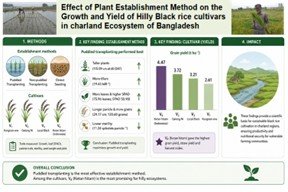
Black rice, rich in anthocyanins, phenolic compounds, and essential micronutrients, offers a promising pathway for enhancing both productivity and nutritional security in the char land ecosystems of Bangladesh. This study aimed to identify suitable plant establishment methods and high-performing hilly black rice cultivars for these vulnerable production environments. Field experiments were conducted to evaluate the effects of establishment methods and genotypes on growth, physiological attributes, yield components, and productivity. Establishment method significantly (p < 0.01) affected tillering, panicle characteristics, grain weight, and grain yield. Puddled transplanting consistently enhanced crop performance, producing the tallest plants (115.09 cm at 60 DAT), highest tiller number (19.43 hill⁻¹), greater leaf production (75.96 hill⁻¹) and more grains panicle⁻¹ (120.60), while reducing spikelet sterility to 11.24%. Genotypic responses were highly significant, with the Indonesian cultivar Ketan hitam achieving the highest grain yield (4.47 t ha⁻¹), straw yield (7.29 t ha⁻¹), biological yield (11.76 t ha⁻¹), and harvest index (40.47%), indicating superior biomass production and assimilate partitioning. Gelong Ni also demonstrated strong performance for tillering and panicle development, whereas Kongnam ene exhibited the lowest productivity. Overall, the combination of puddled transplanting and Ketan hitam emerged as the most productive establishment–genotype strategy. Beyond improving yield, this approach provides a practical entry point for integrating nutritionally riched black rice into charland farming systems, potentially converting marginal production environments into viable sources of both food and nutritional security.Downloads
References
Bhandari, R., Ansari, M. J., Alharbi, S. A., Kushwaha, U. S., & Ghimire, P. (2024). Productivity and profitability of black rice as affected by transplanting methods and crop geometry. Heliyon, 10(14), e34741. https://doi.org/10.1016/j.heliyon.2024.e34741.
Brunet-Loredo, A., Elazab, A., Cordero-Lara, K., Careaga, P., & Garriga, M. (2025). Black rice performance under water deficit conditions and genotype x environment interactions. Plants (Basel, Switzerland), 14(22), 3459. https://doi.org/10.3390/plants14223459.
Cao, J., Li, X., Wang, F., Huang, J., & Peng, S. (2022). The Responses of yield performance to seedling ages with varied seeding or transplanting dates of middle-season rice in central China. Journal of Plant Growth Regulation, 41(8), 3153-3168. https://doi.org/10.1007/s00344-021-10502-3.
Dolie, S., Nongmaithem, D., Jamir, M., Mohan, G., Nakhro, A., Yadav, R., Tzudir, L., Singh, A. P., Kikon, N., & Bera, S. (2025). Competition for nutrients between weeds and black rice as influenced by date of rice transplanting and weed management treatments in system of rice intensification (SRI). Indian Journal of Weed Science, 57(2), 165-171. https://doi.org/10.5958/0974-8164.2025.00028.9.
Gomez, K. A., & Gomez, A. A. (1984). Statistical procedures for agricultural research (2.ed). Statistical procedures for agricultural research (2.ed).
Harding, K. L., Aguayo, V. M., & Webb, P. (2018). Hidden hunger in South Asia: A review of recent trends and persistent challenges. Public Health Nutrition, 21(4), 785-795. https://doi.org/10.1017/S1368980017003202.
Ito, V. C., & Lacerda, L. G. (2019). Black rice (Oryza sativa L.): A review of its historical aspects, chemical composition, nutritional and functional properties, and applications and processing technologies. Food Chemistry, 301, 125304. https://doi.org/10.1016/j.foodchem.2019.125304.
Javed, M., Jawid, J., Zafar, S., Ahmad, A. M. R., Shah, S. H. B. U., Farooq, U., & Abid, J. (2025). Black rice as the emerging functional food: Bioactive compounds, therapeutic potential and industrial applications. Frontiers in Nutrition, 12, 1705983. https://doi.org/10.3389/fnut.2025.1705983.
Karkee, S. S., Sah, S. K., Marhatta, S., Dhakal, S., Kandel, M., & Shrestha, J. (2019). Nitrogen uptake and economics of black rice (Oryza sativa L. indica) under different crop geometries and nitrogen management practices. Archives of Agriculture and Environmental Science, 4(2), 171-176. https://doi.org/10.26832/24566632.2019.040207.
Kaur, A., Purewal, S. S., Swamy, C. T., & Sen, A. (2025). Harnessing the power of black rice anthocyanins: A review in context of extraction and chromatographic techniques. Journal of Food Quality, 2025(1), 4005156. https://doi.org/10.1155/jfq/4005156.
Kawatra, A., Ghai, N., & Dhillon, B. S. (2021). Growth and reproductive efficiency of transplanted rice (Oryza sativa) in relation to seedling age and growth regulators. Agricultural Research, 10(4), 582-591. https://doi.org/10.1007/s40003-020-00520-0.
Midya, A., Saren, B. K., Dey, J. K., Maitra, S., Praharaj, S., Gaikwad, D. J., Gaber, A., Alsanie, W. F., & Hossain, A. (2021). Crop Establishment methods and integrated nutrient management improve: part i. crop performance, water productivity and profitability of rice (Oryza sativa L.) in the lower Indo-Gangetic Plain, India. Agronomy, 11(9), 1860. https://doi.org/10.3390/agronomy11091860.
Palupi, T., Franky Pangaribuan, H., Fadjar Riyanto, W., & Zulfita., D. (2020). Morphological and agronomical characters of four black rice varieties from West Kalimantan, Indonesia. Biodiversitas Journal of Biological Diversity, 21(3). https://doi.org/10.13057/biodiv/d210329.
Paul, P. L. C., Bell, R. W., Barrett-Lennard, E. G., Roy, D., Mainuddin, M., Maniruzzaman, M., Hossain, M. B., Yesmin, M. S., & Sarker, K. K. (2024). Impact of boro rice establishment methods on soil salinity, crop growth and yield in south-west salt-affected coastal region of Bangladesh. Journal of the Indian Society of Coastal Agricultural Research, 42(1). https://doi.org/10.54894/JISCAR.42.1.2024.146196.
Rahim, M. A., Umar, M., Habib, A., Imran, M., Khalid, W., Lima, C. M. G., Shoukat, A., Itrat, N., Nazir, A., Ejaz, A., Zafar, A., Awuchi, C. G., Sharma, R., Santana, R. F., & Emran, T. B. (2022). Photochemistry, functional properties, food applications, and health prospective of black rice. Journal of Chemistry, 2022(1), 2755084. https://doi.org/10.1155/2022/2755084.
Rahman, B., A. N. M., R., & Zhang, J. (2023). Trends in rice research: 2030 and beyond. Food and Energy Security, 12(2), e390. https://doi.org/10.1002/fes3.390.
Rahman, M. R., Anwar, M. P., & Mahzabin, I. A. (2019). Agronomic manipulation for adaptation of black rice cultivars in plain land environment to eliminate hidden hunger. Archives of Agriculture and Environmental Science, 4(2), 198-205. https://doi.org/10.26832/24566632.2019.0402011.
Rahman, M. R., Rahman, M. R., Fazal, M. J., & Anwar, M. P. (2020). Phenological characterization and yield performance of hilly black rice cultivars under year-round cultivation in plain land ecosystem of Bangladesh. Tropical Agrobiodiversity, 1(2), 66-71. https://doi.org/10.26480/trab.02.2020.66.71.
Rian, S. R., Chowlani, M., Avinash, S., S, D. V., Devendra, S., & Himanshu, P. (2022). Performance of black rice (Oryza sativa) varieties grown in Namsai district of Arunachal Pradesh, India. Research on Crops, 23(1), 11-14.
Tadesse, Z. (2021). Effect of seedling age at trans planting on yield and yield components of low land rice in Fogera plain. Advances in Crop Science and Technology, 9(3). https://doi.org/10.4172/2329-8863.1000463.
Veni, B. K., Raja, D. S., & Tushara, M. (2025). Nutritional and cooking quality superiority of black rice genotype BPT 2841 with enhanced lysine content. Scientific Reports, 15, 16629. https://doi.org/10.1038/s41598-025-00440-5.
Zayed, B. A., Ghazy, H. A., Negm, M. E., Bassiouni, S. M., Hadifa, A. A., El-Sharnobi, D. E., Abdelhamed, M. M., Abo-Marzoka, E. A., Okasha, A. M., Elsayed, S., Farooque, A. A., & Yaseen, Z. M. (2023). Response of varied rice genotypes on cell membrane stability, defense system, physio-morphological traits and yield under transplanting and aerobic cultivation. Scientific reports, 13(1), 5765. https://doi.org/10.1038/s41598-023-32191-6.
Downloads
Published
How to Cite
Issue
Section
License
Copyright (c) 2026 Agriculture and Environmental Science Academy

This work is licensed under a Creative Commons Attribution-NonCommercial 4.0 International License.