Water quality, fish production, economics and greenhouse gas emission under different dietary protein levels in pond reared with tilapia (Oreochromis mossambicus)
DOI:
https://doi.org/10.26832/24566632.2026.110304Keywords:
Economic outcome, Environmental impact, Fish growth, Greenhouse gas emissionAbstract
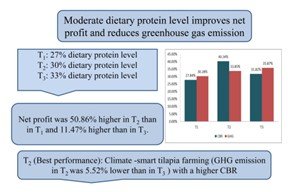
The present experiment was carried out to study the water quality, production, economics and greenhouse gas emissions under different dietary protein levels in tilapia (Oreochromis mosssambicus) farming pond. The experiment was carried out using three treatments with varying dietary protein levels viz. T1: 27%; T2: 30% and T3: 33%, each with two replications. Tilapia stocking density (49400 individuals/ha) was similar across the treatments. Water quality was monitored fortnightly and calculated values of temperature, transparency, DO, CO2, pH, alkalinity, ammonia-nitrogen and TDS were recorded as 29.30±0.28 to 29.65±0.49oC, 29.37±1.22 to 34.70±2.54 cm, 4.98±0.17 to 6.17± 0.03 mg/L, 4.54±0.02 to 5.64±0.24 mg/L, 5.35±0.28 to 6.55±0.07, 86.25±3.81 to 97.77±2.51 mg/L, 0.10±0.01 to 0.35±0.07 mg/L and 522.82± 10.85 to 563.43±2.92 mg/L, respectively. The average measurement of weight gain, SGR, survival rate, FCR and yield of tilapia varied from 172.34 ±2.81 to 227.55 ±2.84 g, 1.25±0.01 to 1.34 ±0.11 % bwd-1, 78.00 ± 5.35 to 87.00 ±7.07 %, and 1.68±0.04 to 1.89±0.05 and 8062.08 ±70.72 to 9517.40±63.58 Kg/ha/6months, respectively. The mean values of net profit (BDT/ha), CBR and greenhouse gas emission (CO2e Kg/ha/year) were 320892.91±2474.68 to 484099.20±565.60, 0.49±0.00 to 0.71±0.00 and 7.20±0.12 to 8.52±0.04. Fish yield varied from 16124.16±49.41 (T1) to 19034.80±116.88 (T3) kg/ha/year. Greenhouse gas emission was found significantly (p<0.05) highest in the treatment T3, while net benefit and CBR were observed significantly (p<0.05) highest in the treatment T2. Thus, dietary protein level significantly influences water quality, fish growth, net profit and greenhouse gas emission in pond raised with tilapia (O. mossambicus).Downloads
References
Ahsan, M.E., Wahab, M.A, Siddik, M.A., Alam, M. A., Sharker, M. R., & Nahar, A. (2013). Impact of inclusion of column feeder rohu (Labeo rohita) at different stocking densities on growth and production in freshwater prawn finfish polyculture system. International Journal of Biological Science, 1(2), 48-54.
Ali, A., Al-Ogaily, S.M. Al-asgah, N.A., Goddard, J.S., & Ahmed, S.I. (2008). Effect of feeding different protein to energy ratios on the growth performance and body composiotion of Oreochromis niloticus fingerlings. Journal of Applied Ichthyology, 24, 32-37. https://doi.org/10.1111/j.1439-0426.2007.00897.x
Ali, A., Rahman, M. R., Alam, M. J., Nishat, A. A., Rabbi, M. F., Haque, M. A., & Ullah, M. A. (2018). Production of stinging catfish (Heteropneustes fossilis) in different stocking densities with GIFT (Oreochromis niloticus) and Thai Sharpunti (Barbonymus gonionotus) in ponds. Journal of Fisheries and Life Science, 3(1), 9-15.
Begum, A., Mondal, S., Ferdous, Z., Zafar, M. A., & Ali, M. M. (2014). Impact of water quality parameters on monosex tilapia (Oreochromis niloticus) production under pond condition. International Journal of Animal and Fisheries Science, 2(1), 14-21.
Boyd, C. E. (1998). Water quality for fish pond. Aquaculture Research and Development Series No. 43. Aburn University, Alabama, USA, pp 39.
Carneiro, W.F., Colpini, L.M.S., Souza, R.C.T., Bombardelli, R.A., Balen, R.E., & Meurer, F. (2020). Effect of the digestible protein-energy relationship on the growth performance of Nile tilapia (Oreochromis niliticus) fed fishmeal –free diets. Animal Feed Science and Technology, 262, 379. https://doi.org/10.1016/j.anifeedsci.2019.114379
Cho, C. Y., & Kaushik, S.J. (1985). Effect of protein intake on metabolism and net energy values of fish diets. Nutrition and Feeding in Fish. Academic press, London, 96-117pp.
Datta, A., Nayak, D. R., Sinhababu, D. P., & Adhya, T. K. (2009). Methane and nitrous oxide emissions from an integrated rainfed rice–fish farming system of Eastern India. Agriculture, Ecosystems and Environment, 129(1-3), 228-237. https://doi.org/10.1016/j.agee.2008.09.003
DoF (Department of Fisheries). (2024). National Fish week 2024.Copendium (in Bangla). Department of Fisheries, Ministry of Fisheries and Livestock, Bangladesh. pp 160.
Fang, Y., Hu, Z., Zou, Y., Fan, J., Wang, Q., & Zhu, Z. (2017). Increasing economic and environmental benefits of media-based aquaponics through optimizing aeration pattern. Journal of Cleaner Production, 162, 1111-1117. https://doi.org/10.1016/j.jclepro.2017.06.158
FAO (Food and Agricultural Organization). (2014). World Review of Fisheries and Aquaculture, Rome, 224p.
FAO (Food and Agricultural Organization). (2024). The state of World Fisheries and Aquaculture, Rome, 216p.
Green, B.W., Nagdy, E.L., & Hebicha, H. (2002). Evaluation of Nile tilapia pond management strategies in Egypt. Aquaculture Research, 33(13), 1037-1048. https://doi.org/10.1046/j.1365-2109.2002.00767.x
Hu, Z., Lee, J.W., Chandran, K., Kim, S., & Khanal, S.K. (2012). Nitrous oxide (N2O) emission from aquaculture: a review. Environmental Science and Technology, 46(12), 6470-6480.
Islam, M. M., Kundu, G. K., & Khan, M. I. (2020). Aquaculture: a faster growing greenhouse gas emission sector in Bangladesh. Journal of Ecology and Development, 35(3), 1-15. http://www.ceser.in/ceserp/index.php/ijed/issue/archive
Kais, S. M., & Islam, M. S. (2018). Impacts of and resilience to climate change at the bottom of the shrimp commodity chain in Bangladesh: A preliminary investigation. Aquaculture, 493, 406-415. https://doi.org/10.1016/j.aquaculture.2017.05.024
Kohinoor, A.H.M., Sultana, R., Islam, M.S., Mazid, M.A., & Hossain, M.G. (1997). Comparative studies on growth of fry of GIFT and existing strain of Nile tilapia. Bangladesh Journal of Fisheries Research, 1(1), 25-30.
Kohinoor, A.H.M., Wahab, M.A., Islam, M.L., & Thilsted, S.H. (2001). Culture potential of mola, Amblypharyngodon mola; chela, Chela cachius; and punti, Puntiussophore under monoculture system. Bangladesh Journal of Fisheries Research, 5(2), 123-134.
Kumar, N., Ojha, M. L., Sharma, B. K., Sharma, S. K., & Meena, N. L. (2023). Assessment of water quality parameters when Nile tilapia (Oreochromis niloticus) fingerlings fed with Tulsi (Ocimum sanctum). The Pharma Innovation Journal, 12(5), 3903-3908.
Lesschen, J. P., van den Berg, M., Westhoek, H. J., Witzke, H. P., & Oenema, O. (2011). Greenhouse gas emission profiles of European livestock sectors. Animal Feed Science and Technology, 166, 16-28. https://doi.org/10.1016/j.anifeedsci.2011.04.058
Liu, L., Hu, Z., Dai, X., & Avnimelech, Y. (2014). Effects of addition of maize starch on the yield, water quality and formation of bioflocs in an integrated shrimp culture system. Aquaculture, 418, 79-86. https://doi.org/10.1016/j.aquaculture.2013.10.005
Mahmud, M. T., Rahman, M. M., Shathi, A. A., Rahman, M. H., & Islam, M. S. (2021). Growth variation of tilapia (Oreochromis niloticus) with variation of environmental parameters. Journal of Agriculture, Food and Environment, 2(2), 75-79. https://doi.org/10.47440/JAFE.2021.2213
Majumder, T. H., Chowdhury, P., Shahjahan, M., & Rahman, M. G. (2017). Effects of population density on growth and production of tilapia in monoculture. International Journal of Agricultural Research, Innovation and Technology, 7(2), 49-56. http://dx.doi.org/10.22004/ag.econ.305439
Milstein, A., Wahab, M. A., Kadir, A., Sagor, M.F.H., & Islam, M.A. (2009). Effects of Intervention in the water column and/or and bottom through species composition on polyculture of large carps and small indigenous species. Aquaculture, 286(3-4), 246-253. https://doi.org/10.1016/j.aquaculture.2008.09.036
Nabi, M. M., Halim, M. A., & Nahar, S. (2017). Study on production performance and economic of mono-sex tilapia culture at marginal farmer’s ponds in Gopalgonj, Bangladesh. International Journal of Fisheries and Aquatic Studies, 5(3), 104-108.
Nobre, A. M., Robertson-Andersson, D., Neori, A., & Sankar, K. (2010). Ecological–economic assessment of aquaculture options: comparison between abalone monoculture and integrated multi-trophic aquaculture of abalone and seaweeds. Aquaculture, 306(1), 116-126. https://doi.org/10.1016/j.aquaculture.2010.06.002
Ogola, M., Owiti, D. O., & Ominde, J. (2020). Growth performance of Nile tilapia (Oreochromis niloticus) fingerlings fed on soybean (Glycine max) compared to dagaa (Rastrineobola argentea) meal with diet supplement of maize bran. Journal of Fisheries Research,3(2), 15-21.
Pearce, W., Holmberg, K., Hellsten, I., &Nerlich, B. (2014). Climate change on Twitter: Topics, communities and conversations about the IPCC (Intergovernmental Panel on Climate Change) working group 1 report. PloS one, 9(4), e94785. https://doi.org/10.1371/journal.pone.0094785
Rahman, M. M., Mondal, D. K., Amin, M. R., & Muktadir, M. G. (2016). Impact of stocking density on growth and production performance of monosex tilapia (Oreochromis niloticus) in ponds. Asian Journal of Medical and Biological Research, 2(3), 471-476. https://doi.org/10.3329/ajmbr.v2i3.30120
Ren, F., Zhang, X., Liu, J., Sun, N., Wu, L.Li.Z., & Xu, M. (2017). A systhematic analysis of greenhouse gas emission from manure amended agricultural soils in Chaina. Scientific Reports, 7(1), 8123.
Robb, D. H., MacLeod, M., Hasan, M. R., & Soto, D. (2017). Greenhouse gas emissions from aquaculture: a life cycle assessment of three Asian systems. FAO Fisheries and Aquaculture Technical Paper, 609, 1-92.
Satter, A., Islam, M. F., Rahman, M., & Rahman, R. (2019). Growth and Yield Performance of Tilapia (Oreochromis niloticus) and Indian Major Carps in Culture Condition. Journal of Veterinary Science and Technology, 8(2), 18-24.
Sharmin, F., Rahman, M. S., Shahjahan, M. and Chowdhury, P. (2019). Study of growth and productions of tilapia (Oreochromis niloticus) on different population densities in monoculture. International Journal of Agricultural Research, Innovation and Technology, 9(2), 76-83. http://dx.doi.org/10.22004/ag.econ.303819
Sinha, L., Singh, S., Jain, U. and Goya, N. 2015. A comparative assessment of water quality for Pithampur Industrial area, Indore, India. International Journal of scientific Research in Science, Engineering and Technology, 4(1), 388-395.
Talukdar, M.G. S., Mohsin, A. B. M., Hossain, M. A., & Khan, M. R. I. (2017). Optimization of stocking weight in carp polyculture ponds under drought prone Barind area of Bangladesh. Journal of Fisheries, 5(3), 519-524. http://dx.doi.org/10.17017/jfish.v5i3.2017.300
Uddin, M. S., Rahman, S. S., Azim, M. E., Wahab, M. A., Verdegem, M. J., & Verreth, J. A. (2007). Effects of stocking density on production and economics of Nile tilapia (Oreochromis niloticus) and freshwater prawn (Macrobrachim rosenbergii) polyculture in periphyton‐based systems. Aquaculture Research, 38(16), 1759-1769. https://doi.org/10.1111/j.1365-2109.2007.01837.x
Zhang, L., Wang, X., Huang, L., Wang, C., Gao, Y., Peng, S., & Piao, S. (2024). Inventory of methane and nitrous oxide emissions from freshwater aquaculture in China. Communications Earth and Environment, 5(1), 531.
Downloads
Published
How to Cite
Issue
Section
License
Copyright (c) 2026 Agriculture and Environmental Science Academy

This work is licensed under a Creative Commons Attribution-NonCommercial 4.0 International License.