Enhancing phosphorus bioavailability in rice bran and wheat bran through fermentation with rumen liquor
DOI:
https://doi.org/10.26832/24566632.2026.110305Keywords:
Broiler diets, Phytate phosphorus, Protein-rich feed, Rumen liquor, Wheat and rice branAbstract
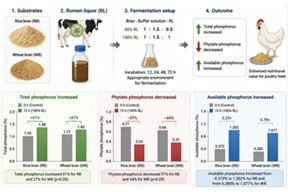
Rice bran (RB) and wheat bran (WB) are two agro-industrial by-products, generated during the processing of rice and wheat grain and are widely used as a poultry feed in many developing countries. However, their use in poultry diets is limited by their high fiber and presence of anti-nutritional factors, particularly phytate phosphorus, which reduces nutrient availability specially phosphorus. Therefore, this study aimed to reduce phytate phosphorus and increase available phosphorus content of RB and WB through fermentation with rumen liquor (RL). Fermentation was carried out by mixing bran with buffer solution, and diluted RL at ratios of 1:1.5:0.5 and 1:1.5:1 corresponding to 50% and 100% RL inclusion levels, respectively for 12, 24, 48 and 72 h with maintaining an appropriate environment for fermentation. The best result was obtained after 48 h and 72 h fermentation for both 50% and 100% RL. Total phosphorus increased 41% for RB and 27% for WB after 72 h with 100% RL (p<0.05). However, after 12 h of fermentation, phytate phosphorus started to reduce with increasing fermentation duration, and it was decreased 57% for RB and 44% for WB after 72 h with 100% RL (p<0.05). The available phosphorus level was also increased from 0.372% to 1.202% for RB and from 0.285% to 1.077% for WB after 72 h with 100% RL. Phytate phosphorus decreased, while available phosphorus increased with increasing fermentation time (p<0.05). These improvements enhance the nutritional value of RB and WB, making them more suitable and potentially cost-effective ingredients for poultry feed.Downloads
References
Abbasi, F., Fakhur-Un-Nisa, T., Liu, J., Luo, X., & Abbasi, I. H. R. (2019). Low digestibility of phytate phosphorus, their impacts on the environment, and phytase opportunity in the poultry industry. Environmental Science and Pollution Research, 26(10), 9469–9479. https://doi.org/10.1007/s11356-018-4000-0
Bodie, A. R., Micciche, A. C., Atungulu, G. G., Rothrock, M. J., & Ricke, S. C. (2019). Current trends of rice milling byproducts for agricultural applications and alternative food production systems. Frontiers in Sustainable Food Systems, 3, Article 47. https://doi.org/10.3389/fsufs.2019.00047
Bohn, L., Meyer, A. S., & Rasmussen, S. K. (2008). Phytate: Impact on environment and human nutrition. A challenge for molecular breeding. Journal of Zhejiang University Science B, 9(3), 165–191. https://doi.org/10.1631/jzus.B0710640
Bravo, D., Meschy, F., Bogaert, C., & Sauvant, D. (2000). Ruminal phosphorus availability from several feedstuffs measured by the nylon bag technique. Reproduction Nutrition Development, 40(2), 149–162. https://doi.org/10.1051/rnd:2000126
Carlson, D., & Poulsen, H. D. (2003). Phytate degradation in soaked and fermented liquid feed—Effect of diet, time of soaking, heat treatment, phytase activity, pH and temperature. Animal Feed Science and Technology, 103(1), 141–154. https://doi.org/10.1016/S0377-8401(02)00288-2
Chen, M. H., Choi, S. H., Kozukue, N., Kim, H. J., & Friedman, M. (2012). Growth-inhibitory effects of pigmented rice bran extracts and three red bran fractions against human cancer cells: Relationships with composition and antioxidative activities. Journal of Agricultural and Food Chemistry, 60(36), 9151–9161. https://doi.org/10.1021/jf3025453
Chowdhury, R., Mamun, M., Rahman, M., & Hoque, A. (2022). Phosphorus availability in broilers given phosphorus deficient diets containing phytase with and without citric acid. Journal of Bangladesh Agricultural University, 20, 1. https://doi.org/10.5455/JBAU.50128
Debi, M. R., & Ivy, M. B. K. (2024). A review of the effects of using fermented agro-industrial byproducts for non-ruminants. Bangladesh Journal of Animal Science, 53(4), 121–134. https://doi.org/10.3329/bjas.v53i4.78845
Debi, M. R., Islam, K. M. S., & Saha, B. K. (2024). Fermentation time and environmental conditions changes nutritional composition of fermented rice and wheat bran. Indian Journal of Animal Nutrition, 41(3). https://epubs.icar.org.in/index.php/IJAN/article/view/150698
Debi, M. R., Wichert, B. A., & Liesegang, A. (2019). Method development to reduce the fiber content of wheat bran and rice bran through anaerobic fermentation with rumen liquor for use in poultry feed. Asian-Australasian Journal of Animal Sciences, 32(3), 395–404. https://doi.org/10.5713/ajas.18.0446
Debi, M. R., Wichert, B. A., & Liesegang, A. (2022a). Anaerobic fermentation of rice bran with rumen liquor for reducing their fiber components to use as chicken feed. Heliyon, 8(4), e09275. https://doi.org/10.1016/j.heliyon.2022.e09275
Debi, M. R., Wichert, B. A., Wolf, P., & Liesegang, A. (2022b). Effect of a two-step fermentation method with rumen liquor on protein quality of wheat bran and rice bran to use as poultry feed. Heliyon, 8(12), e11921. https://doi.org/10.1016/j.heliyon.2022.e11921
DePeters, E. J., & George, L. W. (2014). Rumen transfaunation. Immunology Letters, 162(2, Part A), 69–76. https://doi.org/10.1016/j.imlet.2014.05.009
Dersjant-Li, Y., Awati, A., Schulze, H., & Partridge, G. (2015). Phytase in non-ruminant animal nutrition: A critical review on phytase activities in the gastrointestinal tract and influencing factors. Journal of the Science of Food and Agriculture, 95(5), 878–896. https://doi.org/10.1002/jsfa.6998
Durand, M., & Komisarczuk, S. (1988). Influence of major minerals on rumen microbiota. The Journal of Nutrition, 118(2), 249–260. https://doi.org/10.1093/jn/118.2.249
Ellis, L. C., & Tillman, A. D. (1961). Utilization of phytin phosphorus in wheat bran by sheep. Journal of Animal Science, 20(3), 606–607. https://doi.org/10.2527/jas1961.203606x
Fiske, C. H., & Subbarow, Y. (1925). The colorimetric determination of phosphorous. Journal of Biological Chemistry, 66(2), 375–400. https://doi.org/10.1016/S0021-9258(18)84756-1
Gupta, R. K., Gangoliya, S. S., & Singh, N. K. (2015). Reduction of phytic acid and enhancement of bioavailable micronutrients in food grains. Journal of Food Science and Technology, 52(2), 676–684. https://doi.org/10.1007/s13197-013-0978-y
Haese, E., Lengowski, M., Gräter, E., Föll, A., Möhring, J., Steingass, H., Schollenberger, M., & Rodehutscord, M. (2017). Ruminal phytate degradation of maize grain and rapeseed meal in vitro and as affected by phytate content in donor animal diets and inorganic phosphorus in the buffer. Journal of Animal Physiology and Animal Nutrition, 101(5), 868–880. https://doi.org/10.1111/jpn.12500
Haese, E., Müller, K., Steingass, H., Schollenberger, M., & Rodehutscord, M. (2014). Effects of mineral and rapeseed phosphorus supplementation on phytate degradation in dairy cows. Archives of Animal Nutrition, 68(6), 478–491. https://doi.org/10.1080/1745039X.2014.968702
Islam, K. M. S., Elsabagh, M., Lv, R., Dang, H. L., Sugino, T., & Obitsu, T. (2022). Anaerobic fermentation of rice bran using rumen liquor for desirable chemical changes as animal feed. Journal of Advanced Veterinary and Animal Research, 9(4), 728–735. https://doi.org/10.5455/javar.2022.i642
Kang, H. K., Kim, J. H., & Kim, C. H. (2015). Effect of dietary supplementation with fermented rice bran on the growth performance, blood parameters and intestinal microflora of broiler chickens. European Poultry Science, 79, 1–11. https://doi.org/10.1399/eps.2015.112
Krás, R., Kessler, A., Ribeiro, A. M. L., Henn, J., Santos, II, Halfen, D., & Bockor, L. (2013). Effect of dietary fiber and genetic strain on the performance and energy balance of broiler chickens. Revista Brasileira de Ciência Avícola, 15, 15–19. https://doi.org/10.1590/S1516-635X2013000100003
McDougall, E. I. (1948). The composition and output of sheep's saliva. Biochemical Journal, 43(1), 99–109.
Navales, R. A. S., Tokach, M. D., DeRouchey, J. M., Gaffield, K. N., Woodworth, J. C., Goodband, R. D., Gebhardt, J. T., Euken, R. M., & Dekkers, J. C. M. (2025). Technologies and practices to improve feed and nutrient utilization by pigs. Journal of Animal Science, 103. https://doi.org/10.1093/jas/skaf043
Pujaningsih, R. (2004). Fermentation of rice bran to increase phosphorous availability by using rumen liquor. Journal of Agriculture and Rural Development in the Tropics and Subtropics, Supplement, 334–341.
Ravindran, V. (1995). Phytases in poultry nutrition: An overview. Proceedings of the Australian Poultry Science Symposium, 7, 135–139.
Satinder, K., Sharma, S. S., & Nagi, H. (2011). Functional properties and anti-nutritional factors in cereal bran. Asian Journal of Food and Agro-Industry, 4(2), 122–131.
Sechler, S. R., Mullenix, M. K., Holland, C. M., & Muntifering, R. B. (2017). Fiber digestion kinetics and protein degradability characteristics of stockpiled Tifton 85 bermudagrass. Journal of Animal Science, 95(9), 3922–3931. https://doi.org/10.2527/jas2017.1600
Shen, J., Liu, Z., Yu, Z., & Zhu, W. (2017). Monensin and nisin affect rumen fermentation and microbiota differently in vitro. Frontiers in Microbiology, 8, Article 1111. https://doi.org/10.3389/fmicb.2017.01111
Steiner, T., Mosenthin, R., Zimmermann, B., Greiner, R., & Roth, S. (2007). Distribution of phytase activity, total phosphorus and phytate phosphorus in legume seeds, cereals and cereal by-products as influenced by harvest year and cultivar. Animal Feed Science and Technology, 133(3), 320–334. https://doi.org/10.1016/j.anifeedsci.2006.04.007
Weiss, C. P., Gentry, W. W., Cole, N. A., McCollum, F. T., & Jennings, J. S. (2017). Effects of feeding condensed distiller's solubles and crude glycerin alone or in combination on finishing beef cattle performance, carcass characteristics, and in vitro fermentation. Journal of Animal Science, 95(2), 922–929. https://doi.org/10.2527/jas.2016.0941
Woyengo, T. A., & Nyachoti, C. M. (2013). Review: Anti-nutritional effects of phytic acid in diets for pigs and poultry—Current knowledge and directions for future research. Canadian Journal of Animal Science, 93(1), 9–21. https://doi.org/10.4141/cjas2012-017
Xia, N., Wang, J., Yang, X., Yin, S., Qi, J., Hu, L., & Zhou, X. (2012). Preparation and characterization of protein from heat-stabilized rice bran using hydrothermal cooking combined with amylase pretreatment. Journal of Food Engineering, 110(1), 95–101. https://doi.org/10.1016/j.jfoodeng.2011.12.004
Downloads
Published
How to Cite
Issue
Section
License
Copyright (c) 2026 Agriculture and Environmental Science Academy

This work is licensed under a Creative Commons Attribution-NonCommercial 4.0 International License.