Role of credit in mechanization of paddy production in a selected area of Bangladesh
DOI:
https://doi.org/10.26832/24566632.2026.110306Keywords:
Adoption, Bangladesh, Credit, Mechanization, Paddy productionAbstract
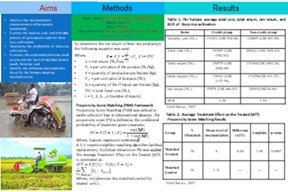
Agricultural credit plays an important role in facilitating the adoption of mechanized technologies and improving the productivity of paddy farming in Bangladesh. This study examined the socioeconomic characteristics of Boro rice farmers, assessed credit sources and farm profitability, estimated the impact of agricultural credit on the level of mechanization, and identified the major constraints to mechanization in Mymensingh district, Bangladesh. Primary data were collected through a field survey using a semi-structured interview schedule from 80 Boro rice farmers, comprising 40 credit recipients and 40 non-credit farmers. Descriptive statistics, profitability analysis, and Propensity Score Matching (PSM) were employed to analyze the data. The results showed that NGOs were the principal source of agricultural credit (60%), with most farmers receiving loans ranging from Tk. 30,000 (US$245.28) to Tk. 50,000 (US$408.80). Boro rice cultivation was profitable for both groups; however, credit recipients achieved higher net returns and benefit–cost ratios than non-credit farmers. The PSM analysis demonstrated that agricultural credit had a positive and statistically significant effect on farm mechanization. Credit recipients achieved a mean mechanization score of 4.00 compared with 3.32 for matched non-credit farmers, resulting in an Average Treatment Effect on the Treated (ATT) of 0.68. Despite these benefits, farmers faced several problems and constraints in adopting mechanization including complex bureaucratic procedures for credit, lack of collateral and high machinery prices. The findings highlight the simplification of the loan application procedures, machinery subsidies and the expansion of extension services to accelerate mechanization and promote sustainable Boro rice production in Bangladesh.Downloads
References
ACIAR (2025). Annual Operational Plan 2024–25: Bangladesh. Australian Centre for International Agricultural Research. Accessed on 30 June 2026 at https://www.aciar.gov.au/sites/default/files/
Adesiyan, T. (2025). Leveraging Agricultural Credit and Digital Finance for Enhancing Smallholder Productivity and Rural Economic Growth. International Journal of Research Publication and Reviews, 6(8), 642-667. https://doi.org/10.55248/gengpi.6.0825.3090.
Ahammad, S., Kazal, M., Sultana, M., & Sujan, M. (2025). Technical efficiency of combine harvester user boro rice farmers in Haor ecosystem of Bangladesh. Discover Agriculture, 3(1). https://doi.org/10.1007/s44279-025-00213-8.
Ahmed, J. U., Kashem, M. A., Abedien, M. J., Ahamed, T., Jannat, A., & Islam, M. M. (2025). Socio-ecological factors influencing Boro rice yield and profitability in wetland areas of Bangladesh: An integrated assessment. Scientific Reports, 15, Article 1220. https://doi.org/10.1038/s41598-024-81620-6.
Austin, P. C. (2009). Balance diagnostics for comparing the distribution of baseline covariates between treatment groups in propensity-score matched samples. Statistics in Medicine, 28(25), 3083-3107. https://doi.org/10.1002/sim.3697.
Banik, S., Rahman, M. S., & Islam, M. T. (2026). Determinants of modern agricultural machinery adoption in northern Bangladesh: A multivariate probit analysis. Sustainable Futures, 10, 100459. https://doi.org/10.1016/j.sftr.2025.100459.
Caliendo, M., & Kopeinig, S. (2008). Some practical guidance for the implementation of propensity score matching. Journal of Economic Surveys, 22(1), 31-72. https://doi.org/10.1111/j.1467-6419.2007.00527.x.
FAO (2025). Global Information and Early Warning System (GIEWS): Bangladesh Country Report. Rome: Food and Agriculture Organization of the United Nations.
FICCI (2024). Sustainable Agriculture and Climate Resilient Practices in Bangladesh. FICCI Monthly Bulletin, November 2024. Dhaka: Foreign Investors' Chamber of Commerce & Industry.
Gebiso, T., Ketema, M., Shumetie, A., & Feye, G. L. (2024). Impact of farm mechanization on crop productivity and economic efficiency in central and southern Oromia, Ethiopia. Frontiers in Sustainable Food Systems, 8. https://doi.org/10.3389/fsufs.2024.1414912.
Islam, A. K. M. S. (2020). Mechanized cultivation increases labour efficiency. Bangladesh Rice Journal, 24(2), 49-66. https://doi.org/10.3329/brj.v24i2.53448.
Islam, M. A., Pariyar, S., Krupnik, T. J., & Becker, M. (2024). Changing trends in crop management practices and performance attributes of rice-based systems of coastal Bangladesh. Frontiers in Agronomy, 6. https://doi.org/10.3389/fagro.2024.1397474.
Jamal, M. R., Kristiansen, P., Kabir, M. J., & de Bruyn, L. L. (2023). Challenges and adaptations for resilient rice production under changing environments in Bangladesh. Land, 12(6). https://doi.org/10.3390/land12061217.
Karim, M.A., Shamma, R., Bakhtiar, M.M., Belton, B., Kishore, A., & Ahmed, A. (2026). Mechanizing agriculture in Bangladesh: Trends, challenges, and policy priorities', in Ma, W., Rahut, D.B. and Sonobe, T. (eds.) Transforming Smallholder Agriculture Through Mechanization in Asia, Volume 1: Pathways and Policies. Chapter 1.
Moazzem, K.G., Rahman, M.M., & Chowdhury, T.A. (2025). Access to Finance for Agricultural Mechanization in Bangladesh: Explaining Alternative Financial Instruments. Dhaka: Centre for Policy Dialogue (CPD).
Peng, J., Zhao, Z., & Liu, D. (2022). Impact of agricultural mechanization on agricultural production, income, and mechanism: Evidence from Hubei Province, China. Frontiers in Environmental Science, 10. https://doi.org/10.3389/fenvs.2022.838686.
Rahman, M. S., Sujan, M. H. K., Alam, S., & Kabir, M. (2021). Adoption and dis-adoption of farm mechanization in Bangladesh: Case of rice-wheat thresher. Emirates Journal of Food and Agriculture, 33(12), 1000-1007. https://doi.org/10.9755/ejfa.2021.v33.i12.2794.
Rayhan, S. J., Rahman, M. S., & Lyu, K. (2023). The role of rural credit in agricultural technology adoption: The case of Boro rice farming in Bangladesh. Agriculture, 13(11), 2144. https://doi.org/10.3390/agriculture13112144.
Rayhan, S. J., Rahman, M. S., & Lyu, K. (2024). Increasing Boro rice productivity through credit: Evidence from Bangladesh. Agricultural Economics – Czech, 70(2), 49-59. https://doi.org/10.17221/341/2023-AGRICECON.
Rosenbaum, P. R., & Rubin, D. B. (1983). The central role of the propensity score in observational studies for causal effects. Biometrika, 70(1), 41-55. https://doi.org/10.1093/biomet/70.1.41.
Salam, M. A., & Sarker, M. N. I. (2023). Impact of hybrid variety adoption on the performance of rice farms in Bangladesh: A propensity score matching approach. World Development Sustainability, 2, 100042. https://doi.org/10.1016/j.wds.2023.100042.
Sarker, M. R., Galdos, M. V., Challinor, A. J., & Hossain, A. (2021). A farming system typology for the adoption of new technology in Bangladesh. Food and Energy Security, 10(3), e287. https://doi.org/10.1002/fes3.287.
Sujan, M. H. K., Sarker, M. R., Sarkar, M. A. R., Sultana, M., Rahman, M. S., Ahammad, S., & Khan, M. (2025). Harnessing rice combine harvester adoption for sustainable agriculture in the Haor (wetland) ecosystem of Bangladesh. Australian Journal of Agricultural and Resource Economics. https://doi.org/10.1111/1467-8489.70055.
Yasar, H., Raza, M. H., Faisal, M., Nadeem, N., Khan, N., Kassem, H. S., & Mahmood, S. (2024). Does farm mechanization improve farm performance and ensure food availability at household level? Empirical evidence from Pakistan. Frontiers in Sustainable Food Systems, 8. https://doi.org/10.3389/fsufs.2024.1453221.
Yeasmin, R., Ahmad, B., Khanom, S., Hossain, M. S., Uddin, M. M., Selim, S., Hossain, A., & Sohag, A. (2025). Agricultural finance dynamics in Bangladesh: Exploring factors influencing rice yield and farmers'' access to credit. International Journal of Sustainable Agricultural Management and Informatics, 11(4), 402-427. https://doi.org/10.1504/IJSAMI.2025.149225.
Downloads
Published
How to Cite
Issue
Section
License
Copyright (c) 2026 Agriculture and Environmental Science Academy

This work is licensed under a Creative Commons Attribution-NonCommercial 4.0 International License.