Influence of different spacing regimes on growth and productivity of BARI tomato-2
DOI:
https://doi.org/10.26832/24566632.2025.1003013%20Keywords:
Biological yield, Productive branch, Spacing, TomatoAbstract
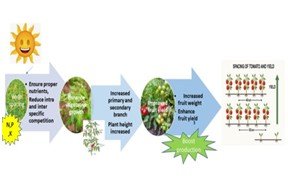
Tomato (Solanum lycopersicum L.) is a widely cultivated vegetable crop whose productivity is strongly influenced by its spacing and plant population. A field experiment was conducted at Rajshahi region during December,2024 to April, 2025 to evaluate the effect of different plant spacing’s (D1=40 × 45 cm, D2=50 × 45 cm, and D3=60 × 45 cm) on the growth and yield of tomato (BARI Tomato -2). The experiment was laid out in a randomized complete block design (RCBD) with three replications. Healthy seedlings of BARI Tomato-2 were transplanted in well-prepared plots according to the assigned spacing treatments. Results revealed that wider spacing (D3) significantly enhanced vegetative and reproductive parameters compared to narrower spacings. Plants at D3 cm attained the greatest height, which was 72% higher than those grown at D1 cm. This spacing produced a higher number of primary (24%) and productive branches (62%) compared to D1. Furthermore, proper spacing provides more fruit weight, more fruits per plant (25% more than D1) and increased biological yield (4.3 tha1) compared to closed spacing. Consequently, D3 spacing achieved the highest yield (38%) per hectare, which was 26% higher than D1. Thus, adopting an appropriate spacing (both inter and intra row) regime, particularly D3 is crucial for maximizing tomato growth and yield.
Downloads
References
Aamare, G., & Gebremedhin, H. (2020). Effect of plant spacing on yield and yield components of tomato (Solanum lycopersicum L.) in Shewarobit, Central Ethiopia. Scientifica, 2020(1), 8357237. https://doi.org/10.1155/2020/8357237
Agele, S. O., Iremiren, G. O., & Ojeniyi, S.O. (1999). Effects of plant density and mulching on the performance of late-season tomato (Lycopersicon esculentum) in southern Nigeria, The Journal of Agricultural Science, 133(4), 397–402.
Abriham, A., & Kefale, D. H. (2020). Effect of intra-row spacing on plant growth, yield and quality of tomato (Lycopersicon esculentum mill) varieties at mizan-aman, southwestern Ethiopia. International Journal of Agricultural Extension, 8(1), 33-42. https://doi.org/10.33687/ijae.008.01.3093
Amundson, S., Deyton, D. E., Kopsell, D. A., Hitch, W., Moore, A., & Sams, C. E. (2012). Optimizing plant density and production systems to maximize yield of greenhouse-grown ‘trust’ tomatoes. HortTechnology, 22(1), 44–48. https://doi.org/10.21273/HORTTECH.22.1.44
Ayarna, A.W., Tsukagoshi, S., Nkansah, G.O., & Maeda, K. (2021) Effect of plant density on the yield of hydroponically grown heat tolerant tomato under summer temperature conditions. American Journal of Plant Sciences, 12, 901-913. https://doi.org/10.4236/ Ajps.2021.126060
Bhandari, H. R., Srivastava, K., Tripathi, M. K., & Chaudhary, B. (2021). Genotype–environment interaction for quality traits in tomato hybrids. Agriculture Research, 11, 382–389. https://doi.org/10.1007/s40003-021-00579-3
Bertin, N., Borel, C., Brunel, B., Cheniclet, C., & Causse, M. (2003). Plant density and fruit load affect growth and dry matter allocation in tomato genotypes. Scientia Horticulturae, 95(1–2), 23–35. https://doi.org/10.1016/S0304-4238(02)00183-5
BBS, Bangladesh Bureau of Statistics. (2022). Yearbook of Agricultural Statistics 2022. Ministry of Planning, Government of the People’s Republic of Bangladesh. Retrieved from http://www.bbs.gov.bd
Chernet, S., Belay, F., Tekle, G., Kahsay, Y., Weldu, N., & Zerabruk, G. (2017). Response of yield and yield components of tomato (Solanum lycopersicon L.) to different inter- and intra-row spacing at Merebleke, Northern Ethiopia. African Journal of Agricultural Research, 12(33), 2614–2619. https://doi.org/10.5897/ajar2016.11116
Eltez, R. Z., Gubbuk, H., & Demir, A. (2002). Plant density and its effect on yield and quality of processing tomato. Acta Horticulturae, 613, 133–137. https://doi.org/10.17660/ActaHortic.2002.613.20
Hossain, Md., Ali, Md., Ripa, R., Subrina, A., & Shareef, M. (2019). Influence of rootstocks on yield and quality of summer tomato cv. ‘BARI tomato 4’. Earth System and Environment, 3. https://doi.org/10.1007/s41748-019-00101-4
Irin, I. J., Paul, S. K., Dhungana, L., & Rani, S. (2024). Optimizing soil quality and mustard (Brassica juncea) yield through spacing and sesbania incorporation. Archives of Agriculture and Environmental Science, 10(1), 81–86. https://doi.org/10.26832/24566632.2025.1001012
Islam, M. R., Hoque, M. A., & Rahman, M. M. (2011). Effect of spacing on the growth and yield of tomato. Bangladesh Journal of Agricultural Research, 36(3), 495–505. https://doi.org/10.3329/bjar.v36i3.9276
Nkansah, G. O., Amoatey, C., Zogli, M. K., Nketia, S. O., Ofori, P. A., & Agyemang, F. O. (2021). Influence of topping and spacing on growth, yield, and fruit quality of tomato (Solanum lycopersicum L.) under greenhouse condition. Frontiers in Sustainable Food System, 5. https://doi.org/10.3389/fsufs.2021.659047
Patil, B. C., Chimmad, V. P., & Hiremath, S. M. (2018). Influence of plant spacing on yield and quality of tomato. International Journal of Current Microbiology and Applied Sciences, 7(1), 1214–1220. https://doi.org/10.4314/agrosh.v19i1.4
Rahman, M. A., Uddin, M. N., & Hossain, M. S. (2013). Evaluation of growth and yield performance of important tomato varieties released by Bangladesh
Agricultural Research Institute. Bangladesh Journal of Agricultural Research, 38(1), 71–80. https://doi.org/10.3329/bjar.v38i1.15102
Rahman, M. S., & Acharjee, D. (2020). Impact of off-season summer tomato cultivation on income and food security of the growers. In book: Agricultural Economics Publisher: Intech Open, UK. https://doi.org/10.5772/intechopen.93674
Song, Z., Guo, Y., Guo, W., Zhao, H., Liu, J., & Li, G. (2024). Effects of planting density on growth, photosynthetic capacity, and fruit yield of tomato under greenhouse conditions. Frontiers in Plant Science, 15, 1386950. https://doi.org/10.3389/fpls.2024.1386950
Downloads
Published
How to Cite
Issue
Section
License
Copyright (c) 2025 Agriculture and Environmental Science Academy

This work is licensed under a Creative Commons Attribution-NonCommercial 4.0 International License.