Evaluation of ground water quality of Saharanpur constituency in Uttar Pradesh, India
DOI:
https://doi.org/10.26832/24566632.2026.110205Keywords:
Correlation, Industrialisation, Regression, Urbanisation, Water qualityAbstract
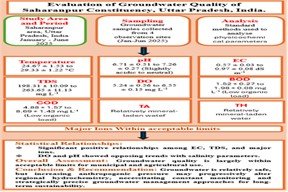
This study was conducted to evaluate the groundwater quality at designated sites in the Saharanpur area of Uttar Pradesh, India, focusing on key physicochemical attributes and their statistical relationships. Water samples were collected from four sites and analysed using standard assessment methods. The parameters measured included temperature, pH, electrical conductivity (EC), total dissolved solids (TDS), dissolved oxygen (DO), biochemical oxygen demand (BOD), chemical oxygen demand (COD), total alkalinity (TA), total hardness (TH), and major ions. The results showed that groundwater quality was largely within acceptable limits for municipal and agricultural use. Temperature ranged from 24.67±1.53 to 29.33±1.22°C, and pH values varied between 6.71±0.51 to 7.26±0.27, indicating a slightly acidic to neutral nature EC and TDS levels ranged from 0.57±0.03 to 0.97±0.08 dS m-¹ and 198.31±10.09 to 263.65±11.13 mg L-¹, respectively, reflecting low salinity. DO values ranged from 5.24±0.56 to 6.55±0.15 mg L-¹, while BOD (1.52±0.27–1.98±0.08 mg L-¹) and COD (4.88±1.57–8.69±1.43 mg L-¹) indicated limited organic load. TA and TH suggested the water was relatively mineral-rich. Statistical analysis revealed significant positive relationships among EC, TDS, and major ions, whereas DO and pH showed opposite trends with salinity parameters. The study highlights that although groundwater quality is currently safe, increasing human-induced stress may progressively alter regional hydrochemistry, necessitating continuous monitoring and well-planned groundwater management strategies for long-term sustainability.Downloads
References
Ali, S., Verma, S., Agarwal, M.B., et al. (2024). Groundwater quality assessment using water quality index and principal component analysis in the Achnera block, Agra district, Uttar Pradesh, Northern India. Scientific Reports, 14, 5381. https://doi.org/10.1038/s41598-024-56056-8
APHA. (2023). Standard methods for the examination of water and wastewater (23rd ed.). American Public Health Association, Washington, DC.
Badar, M.S., Ali, S., Daniyal, Akram, M.W., Faheem, K., Khan, S.U., & Farooqi, I.H. (2024). GIS-based assessment of groundwater vulnerability to heavy metal contamination via water quality pollution indices in urban Aligarh, India. Water Practice and Technology, 19(2), 419–434. https://doi.org/10.2166/wpt.2024.019
Bano, N., Shamim, S. K., Alam, M., Khalid, W., & Ahmad, A. (2026). Spatial distribution of groundwater quality from excellent to unsuitable conditions in rapidly urbanizing Firozabad city of India. Sustainable Cities and Society: Advances, 2(1), 100028. https://doi.org/10.1016/j.scsadv.2026.100028N
Belal, A.A., Belal, A., Lingala, K., & Viswanath, R. (2024). Estimation of hardness level and total dissolved solids in groundwater at Shendi Town, River Nile State, Sudan. Applied Sciences Research Periodicals, 2(4), 21–29. https://doi.org/10.63002/asrp.24.442
BIS. (2012). Drinking water standards. Bureau of Indian Standards. https://www.bis.org.in
Bhattarai, N., Lobell, D.B., Singh, B., Fishman, R., Pokhrel, Y., & Jain, M. (2023). Warming temperatures exacerbate groundwater depletion rates in India. Science Advances, 9(35), 1–9. https://doi.org/10.1126/sciadv.adi1401
Bhushan, C., Patel, A. P., Kumar, A., Pandey, V. K., Kumar, P. V., Kumar, P., & Tiwari, A. K. (2025). Hydrogeochemical characterisation and human health risk assessment of groundwater in Sultanpur District, Uttar Pradesh, India. Frontiers in Water, 7, 1639708. https://doi.org/10.3389/frwa.2025.1639708
Chaudhary, J. I., Ghate, S.R., Pawar, N. J., Gosavi, W. S., Chauhan, R., & Kale, S. S. (2025). Geochemical assessment of basaltic groundwater contamination in an industrial area: A case study of Ranjangaon MIDC, Maharashtra. Next Sustainability, 6, 100190. https://doi.org/10.1016/j.nxsust.2025.100190
Choden, Y., Badewa, G.K., Cheki, T., & Yangzom, K. (2020). Ground water quality index of Saharanpur city, India and its spatial representation using geographical information systems. International Journal on Emerging Technologies, 11(4), 157–162.
Crowther, J., Palu, A., Dunning, A., Weatherall, L., Spencer, W., Gala, D., Maganja, D., Kissock, K., Trieu, K., Young, S.L., McCausland, R., Leslie, G., & Webster, J. (2025). Global drinking water standards lack clear health-based limits for sodium. Nutrients, 17(13), 2190. https://doi.org/10.3390/nu17132190
DSA, District Saharanpur Administration. (2026). District Saharanpur, Government of Uttar Pradesh. https://saharanpur.nic.in/
FAO. (2024). Renewable water availability per person plunges as global scarcity deepens. Food and Agriculture Organization.
Jasechko, S., Seybold, H., Perrone, D. et al. (2024). Rapid groundwater decline and some cases of recovery in aquifers globally. Nature, 625, 715–721. https://doi.org/10.1038/s41586-023-06879-8
Karunanidhi, L.P., Subramani, D., & Srinivasamoorthy, K. T. (2021). Sources and consequences of groundwater contamination. Archives of Environmental Contamination and Toxicology, 80(1), 1–10. https://doi.org/10.1007/s00244-020-00805-z
Khare, P., Agarwal, A., Vaishali, & Sharma, K. B. (2020). Assessment and minimisation of pollution level of groundwater for drinking purpose. Journal of Emerging Technologies and Innovative Research, 6(6), 952–961. https://www.jetir.org/papers/JETIR1908D17.pdf
Kumar, V., Kumar, S., Srivastava, S., Singh, J., & Kumar, P. (2018). Water quality of River Ganga with reference to physico-chemical and microbiological characteristics during Kanwar Mela 2017, at Haridwar, India: A case study. Archives of Agriculture and Environmental Science, 3(1), 58-63. https://doi.org/10.26832/24566632.2018.030108
Kumar, A., Bharti, D., Dutt, D., & Kumar, V. (2019). Groundwater quality assessment in River Hindon Catchment of Saharanpur, Uttar Pradesh, India. International Journal of Agricultural and Statistical Sciences, 15(1), 415–421. https://www.connectjournals.com/file_html_pdf/2983601H_415-421a.pdf
Kumar, V., Saini, H., Bisht, A., Kumar, P., Bahukhandi, K. D., Kamboj, N., & Kumar, A. (2024). Impact assessment of solid waste dumping sites on soil and groundwater quality in Haridwar district, Uttarakhand, India. Environment Conservation Journal, 25(3), 783-794. https://doi.org/10.36953/ECJ.27302813
Kumari, B., Keesari, T., Roy, A., et al. (2025). Comprehensive assessment of groundwater quality in the Prayagraj District, Ganga Basin. Environmental Science and Pollution Research, 32, 3238–3260. https://doi.org/10.1007/s11356-024-34030-1
Mackie, P.C., Lackey, R., & Levison, J. (2022). Groundwater as a source and pathway for road salt contamination of surface water in the Lake Ontario Basin: A review. Journal of Great Lakes Research, 48(1), 24–36. https://doi.org/10.1016/j.jglr.2021.11.015
Martins, G., & Mafimisebi, P. (2024). Impacts of sewage wastewater on groundwater quality and health risk in Makoko, Lagos, Nigeria. Asian Journal of Basic Science and Research, 6(3), 100–110. http://doi.org/10.38177/AJBSR.2024.6312
Manna, S., Rathnam, U., Udayaraj, A., Rajesh, & Shree, T. (2024). Groundwater hardness and alkalinity as risk factors for kidney stone disease in Alwar, India: An ecological study. Cureus, 16(6), e62272. https://doi.org/10.7759/cureus.62272
Maske, S. R., Markad, S. S., Ansari, F., Borkar, T. C., & Warade, H. C. (2025). Experimental analysis of water hardness and alkalinity. International Journal of Scientific Research in Engineering and Management, 9(12), 1–9. https://doi.org/10.55041/IJSREM55016
Matta, G., Chauhan, A., Kumar, A., & Kumar, A. (2016). Impact of industrial effluent on groundwater and surface water quality: A case study of Dhampur region (U.P.), India. Journal of Chemical and Pharmaceutical Sciences, 9(2), 709–713. https://www.jchps.com/issues/Volume%209_Issue%202/jchps%209(2)%208%20Matta%20Gagan.pdf
Matta, G., Gautam Kumar, R., Avinash, K., & Kumar, P. (2020). Suitability assessment of groundwater quality in rural areas of Haridwar District, Uttarakhand. Pollution Research, 39(1), 91–96. https://www.envirobiotechjournals.com/PR/vol39i12020/Poll%20Res-17.pdf
Meghanad, U.P., Vasanthamohan, V., & Selvakumar, S. (2024). Groundwater quality assessment for drinking and irrigation: A case study in the Cauvery River Basin of Tiruchirappalli District, Tamil Nadu, India. Water Quality Research Journal, 60(1), 73–88. https://doi.org/10.2166/wqrj.2024.031
Nayak, J. (2025). Assessment of Groundwater Quality at Kanpur City. International Journal of Engineering Research & Technology, 14(11), 1-8. https://doi.org/10.5281/zenodo.18074775
Sachin. (2020). Groundwater: Characteristics, pollution and treatments. International Research Journal of Management Sociology and Humanity, 11(4), 224–229. https://doi.org/10.32804/IRJMSH
Sarker, B., Keya, K. N., Mahir, F., Nahiun, K., Shahida, S., & Khan, R. (2021). Surface and groundwater pollution: Causes and effects of urbanization and industrialization in South Asia. Scientific Review, 7, 32–41. https://doi.org/10.32861/sr.73.32.41
Sonawane, G., Pansare, K., Patil, C., Mahajan, S., Sonawane, D., Khairnar, N., & Bhamare, M. (2024). Determination of sodium and potassium in groundwater (borewell) samples of Baglan Region of Maharashtra by flame photometry. Asian Journal of Research in Chemistry, 17(6), 363–367. https://doi.org/10.52711/0974-4150.2024.00061
Sridhar, D., & Parimalarenganayaki, S. (2025). Review on urban groundwater pollution: An Indian perspective: Sources, analysis, and management strategies. Desalination and Water Treatment, 324, 101453. https://doi.org/10.1016/j.dwt.2025.101453
Trivedy, R. K., & Goel, P. K. (1986). Chemical and biological methods for water pollution studies. Environmental Publications, India.
UCL. (2024). Humans are depleting groundwater worldwide—but there are ways to replenish it. https://www.ucl.ac.uk/news/2024/jan/analysis-humans-are-depleting-groundwater-worldwide-there-are-ways-replenish-it
UNESCO, United Nations Educational, Scientific and Cultural Organization. (2024). United Nations world water development report 2024: Water for prosperity and peace. https://www.unesco.org/en/articles/united-nations-world-water-development-report-2024-water-prosperity-and-peace
WHO. (2011). Guidelines for drinking-water quality (4th ed.). World Health Organization. https://www.who.int
Downloads
Published
How to Cite
Issue
Section
License
Copyright (c) 2026 Agriculture and Environmental Science Academy

This work is licensed under a Creative Commons Attribution-NonCommercial 4.0 International License.