Morphological and genetic diversity of local Sudanese lines of snake melon (Cucumis melo var. flexuosus)
DOI:
https://doi.org/10.26832/24566632.2025.1002020Keywords:
Characterization, Clustering, Morphological descriptors, Genetic diversity, PCA, Snake melonAbstract
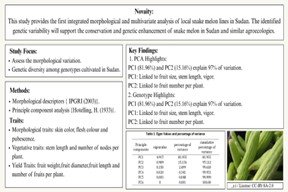
Snake melon (Cucumis melo var. flexuosus), an underutilized cucurbit with nutritional and cultural significance, is widely cultivated in Sudan but lacks comprehensive morphological and genetic characterization. This study aimed to assess the morphological diversity and genetic relationships among seven Sudanese snake melon genotypes using standardized descriptors and Principal Component Analysis (PCA). Field experiments were conducted during the 2022 winter season in Khartoum North under arid-zone conditions. Both qualitative traits (fruit skin and flesh colour, shape, pubescence,) and quantitative traits (fruit number, weight, size, stem length, and node count) were recorded. Significant (p<0.05) morphological variation was observed among genotypes. Genotype HsD11644 exhibited the highest fruit weight (635.33 g), length (48.57 cm), and vegetative vigor (stem length 181.4 cm), while HsD11555, though compact (stem length 84.67 cm), produced the same number of fruits per plant (11.00) as HsD11644. PCA revealed that the first two principal components explained 97.1% of the total phenotypic variation, with PC1 (81.96%) correlating strongly with fruit size and vegetative traits, and PC2 (15.16%) with fruit number. The PCA biplot showed distinct clustering, effectively differentiating genotypes based on their trait profiles. This study provides the first integrated morphological and multivariate analysis of local snake melon lines in Sudan. The identified genetic variability will support the conservation and genetic enhancement of snake melon in Sudan and similar agro-ecological conditions.
Downloads
References
Abdel-Ghani, A. H., & Mahadeen, A. (2014). Genetic Variation in Snake Melon (Cucumis melo var. flexuosus) Populations from Jordan using Morphological Traits and RAPDs. Jordan Journal of Agricultural Sciences, 10(1), 96-119. https://doi.org/10.12816/0029877
Ali-Shtayeh, M. S., Jamous, R. M., Shtaya, M. J., Mallah, O. B., Eid, I. S., & Zaitoun, S. Y. A. (2017). Morphological characterization of snake melon (Cucumis melo var. flexuosus) populations from Palestine. Genetic Resources and Crop Evolution, 64(1), 7–22. https://doi.org/10.1007/s10722-015-0329-0
Bezirganoglu, I. (2018). Botany of Cucumis melo. Horticulture International Journal, 2(3). https://doi.org/10.15406/hij.2018.02.00032
Endl, J., Achigan‐Dako, E. G., Pandey, A. K., Monforte, A. J., Pico, B., & Schaefer, H. (2018). Repeated domestication of melon (Cucumis melo) in Africa and Asia and a new close relative from India. American Journal of Botany, 105(10), 1662–1671. https://doi.org/10.1002/ajb2.1172
Gillman, J.H., Dirr, M.A., & Braman, S.K. (1999) Gradients in susceptibility and resistance mechanisms of Buddleia L. Taxa to the two-spotted spider mite (Tetranychus urticae Koch). Journal of the American Society for Horticultural Science 124:114–121. https://doi.org/10.21273/JASHS.124.2.114
Gomez, K. A., & Gomez, A. A. (1984). Statistical Procedures for Agricultural Research. John Wiley & Sons. https://www.wiley.com/en-us/Statistical+Procedures+for+Agricultural+Research%2C+2nd+Edition-p-9780471870920
Hotelling, H. (1933). Analysis of a complex of statistical variables into principal components. Journal of Educational Psychology, 24(6), 417–441. https://doi.org/10.1037/h0071325
IPGRI, International Plant Genetic Resources Institute (2003). Descriptor list for melon (Cucumis melo L.). International Plant Genetic Resources Institute, Italy. ISBN 92-9043-597-7. URL: http:/www.ipgri.cgiar.org.
Jolliffe, I.T., & Cadima, J. (2016). Principal component analysis: a review and recent developments. Philosophical Transactions of the Royal Society A: Mathematical, Physical and Engineering Sciences, 374(2065), 20150202. https://doi.org/10.1098/rsta.2015.0202
Merheb, J., Pawełkowicz, M., Branca, F., Bolibok-Brągoszewska, H., Skarzyńska, A., Pląder, W., & Chalak, L. (2020). Characterization of Lebanese Germplasm of Snake Melon (Cucumis melo subsp. Melo var. Flexuosus) Using Morphological Traits and SSR Markers. Agronomy, 10(9), 1293. https://doi.org/10.3390/agronomy10091293
Mirghani, K. A. & El Tahir, I. M. (1997). Indigenous vegetables of Sudan: production, utilization and conservation. In: Guarino, L. (Editor). Traditional African vegetables. Proceedings of the IPGRI international workshop on genetic resources of traditional vegetables in Africa: conservation and use, 29–31 August 1995, ICRAF, Nairobi, Kenya. https://www.feedipedia.org/node/6247
Mohammadi, S. A., & Prasanna, B. M. (2003). Analysis of genetic diversity in crop plants—salient statistical tools and considerations. Crop Science, 43(4), 1235-1248. https://doi.org/10.2135/cropsci2003.1235
Pandey, A., Ranjan, P., Ahlawat, S. P., Bhardwaj, R., Dhariwal, O. P., Singh, P. K., Malav, P. K., Harish, G. D., Prabhu, P., & Agrawal, A. (2021). Studies on fruit morphology, nutritional and floral diversity in less-known melons (Cucumis melo L.) of India. Genetic Resources and Crop Evolution, 68(4), 1453–1470. https://doi.org/10.1007/s10722-020-01075-3
Pearson, K. (1901). On Lines and Planes of Closest Fit to Systems of Points in Space. Philosophical Magazine, 2(11), 559–572. https://doi.org/10.1080/14786440109462720
Pitrat, M. (2008). Melon. In: Prohens, J., Nuez, F. (eds) Vegetables I. Handbook of Plant Breeding, vol 1. Springer, New York, NY. https://doi.org/10.1007/978-0-387-30443-4_9.
Sheoran, O. P. (2010). Online statistical analysis (OPSTAT) software developed by Chaudhary Charan Singh Haryana Agricultural University, Hisar, India. Retrieved from http://www.202.141.47.5/opstat/index.asp
Singh, D., Leskovar, D. I., Sharma, S. P., Sarao, N. K., & Vashisht, V. K. (2020). Genetic diversity and interrelationship among Indian and exotic melons based on fruit morphology, quality components and microsatellite markers. Physiology and molecular biology of plants, 26, 985-1002. https://doi.org/10.1007/s12298-020-00814-1
Soltani, F., Akashi, Y., Kashi, A., Zamani, Z., Mostofi, Y., & Kato, K (2010) Characterization of Iranian melon landraces of Cucumis melo L. Groups flexuosus and dudaim by analysis of morphological characters and random amplified polymorphic DNA. Breeding Science, 60(1), 34–45. https://doi.org/10.1270/jsbbs.60.34
Stepansky, A., Kovalski, I., & Perl-Treves, R. (1999). Intraspecific classification of melons (Cucumis melo L.) in view of their phenotypic and molecular variation. Plant Systematics and Evolution, 217, 313–333. https://doi.org/10.1007/BF00984373
Yildiz, M., Akgul, N., & Sensoy, S. (2014). Morphological and Molecular Characterization of Turkish Landraces of Cucumis melo L.Notulae Botanicae Horti Agrobotanici Cluj-Napoca, 42(1), 51–58. https://doi.org/10.15835/nbha4219452
Yousif, M. T., Elamin, T. M., Baraka, M., Jack, A. A., & Ahmed, E. A. (2011). Variability and correlation among morphological, vegetative, fruit and yield parameters of snake melon (Cucumis melo var. flexuosus). Cucurbit Genetics Cooperative Report, 34, 32-35. https://cucurbit.info/wp-content/uploads/2019/01/cgc3334-9.pdf
Downloads
Published
How to Cite
Issue
Section
License
Copyright (c) 2025 Agriculture and Environmental Science Academy

This work is licensed under a Creative Commons Attribution-NonCommercial 4.0 International License.