Performance of rice variety Binadhan-12 as affected by nitrogen management practices under different submergence conditions
DOI:
https://doi.org/10.26832/24566632.2025.1002023Keywords:
BINAdhan-12, Nitrogen level, Submergence, YieldAbstract
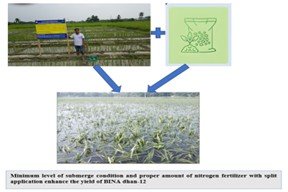
An experiment was conducted at the Agronomy Field Laboratory, Bangladesh Agricultural University, Mymensingh during the Aman (summer season) season from August to December to find out the effect of different N management practices on the performance of Binadhan-12 under submerged condition. The experiment was laid out in a split plot design where submergence levels were allocated in the main plots and nitrogen levels were distributed in sub plots with three replications. Four submergence levels (S0=Control, S1=Submergence up to 15 days after seedling establishment, S2 = Submergence up to 20 days after seedling establishment, S3 = Submergence up to 25 days after seedling establishment) and five Nitrogen levels (N0 = Control, N1 = 100 kg N ha-1 in 3 splits after submergence, N2 = 150 kg N ha-1 in 3 splits after submergence, N3 = 100 kg N ha-1 in 2 splits after submergence, N4 = 150 kg N ha-1 in 2 splits after submergence) were used as treatments. All the crop characters showed significant differences due to the application of nitrogen. When 150 kg N/ha was applied, it showed superior performance for all the crop characters and highest grain yield (2.82 t ha-1) was obtained from this treatment. In case of submergence level maximum yield (3.49 t ha-1) was obtained in no
submergence condition. However, in submergence situation, the grain yield of 2.77 t ha-1 was obtained when 150 kg N/ha was applied with three equal splits until the plants were submerged for 15 days after submergence.
Downloads
References
Akter, M. B., Nahar, N., Rana, M. S., Hasan, M. N., & Rayhan, M. B. (2020). Nitrogen effect on the growth and yield contributing characters of Binadhan-19. Asian Journal of Crop, Soil Science and Plant Nutrition, 04(02), 157–164. https://doi.org/10.18801/ajcsp.040220.20
Akter, Md. B., Islam, Md. T., Mondal, Md. M. A., Hoque, Md. I., Kamruzzaman, Md., Nafis, M. H., Sultana, A., & Ali, Md. S. (2019). Morpho-physiological Basis of yield performance of early maturing rice varieties in Bangladesh. Annual Research & Review in Biology, 1–13. https://doi.org/10.9734/arrb/2019/v32i530097
Banayo, N. P. M. C., Bueno, C. S., Haefele, S. M., Desamero, N. V., & Kato, Y. (2018). Site-specific nutrient management enhances sink size, a major yield constraint in rainfed lowland rice. Field Crops Research, 224, 76–79. https://doi.org/10.1016/j.fcr.2018.05.006
Bui, L. T., Ella, E. S., Dionisio-Sese, M. L., & Ismail, A. M. (2019). Morpho-Physiological changes in roots of rice seedling upon submergence. Rice Science, 26(3), 167–177. https://doi.org/10.1016/j.rsci.2019.04.003
Chen, Y., Song, J., Yan, C., & Hong, X. (2021). Effects of submergence stress at the vegetative growth stage on hybrid rice growth and grain yield in China. Chilean Journal of Agricultural Research, 81(2), 191–201. https://doi.org/10.4067/S0718-58392021000200191
Chivenge, P., Sharma, S., Bunquin, M. A., & Hellin, J. (2021). Improving nitrogen use efficiency—a key for sustainable rice production systems. Frontiers in Sustainable Food Systems, 5, 737412. https://doi.org/10.3389/fsufs.2021.737412
Ghonaim, M. M., Attya, A. M., Aly, H. G., Mohamed, H. I., & Omran, A. A. A. (2023). Agro-morphological, biochemical, and molecular markers of barley genotypes grown under salinity stress conditions. BMC Plant Biology, 23(1), 526. https://doi.org/10.1186/s12870-023-04550-y
Gomez, K. A., & Gomez, A. A., (1984). Statistical procedures for agricultural research (2nd ed). Wiley. https://www.wiley.com/en-us/Statistical+Procedures+for+Agricultural+Research%2C+2nd+Edition-p-9780471870920
Jahan, A., Islam, A., Sarkar, Md. I. U., Iqbal, M., Ahmed, Md. N., & Islam, Md. R. (2022). Nitrogen response of two high yielding rice varieties as influenced by nitrogen levels and growing seasons. Geology, Ecology, and Landscapes, 6(1), 24–31. https://doi.org/10.1080/24749508.2020.1742509
Kamuruzzaman, Md., Rees, R. M., Islam, Md. T., Drewer, J., Sutton, M., Bhatia, A., Bealey, W. J., & Hasan, Md. M. (2024). Improving nitrogen fertilizer management for yield and n use efficiency in wetland rice cultivation in Bangladesh. Agronomy, 14(12), 2758. https://doi.org/10.3390/agronomy14122758
Kato, Y., Collard, B. C. Y., Septiningsih, E. M., & Ismail, A. M. (2019). Increasing flooding tolerance in rice: Combining tolerance of submergence and of stagnant flooding. Annals of Botany, 124(7), 1199–1209. https://doi.org/10.1093/aob/mcz118
Mujumdar, M., Bhaskar, P., Ramarao, M. V. S., Uppara, U., Goswami, M., Borgaonkar, H., Chakraborty, S., Ram, S., Mishra, V., Rajeevan, M., & Niyogi, D. (2020). Droughts and Floods. In R. Krishnan, J. Sanjay, C. Gnanaseelan, M. Mujumdar, A. Kulkarni, & S. Chakraborty (Eds.), Assessment of Climate Change over the Indian Region (pp. 117–141). Springer Singapore. https://doi.org/10.1007/978-981-15-4327-2_6
Nishiuchi, S., Yamauchi, T., Takahashi, H., Kotula, L., & Nakazono, M. (2012). Mechanisms for coping with submergence and waterlogging in rice. Rice, 5(1), 2. https://doi.org/10.1186/1939-8433-5-2
Panda, D., Nayak, A., & Mohanty, S. (2019). Nitrogen management in rice. Oryza-An International Journal on Rice, 56(Special), 125–135. https://doi.org/10.35709/ory.2019.56.spl.5
Parit, R. K., Bharteey, P. K., Saikia, B. J., Bora, S. S., Maurya, P. K., & Tabing, R. (2020). Nitrogen transformation in waterlogged soil in Indian rice fields: A review. Journal of Experimental Agriculture International, 107–118. https://doi.org/10.9734/jeai/2020/v42i330488
Pranto, S., Haque, M. A., & Hoque, M. F. (2023). Requirement and use efficiency of nitrogen in transplanted Aman rice at Ganges tidal water flooded coastal ecosystem. Journal of Bangladesh Academy of Sciences, 47(2), 169–180. https://doi.org/10.3329/jbas.v47i2.67665
Yao, F., Huang, J., Nie, L., Cui, K., Peng, S., & Wang, F. (2015). Dry matter and N contributions to the formation of sink size in early- and late-maturing rice under various N rates in central China. International Journal of Agriculture and Biology, 18(01), 46–51. https://doi.org/10.17957/IJAB/15.0060
Yin, C. C., Zhao, H., Ma, B., Chen, S. Y., & Zhang, J. S. (2017). Diverse roles of ethylene in regulating agronomic traits in rice. Frontiers in Plant Science, 8, 1676. https://doi.org/10.3389/fpls.2017.01676
Yu, Y., Meng, Y., Chen, P., & Cao, K. (2024). Submergence Stress reduces the ability of rice to regulate recovery after disaster. Agronomy, 14(6), 1319. https://doi.org/10.3390/agronomy14061319
Zhu, G., Chen, Y., Ella, E. S., & Ismail, A. M. (2019). Mechanisms associated with tiller suppression under stagnant flooding in rice. Journal of Agronomy and Crop Science, 205(2), 235–247. https://doi.org/10.1111/jac.12316
Downloads
Published
How to Cite
Issue
Section
License
Copyright (c) 2025 Agriculture and Environmental Science Academy

This work is licensed under a Creative Commons Attribution-NonCommercial 4.0 International License.