Impact of agricultural subsidy on three cereal crops cultivated in Dailekh district, Nepal
DOI:
https://doi.org/10.26832/24566632.2025.100203Keywords:
Cereal crops, Farming subsidies, Marginalized farmers, Subsidies accessAbstract
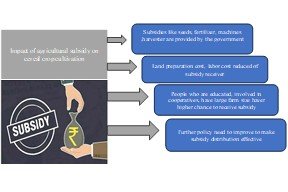
This study aimed to investigate the impact of agricultural subsidies on the three primary cereal crops—rice, maize, and wheat in Dailekh district of Karnali province, Nepal and to evaluate the current status of subsidies, their impact on agricultural cultivation, and the variables affecting their allocation. The data was collected through a scheduled of semi-structured surveys and interviews from Narayan municipality of Dailekh district. Data was collected from 100 respondents, among them 60 were subsidy recipients and 40 were non-recipient, using a random sampling technique. A logistic regression model was used to determine the main factors affecting access to subsidies, such as gender, cooperative membership, farm size, and educational attainment. The results showed that the cost NPR 12,283 (90.94$) and NPR 17,625 (130.49$) on land preparation for rice cultivation; NPR 2,737 (20.26$) NPR 9,973 (73.84$) on land preparation for maize cultivation, while NPR 7,010 (51.90$) and NPR 9,417 (69.72$) on land preparation for wheat cultivation was found to be significantly (p<0.01) different among the subsidy recipients and subsidy non-recipient’s farmers, respectively. Similarly, cost of seeds of rice, maize and wheat was also found to be significantly (p<0.05) different between the subsidy recipients and subsidy non-recipient’s farmers. The findings emphasize that targeted and effective subsidy programs should be required to increase the cereal production in Dailekh district of Nepal. Thus, policymakers should concentrate on enhancing marginalized farmer’s access to subsidies, guaranteeing distribution transparency, and launching training programs in order to optimize the advantages of agricultural support programs.
Downloads
References
Bista, D., Dhungel, S., & Adhikari, S. (2018). Status of fertilizer and seed subsidy in Nepal. Journal of Agriculture and Environment, 17, 1-10. https://doi.org/10.3126/aej.v17i0.19854
Fan, S., Thorat, S., & Gulati, A. (2007). Investment, subsidies, and pro-poor growth in rural India. Agricultural Economics, 37(1), 103-114
GoP (2013). Government of Nepal, Ministry of Agricultural Development, National Seed Board, Seed Quality Control Centre (2013). National Seed Vision 2013-2025 (Seed Sector Development Strategy). Hariharbhawan, Lalitpur, Nepal.
KC., D. Jamarkattel, D., Maraseni, T., Nandwani, D., & Karki, P. (2021). The effects of tunnel technology on crop productivity and livelihood of smallholder farmers in Nepal. Sustainability, 13(14), 1-15.
Mignouna, D. B., Manyon, G. V. M., Rusike, J,, Mutabazi, K. D. S., & Senkondo, E. M. (2011). Determinants of adopting imazapyr-resistant maize technologies and its impact on household income in Western Kenya. AgBioForum, 14(3), 158-163.
Mwangi, M., & Kariuki, S. (2015). Factors determining adoption of new agricultural technology by smallholder farmers in developing countries. Journal of Economics and Sustainable Development, 6(5),1-10.
MOALD. (2021). Statistical Year Book. Ministry of Agriculture and Livestock Development, Government of Nepal, Kathmandu, Nepal.
MoALD. (2024) Statistical Information on Nepali Agriculture FY 2023/24 Singhadurbar, Kathmandu ; MoALD.
MoF. (2024). Budget speech of fiscal year 2023-24.Kathmandu ; Ministry of Finance.
Paudel, Jayash, & Crago, Christine, L. (2017). Fertilizer Subsidy and Agricultural Productivity: Empirical Evidence from Nepal. Annual Meeting, July 30-August 1, Chicago, Illinois 258464.
Shrestha, M.K. (2021). Agricultural support policy of Nepal: Cases of subsidies. International Multidisciplinary Research Journal, 1, 16–22. https://doi.org/10.47722/imrj.2001.04
Takeshima, H., Adhikari, R., Dev Kaphle, B., Shivakoti, S., & Kumar, A. (2017). Heterogeneous Returns to Chemical Fertilizer at the Intensive Margins:Insights from Nepal. Food Policy, 69. https://doi.org/10.1016/j.foodpol.2017.03.007
Timilsena, K. (2019). Agricultural Subsidies: Are they Effective?" The Himalayan Times, 18 September, 2019, Kathmandu, Nepal.
Tranmer, M., & Elliot, M. J. (2016). Binary Logistic Regression Mark Tranmer Mark Elliot.
Downloads
Published
How to Cite
Issue
Section
License
Copyright (c) 2025 Agriculture and Environmental Science Academy

This work is licensed under a Creative Commons Attribution-NonCommercial 4.0 International License.