Soil loss estimation and mapping of water erosion management strategies in the Northern region of Rwanda
DOI:
https://doi.org/10.26832/24566632.2025.100205Keywords:
Dataset, RUSLE, Soil and Water conservation techniques, Soil loss, Water erosionAbstract
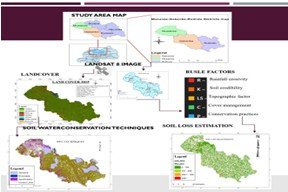
This study was conducted in Gakenke, Musanze and Rulindo districts in northern province of Rwanda from December 2019 to October 2021 to determine Soil and Water Conservation (SWC) status, mapping soil erosion areas, annual estimation of soil loss and spatial distribution in northern Rwanda. The study used Revised Universal Soil Loss Equation (RUSLE)
model based on erosivity index, erodibility of soil, slope steepness, slope distance, vegetation covers and conservation practice parameters generated through arc GIS. The utilized data included the Digital Elevation Model (DEM) for production of slope steepness. Landsat 8 have been processed in ERDAS Imagine 2014 for land use and land cover. Field data for conservation practice factor and rainfall data for soil erosivity in Google Earth Pro and ArcGIS respectively have been produced. The results indicated that the forest was identified as the largest area covering of 84.08% followed by built up areas with 10.43%, radical terraces account for 4.45 %, bare soil (3.23%), agroforestry (0.77%), waterbodies (0.727%), riverbanks (0.38%), and wetland (0.35%). The average rate of water erosion was discovered as 72 t. ha–1. y–1 and
observed that soil erosion is more severe in steep areas than in other places. Inadequate erosion control management results as the cause of spatial distribution of erosion. Thus, it is advisable to prioritize soil and water management practices in steep and mid-elevation unprotected areas before applying them to lower elevations.
Downloads
References
Allotey, P. A., & Reidpath, D. (2000). Information quality in a remote rural maternity unit in Ghana. Health Policy and Planning, 15(2), 170–176. https://doi.org/10.1093/heapol/15.2.170
Arega, E., Deribew, K. T., Moisa, M. B., & Gemeda, D. O. (2024). Assessment of soil erosion and prioritization of conservation and restoration measures using RUSLE and Geospatial techniques: the case of upper Bilate watershed. Geomatics, Natural Hazards and Risk, 15(1). https://doi.org/10.1080/19475705.2024.2336016
Amera, A. M. (2017). An automated method for mapping physical soil and water conservation structures on cultivated land using GIS and remote sensing techniques. https://doi.org/10.1007/s11442-017-1365-9
Benavidez, R., Jackson, B., Maxwell, D., & Norton, K. (2018). A review of the (Revised) Universal Soil Loss Equation (RUSLE): With a view to increasing its global applicability and improving soil loss estimates. Hydrology and Earth System Sciences, 22(11), 6059–6086. https://doi.org/10.5194/hess-22-6059-2018
Bizoza, A. R. (2011). Farmers, institutions and land conservation: institutional economic analysis of bench terraces in the highlands of Rwanda. In Farmers, institutions and land conservation: institutional economic analysis of bench terraces in the highlands of Rwanda. Accessed from: https://core.ac.uk/download/pdf/29235864.pdf
Bizimana, I. (2018). Final Country Report of the LDN Target Setting Programme in Rwanda (Issue June). Accessed from: https://www.unccd.int/sites/default/files/ldn_targets/2019-01/Rwanda%20LDN%20TSP%20Country%20Report.pdf
Byizigiro, R. V, Rwanyiziri, G., Mugabowindekwe, M., Kagoyire, C., & Biryabarema, M. (2020). Estimation of Soil Erosion Using RUSLE Model and GIS: The Case of Satinskyi Catchment, Western Rwanda. Rwanda Journal of Engineering, Science, Technology and Environment, 3(1). https://doi.org/10.4314/rjeste.v3i1.2s
FAO. (1996). Land husbandry - Components and strategy. In 70 FAO Soils Bulletin. Accessed from: https://www.fao.org/4/t1765e/t1765e00.htm
Kabirigi, M., Mugambi, S., Musana, B. S., Ngoga, G. T., Muhutu, J. C., Rutebuka, J., Ruganzu, V., Nzeyimana, I., & Nabahungu, N. L. (2017). Estimation of soil erosion risk , its valuation and economic implications for agricultural production in western part of Rwanda. Journal of Experimental Biology and Agricultural Sciences, 5(4), 525-536. https://doi.org/10.18006/2017.5(4).525.536
Kagabo, D. M., Stroosnijder, L., Visser, S. M., & Moore, D. (2013). Soil erosion, soil fertility and crop yield on slow-forming terraces in the highlands of Buberuka, Rwanda. Soil and Tillage Research, 128, 23–29. https://doi.org/10.1016/j.still.2012.11.002
Karamage, F., Zhang, C., Ndayisaba, F., Shao, H., Kayiranga, A., Fang, X., Nahayo, L., Nyesheja, E. M., & Tian, G. (2016). Extent of cropland and related soil erosion risk in Rwanda. Sustainability (Switzerland), 8(6), 609. https://doi.org/10.3390/su8070609
Luvai, A., Obiero, J., & Omuto, C. (2022). Soil Loss Assessment Using the Revised Universal Soil Loss Equation (RUSLE) Model. Applied and Environmental Soil Science, 1-14, 122554, https://doi.org/10.1155/2022/2122554
Majoro, F., Wali, U. G., Munyaneza, O., Naramabuye, F.-X., & Mukamwambali, C. (2020). On-site and Off-site effects of soil erosion: Causal Analysis and remedial measures in agricultural land - a Review. Rwanda Journal of Engineering, Science, Technology and Environment, 3(2), 1–19. https://doi.org/10.4314/rjeste.v3i2.1
McCool, D. K., Brown, L. C., Foster, G. R., Mutchler, C. K., & Meyer, L. D. (1987). Revised slope steepness factor for the universal soil loss equation. Transactions of the ASAE, 30(5), 1387-1396.
Murindangabo, Y. T., Kopecký, M., & Konvalina, P. (2021). Adoption of conservation agriculture in rwanda: A case study of gicumbi district region. Agronomy, 11(9). https://doi.org/10.3390/agronomy11091732
Mutuyimana, D. (2015). Effects of integrated soil and water management on livelihoods of smallholders in burega sector, Rulindo District, Northern Province, Rwanda. Master Thesis pp .151. https://doi.org/10.1017/CBO9781107415324.004
Niyo, A. B. (2023). Application of GIS and Remote sensing in assessing soil loss potential in Western Province, Rwanda. Accessed from: https://www.researchgate.net/publication/370004740_Application_of_GIS_and_Remote_Sensing_in_Assessing_Soil_Loss_Potential_in_Western_Province_RWANDA
Nambajimana, J. D. J., He, X., Zhou, J., Justine, M. F., Li, J., Khurram, D., Mind’je, R., & Nsabimana, G. (2020). Land use change impacts on water erosion in Rwanda. Sustainability (Switzerland), 12(1), 1–23. https://doi.org/10.3390/SU12010050
RWB & IUCN. (2022). Rwanda Water Resource Board & International Union for conservation of Nature . The State of Soil Erosion Control in Rwanda. May, 118–127. https://waterportal.rof conservation of nature wb.rw/sites/default/files/2022-08/
Sentis, I. P. (2010). College on Soil Physics : Soil Physical Properties and Processes under Climate Change. https://indico.ictp.it/event/a09165/
Shiferaw, A. (2011). Estimating soil loss rates for soil conservation planning in the Borena woreda of south Wollo highlands, Ethiopia. Journal of Sustainable Development in Africa, 13(3), 87–106.
Suhara, K.K., S., Varughese, A., Sunny, A. C., & Krishna P.R.A. (2023). Erosivity Factor of the Revised Universal Soil Loss Equation (RUSLE) - A Systematized Review. Current World Environment, 18(2), 433–445. https://doi.org/10.12944/cwe.18.2.02
SIDA. (2024). Multidimensional Poverty Analysis. Accessed on May, 1–26. https://cdn.sida.se/app/uploads/2025/01/10165832/MDPA_Demokratiska_Republiken_Kongo_2024.pdf
Tamene, L., & Le, Q. B. (2015). Estimating soil erosion in sub-Saharan Africa based on landscape similarity mapping and using the revised universal soil loss equation (RUSLE). Nutrient Cycling in Agroecosystems, 102(1), 17–31. https://doi.org/10.1007/s10705-015-9674-9
Williams, J. R. (1995). The EPIC Model. In: Computer models of watershed hydrology. Water Resources Publications. https://www.scirp.org/reference/referencespapers?referenceid=1153277
Wischmeier, W. H., & Smith, D. D. (1978). Predicting rainfall erosion losses—a guide for conservation planning. U.S. Department of Agriculture, Agriculture. Handbook pp. 537. https://www.scirp.org/reference/referencespapers?referenceid=1687723
Downloads
Published
How to Cite
Issue
Section
License
Copyright (c) 2025 Agriculture and Environmental Science Academy

This work is licensed under a Creative Commons Attribution-NonCommercial 4.0 International License.