Effectiveness of salt licking sites for wild animals in Bardia National Park, Nepal
DOI:
https://doi.org/10.26832/24566632.2025.1004012Keywords:
Camera traps, Salt licks, Significance, Species diversity, ThreatsAbstract
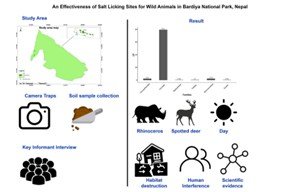
Salt licks are naturally occurring spots vital to numerous wildlife species worldwide. This study aimed to examine the use of natural salt licks by wild animals inside Bardia National Park (BNP), Nepal. Five camera traps were installed at five selected salt licks for a period of 18 days. A total 6 families and 10 species, were recorded at the salt lick sites were recorded during the investigation. The sites, Baghaura A and Baghaura C emerged as the most diverse salt licks in terms of species richness. The Shannon-Weiner diversity index was highest at Baghaura C, while the species evenness index was also highest there and lowest at Patthar Bandha South. The Simpson diversity index was highest in Patthar Bandha South and lowest at Baghaura B. Spotted deer, followed by rhino, were the most frequent visitors with the highest Capture Frequency (CF) and Relative Abundance Index (RAI). Carnivores and omnivores were least abundant. Temporal activity pattern was varied with species and habitat, with maximum activity during the day. The soil analysis also showed the highest pH and exchangeable sodium at Patthar Bandha South and the lowest at Baghaura A. Among the five identified threats, Habitat destruction and human interference were identified as the most severe threats. Disease transmission and poisoning ranked high and medium threats, respectively. Therefore, this study provides science-based evidence for the protection of salt lick sites for effective wildlife management in Bardia National Park, Nepal.
Downloads
References
Adhikari, S., & Khadka, A. (2009). Study on relative abundance and distribution of tiger prey base (ungulates) in Khata Corridor, Bardia National Park. Kathmandu University Journal of Science, Engineering and Technology, 5(1), 121-135. https://doi.org/10.3126/kuset.v5i1.2852
Ajayi, S. S., & Halstead, L. B. (2018). Big game utilization of natural mineral licks. In Routledge Revivals: Wildlife Management in Savannah Woodland (1979) (pp. 105-115). Routledge Press.
Ayotte, J. B., Parker, K. L., Arocena, J. M., & Gillingham, M. P. (2006). Chemical composition of lick soils: functions of soil ingestion by four ungulate species. Journal of Mammalogy, 87(5), 878-888. https://doi.org/10.1644/06-MAMM-A-055R1.1
Blake, J. G., Guerra, J., Mosquera, D., Torres, R., Loiselle, B. A., & Romo, D. (2010). Use of mineral licks by white-bellied spider monkeys (Ateles belzebuth) and red howler monkeys (Alouatta seniculus) in eastern Ecuador. International Journal of Primatology, 31, 471-483.
BNP, Bardia National Park. (2016). Bardia National Park and its buffer zone management plan (2016–2020). Bardia National Park.
Bravo, A., Harms, K. E., & Emmons, L. H. (2012). Keystone resource (Ficus) chemistry explains lick visitation by frugivorous bats. Journal of Mammalogy, 93(4), 1099-1109. https://doi.org/10.1644/11-MAMM-A-333.1
Burger, J., & Gochfeld, M. (2003). Parrot behavior at a Rio Manu (Peru) clay lick: temporal patterns, associations, and antipredator responses. Acta Ethologica, 6, 23-34.
Cabrera, J. A. (2012). Natural licks and people: Towards an understanding of the ecological and social dimensions of licks in the Colombian Amazon. Canterbury: School of Antrhopology and Conservation, University of Kent.
Chew, M. Y., Hymeir, K., Nosrat, R., & Shahfiz, M. A. (2014). Relation between grasses and large herbivores at the Ulu Muda salt licks, Peninsular Malaysia. Journal of Tropical Forest Science, 554-559.
Chhetri, N. B., Dhami, B., Neupane, B., Sadadev, B. M., & Thapa, N. (2020). Distributional evidences and threats to cheer pheasant (Catreus wallichii) in Annapurna Conservation Area of Nepal. Nepalese Journal of Zoology, 4(2), 140-146.
Chong, M. H. N., Tang, S. H., & Suksuwan, S. (2005). Management recommendations for wildlife saltlicks with particular reference to Sira Air Hangat at Ulu Muda Forest Reserve, Kedah. World Wide Fund for Nature Malaysia, Petaling Jaya.
Couturier, S., & Barrette, C. (1988). The behavior of moose at natural mineral springs in Quebec. Canadian Journal of Zoology, 66(2), 522-528. https://doi.org/10.1139/z88-075
Denton, D. A. (1982). The hunger for salt: an anthropological, physiological, and medical analysis. https://library.wur.nl/WebQuery/titel/197776
Devkota, A., Karki, B., Magar, L. K., & Lamichhane, P. (2025). Assessing the impact of canopy opening in regeneration status of tropical Terai forest of Nepal. Trees, Forests and People, 100904.
DNPWC. (2022). Bardiya National Park. https://dnpwc.gov.np/en/conservation-area-detail/80/
Emmons, L. H., & Stark, N. M. (1979). Elemental composition of a natural mineral lick in Amazonia. Biotropica, 11(4), 311-313. https://doi.org/10.2307/2387925
Ghimire, A., Paudel, S., & Devkota, A. (2022). Silvicultural Systems in the Restoration of Normal Forest: A Review. Forestry: Journal of Institute of Forestry, Nepal, 19(01), 64-72.
Holdø, R. M., Dudley, J. P., & McDowell, L. R. (2002). Geophagy in the African elephant in relation to availability of dietary sodium. Journal of Mammalogy, 83(3), 652-664. https://doi.org/10.1644/1545-1542(2002)083
Hon, J., Shibata, S., & Samejima, H. (2020). Species Composition and Use of Natural Salt Licks by Wildlife Inside a Production Forest Environment in Central Sarawak. In Anthropogenic Tropical Forests (pp. 171-180). Springer, Singapore.
Jenks, K. E., Chanteap, P., Kanda, D., Peter, C., Cutter, P., Redford, T., & Leimgruber, P. (2011). Using relative abundance indices from camera-trapping to test wildlife conservation hypotheses–an example from Khao Yai National Park, Thailand. Tropical Conservation Science, 4(2), 113-131.
Joshi, H. C., Ojha, P., Khadka, S., & Adhikari, S. (2022). An Assessment of Human-Wildlife Conflict in Basanta Corridor: a Case Study from Kailari Rural Municipality, Nepal. Indonesian Journal of Social and Environmental Issues (IJSEI), 3(3), 213-222.
King, A., Behie, A.M., Naven, H., & Rawson, B.M. (2016). Patterns of salt lick use by mammals and birds in northeastern Cambodia. Cambodian Journal of Natural History, 40–50. https://doi.org/10.17102/cnr.2022.7727BJNRD
Kohl, M. T., Stahler, D. R., Metz, M. C., Forester, J. D., Kauffman, M. J., Varley, N., & MacNulty, D. R. (2018). Diel predator activity drives a dynamic landscape of fear. Ecological Monographs, 88(4), 638-652.
Koirala, P., Neupane, B., Silwal, T., Dhami, B., Regmi, S., & Dahal, D. (2020). Distribution of blue bull (Boselaphus tragocamelus) and its conservation threats in Bardia National Park, Nepal. Journal of Forest and Natural Resource Management, 2(1), 50-60.
Lameed, A. G., & Adetola, J. O. (2012). Species-diversity utilization of salt lick sites at Borgu Sector of Kainji Lake National Park, Nigeria. Biodiversity Enrichment in a Diverse World, 2(3), 35-62.
Link, A., Galvis, N., Fleming, E., & Di Fiore, A. (2011). Patterns of mineral lick visitation by spider monkeys and howler monkeys in Amazonia: are licks perceived as risky areas?. American Journal of Primatology, 73(4), 386-396. https://doi.org/10.1002/ajp.20910
Magurran, A. E. (1988). Ecological diversity and its measurement. Princeton university press.
Margalef, R. (1958). Information theory in ecology. General Systematics, 3: 36– 71.
Marinho, P. H., Bezerra, D., Antongiovanni, M., Fonseca, C. R., & Venticinque, E. M. (2018). Activity patterns of the threatened northern tiger cat Leopardus tigrinus and its potential prey in a Brazilian dry tropical forest. Mammalian Biology, 89, 30–36. https://doi.org/10.1016/j.mambio.2017.12.004
Matsubayashi, H., Lagan, P., Majalap, N., Tangah, J., Sukor, J. R. A., & Kitayama, K. (2007a). Importance of natural licks for the mammals in Bornean inland tropical rain forests. Ecological Research, 22(5), 742-748. https://doi.org/10.1007/s11284-006-0313-4
Matsubayashi, H., Lagan, P., Sukor, J. R. A., & Kitayama, K. (2007b). Seasonal and daily use of natural licks by sambar deer (Cervus unicolor) in a Bornean tropical rain forest. Tropics, 17(1), 81-86. https://doi.org/10.3759/tropics.17.81
Michael, P. (1984). Ecological methods for field and laboratory investigations.
Mojiol, A. R., & Lim, W. S. (2022). Variability in the patterns of terrestrial mammals in visiting the natural salt-licks at a tropical forest. HUTAN TROPIKA, 17(1), 1-20.
Molina, E., León, T. E., & Armenteras, D. (2014). Characteristics of natural salt licks located in the Colombian Amazon foothills. Environmental Geochemistry and Health, 36, 117-129.
Morales, M. A. (2009). The importance of natural soil licks to wildlife and humans in subtropical Paraguay, South America (Vol. 71, No. 03).
Nakabayashi, M., Kanamori, T., Matsukawa, A., Tangah, J., Tuuga, A., Malim, P. T., Bernard, H., Ahmad, A. H., Matsuda, I., & Hanya, G. (2021). Temporal activity patterns suggesting niche partitioning of sympatric carnivores in Borneo, Malaysia. Scientific Reports, 11(1), 1–12. https://doi.org/10.1038/s41598-021-99341-6.
Ojha, P., Acharya, K. R., Subedi, A., & Regmi, S. (2023). Impact of silviculture system on regeneration status and species diversity: reflection from far-western lowland, Nepal. Banko Janakari, 33(2), 24-37.
Panichev, A. M., Popov, V. K., Chekryzhov, I. Y., Seryodkin, I. V., Sergievich, A. A., & Golokhvast, K. S. (2017). Geological nature of mineral licks and the reasons for geophagy among animals. Biogeosciences, 14(11), 2767-2779. https://doi.org/10.5194/bg-14-2767-2017
Panichev, A.M., Golokhvast, K.S., Gulkov, A.N. and Chekryzhov, I.Y. (2013). Geophagy in animals and geol-ogy of kudurs (mineral licks): a review of Russian publications. Environmental Geochemistry and Health,35(1): 133-152.
Pielou, E. C. (1966). Species-diversity and pattern-diversity in the study of ecological succession. Journal of Theoretical Biology, 10(2), 370-383. https://doi.org/10.1016/0022-5193(66)90133-0
Powell, L. L., Powell, T. U., Powell, G. V., & Brightsmith, D. J. (2009). Parrots take it with a grain of salt: available sodium content may drive collpa (clay lick) selection in southeastern Peru. Biotropica, 279-282.
Rajaratnam, R., Sunquist, M., Rajaratnam, L., & Ambu, L. (2007). Diet and habitat selection of the leopard cat (Prionailurus bengalensis borneoensis) in an agricultural landscape in Sabah, Malaysian Borneo. Journal of Tropical Ecology, 23(2), 209-217. https://doi.org/10.1017/S0266467406003841
Rawson, B. M., & Bach, L. T. (2011). Preliminary observations of geophagy amongst Cambodia’s Colobinae. Vietnamese Journal of Primatology, 5, 41-46.
Razali, N. B., Mansor, M. S., Ismail, N. A., Patah, P. A., Husin, S. M., Hussein, M. S. R., & Nor, S. M. (2022). The use of salt licks by birds in Peninsular Malaysia. Global Ecology and Conservation, 38, e02210.
Razali, N. B., Shafie, M. S. H., Jobran, R. A. M., Karim, N. H. A., Khamis, S., Mohd-Taib, F. S., & Hussein, M. S. R. (2020). Physical factors at salt licks influenced the frequency of wildlife visitation in the Malaysian tropical rainforest. Tropical Zoology, 33(3). htpps://doi.org/10.4081/tz.2020.69.
Ruggiero, R. (1990). The effects of poaching disturbance on elephant behaviour. Pachyderm, 13, 42-44.
Ruggiero, R. G., & FAY, J. M. (1994). Utilization of termitarium soils by elephants and its ecological implications. African Journal of Ecology, 32(3), 222-232. https://doi.org/10.1111/j.1365-2028.1994.tb00573.x
Simpson, B. K., Nasaruddin, N., Traeholt, C., & Nor, S. M. (2020). Mammal Diversity at Artificial Saltlicks in Malaysia: A Targeted Use. Frontiers in Environmental Science, 8, 556877. https://doi.org/10.3389/fenvs.2020.556877
Steinmetz, R., Seuaturien, N., & Chutipong, W. (2013). Tigers, leopards, and dholes in a half-empty forest: assessing species interactions in a guild of threatened carnivores. Biological Conservation, 163, 68-78.
Subedi, A., & Bashyal, B. (2022). Medicinal properties and uses of Aegle marmelos (Bel) plant: A review. Asian Journal of Pharmacuitics, 6(1), 10-20.
Subedi, A., Shrestha, P., & Ojha, P. (2022). Status, Distribution, and Threats of Red Panda (Ailurus fulgens Cuvier, 1825) in Nepal. Indonesian Journal of Social and Environmental Issues (IJSEI), 3(3), 233-240.
Thapa, K., Kelly, M. J., Karki, J. B., & Subedi, N. (2013). First camera trap record of pack hunting dholes in Chitwan National Park, Nepal. Canid Biology and Conservation, 16(2), 4-7.
Vitousek, P. M., & Sanford Jr, R. L. (1986). Nutrient cycling in moist tropical forest. Annual review of Ecology and Systematics, 17(1), 137-167. https://doi.org/10.1146/annurev.es.17.110186.001033
Wahab, M. K. A., Akinsorotan, A. O., & Idowu, I. A. (2020). Species Diversity Associated with Salt Lick Utilization in Borgu sector of Kainji Lake National Park, Nigeria. World News of Natural Sciences, 31, 146-154.
Wikramanayake, E., McKnight, M. E. G. H. A. N., Dinerstein, E., Joshi, A., Gurung, B., & Smith, D. (2004). Designing a conservation landscape for tigers in human-dominated environments. Conservation Biology, 18(3), 839-844. https://doi.org/10.1111/j.1523-1739.2004.00145.x
WWF, (2007). Resources for Implementing the WWF Project & Programme Standards. Step 1.4 Define: Threat Ranking
Downloads
Published
How to Cite
Issue
Section
License
Copyright (c) 2025 Agriculture and Environmental Science Academy

This work is licensed under a Creative Commons Attribution-NonCommercial 4.0 International License.