Survey and efficacy test of selected botanical pesticides to manage maize weevil at Gauradaha, Jhapa, Nepal
DOI:
https://doi.org/10.26832/24566632.2026.1101012Keywords:
Acorus calamus, Botanicals, Gauradaha, Maize weevil, Melia azedarachAbstract
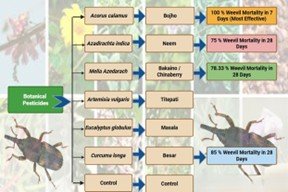
This study was carried out in eastern terai-Gauradaha municipality, Jhapa-of Nepal to evaluate the effectiveness of locally available botanicals for managing the maize weevil (Sitophilus zeamais). Lab experiment was set up in Completely Randomized Design (CRD) with 7 treatments and 3 replications. Six botanicals such as Acorus calamus, Azadirachta indica, Melia azedarach, Artemisia vulgaris, Eucalyptus globulus and Curcuma longa were compared with the control. The botanicals were used in dust forms at the rate of 2g/200g of maize grains. Maize grains were infested with Sitophilus zeamais at the rate of 20 adults/200g. In preference analysis, 66% farmers preferred the use of botanicals, 12% preferred using chemicals and 22% preferred both. On the 28 days of treatment, the highest mortality of maize weevil recorded was 100% in A. calamus and the lowest mortality of maize weevil recorded was 45% in control. Grain damage and weight loss were recorded significantly highest (17.15% and 24.33%, respectively) in control and lowest (0% and 0%) in A. calamus. Also, 100% weevil mortality was observed in A. calamus within 7 days, making it the most effective. Turmeric followed closely with 85% mortality within 28 days followed by chinaberry (78.33%) and neem (75%) during the study. Therefore, varied concentrations of these botanicals can be used to find out effective dose for the management of weevil and further suggests farmers to use recommended dose of botanical pesticides.
Downloads
References
Aryal, S., Poudel, A., Kafle, K., & Aryal, L. N. (2023). Insecticidal toxicity of essential oil of Nepalese Acorus calamus (Acorales: Acoraceae) against Sitophilus zeamais (Coleoptera: Curculionidae). Heliyon, 9(11), e22130. https://doi.org/10.1016/j.heliyon.2023.e22130
Basyal, K., Sapkota, R., Bajryacharya, A., & Bhattarai, S. (2022). Use of botanicals for management of weevil (Sitophilus zeamais motschulky) in maize storage. Journal of Agriculture and Environment, 166-176.
Cosmas, P., John, C. T., Agathar, K., Ronald, M., Kufa, M., & Betty, C. (2018). Use of botanical pesticides in controlling Sitophilus zeamais (maize weevil) on stored Zea mays (maize) grain. Modern Concepts and Developments in Agronomy, 1(4), 1-4. https://crimsonpublishers.com/mcda/pdf/MCDA.000517.pdf
Erenstein, O., Jaleta, M., Sonder, K., Mottaleb, K., & Prasanna, B. M. (2022). Global maize production, consumption and trade: trends and R&D implications. Food Security, 14(5), 1295-1319. https://doi.org/10.1007/s12571-022-01288-7
Getahun, D., & Wondimu, M. (2020). Screening of Some Botanical Insecticides against Maize Weevil, Sitophilus Zeamais Motsch.(Coleoptera: Curculionidae), on Maize. Ethiopian Journal of Science and Sustainable Development, 7(1), 54-62. https://doi.org/10.20372/ejssdastu:v7.i1.2020.149
Gezahegn, A. M. (2021). Role of integrated nutrient management for sustainable maize production. International Journal of Agronomy, 2021(1), 9982884. https://doi.org/10.1155/2021/9982884
Kadi, H. A. K., Ibrahim, A. M., Pendleton, B. B., & Aboubacar, K. (2025). Efficacy of selected botanical powders to control maize weevil, Sitophilus zeamais Motschulsky in stored sorghum grain. Journal of Agricultural Chemistry and Environment, 14(1), 23-36. https://doi.org/10.4236/jacen.2025.141002
Neupane, B. P., Sharma, P. N., Aryal, S., & Shrestha, J. (2022). Evaluation of locally available botanicals for the management of maize weevil (Sitophilus zeamais Motsch.) in room storage condition. Psyche: A Journal of Entomology, 2022(1), 3362779. https://doi.org/10.1155/2022/3362779
Poudel, B. (2024). Predicting cultivation area, production, and yield of maize in Nepal: An ARIMA model approach. Nepalese Journal of Statistics, 8, 61-78. https://doi.org/10.3126/njs.v8i1.73170
Poudel, P. K., Bhattarai, A., Khadka, P., Poudel, N. K., Gouli, S., & Singh, N. B. (2023). Efficacy of essential oils against Maize Weevil (Sitophilus zeamais) under laboratory condition of Lamjung Campus. Malaysian Journal of Halal Research Journal (MJHR), 6(1), 05-08. https://doi.org/10.26480/mjhr.01.2023.05.08
Zuluaga, L. F., Plata-Rueda, A., & Martínez, L. C. (2026). Allium sativum essential oil against Sitophilus zeamais (Coleoptera: Curculionidae): composition, insecticidal activity, and behavioral response. Journal of Stored Products Research, 116, 102943. https://doi.org/10.1016/j.jspr.2025.102943
Downloads
Published
How to Cite
Issue
Section
License
Copyright (c) 2026 Agriculture and Environmental Science Academy

This work is licensed under a Creative Commons Attribution-NonCommercial 4.0 International License.