Growth performance and nutrients digestibility of cockerels fed varying levels of Garri-waste as replacement of maize
DOI:
https://doi.org/10.26832/24566632.2026.1101015Keywords:
Cockerels, Gari-waste, Maize performance, Nutrient digestibilityAbstract
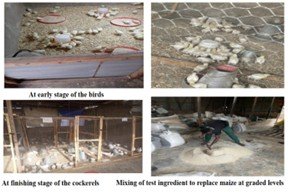
This study evaluated the effects of replacing maize with gaari-waste on the performance and nutrient digestibility of cockerels. One hundred and twenty cockerels were fed diets with 0%, 25%, 50% and 75% gaari-waste replacing maize for 70 days to determine the optimal level of gaari-waste inclusion in the cockerel diets. Experiments was conducted under completely randomized design (CRD) design using four dietary treatments, three replicates, and ten birds per replicate. Results revealed no significant difference (p>0.05) in feed intake, weight gain and feed conversion ratio among treatments. Birds fed diet-1, diet-3 and diet-4 at the starter phase had the highest values of weight gain 40.41g, 33.26g and 30.66g, respectively while weight gains decreased as the inclusion levels of garri-waste increased as followed 45.77g, 43.03g, 38.77g and 35.67g for T1, T2, T3 and T4 across dietary treatments, respectively. The highly significant (p<0.05) effect of crude protein (82.91), fiber (53.33) and dry matter digestibility (46.14) were observed with T2 treatment, the least (68.63%) crude protein digestibility was obtained on the T1 treatment while ash and dry matter digestibility with T4 treatment had the least significant (p<0.05) effect of 30.77% and 22.08%, respectively. Conclusively, garri-waste can replace maize in cockerels’ diets up to 75% without adverse effects on growth performance and apparent nutrient digestibility, offering a cost-effective alternative to maize.
Downloads
References
Adeola, O., & Akinola, O. (2018). Poultry production in Nigeria; Challenges and opportunity. Journal of poultry Science, 55(2), 123-135. https://doi.org/10.3382/ps/pe408
Buitrago, J. A., Ospina, B., Gil, J. L., & Aparicio, H. (2002). Cassava root and leaf meals as the main ingredients in poultry feeding: some experiences in Columbia. pp. 523-541. https://doi.org/10.1016/S0377-8401(01)00276-5
Durunna, C.S., Udedibie, A.B.I, & Uchegbu, M.C. (2005). Effect of dietary inclusion of anthonata macrophyla meal on performance of broiler starter chicks. Nigerian Journal of Animal Science, 32: 268-273.
Enwelim, R. (2025). Utilization of cassava by-products in poultry feed. Nigerians Journal of Animal Production, 52(1), 1-10. https://doi.org/10.4314/njas.v52i1.1
FAO (2018). Food and Agriculture Organization of the United Nations. Cassava production and processing. Maplandia (2016). Lagos 3D map in Google Earth.
NRC, National Research Council. (1994). Nutrient requirements of Poultry. National Academies Press. https://doi.org/10.17226/2114
Ogunji, J. & Okoye, F. (2017). Utilization of cassava by-products in poultry feed. Nigerian Journal of Animal Production, 44(1), 211-220. https://doi.org/10.4314/NJAS.V44i1.21
Ojewola, G. S., & Obasi, V. O. (2003). Feed efficiency growth and weight of slaughtered local turkey poults to various level of dietary energy. Animal Science Health, 51, 49-34.
Owen, O. J., Amakiri, A. O., & Ngoka, D. A. (2017). Effect of feeding varying levels of palm kernel cake on the growth performance and carcass characteristics of broiler chickens, Journal of Animal Science, 5(2), 1-6. https://doi.org/10.11648/J.JAS.20170502.11
SPSS, (2021). Statistical Package for Social Students, Version 27. IBM Inc. 444 Michigan Avenue, Chicago IL60611, USA.
Stupak M., H. Vandeschuren, W., Gruisssem & P. Zhang. (2006), Biotechnological approaches to cassava protein improvement. Trends Food Science Technology, 17, 634-641. https://doi.org/10.16/j.tifs.2006.06.004
Unah, U. L., Ekpo, K. O., Ugwuene, M. C., & Ndelekwute, E. K. (2019). Growth performance and economic value of gaari used as a replacement for maize in the diets of local turkeys. https://doi.org/10.31031/APDC.2019.06.000627
Udensi, E. A., Okechukwu, S. O., & Nwosu, D. C. (2024). Nutritional evaluation of gaari waste in poultry diets. Journal of Poultry Science, 61(1), 1-8. https://doi.org/10.3382/PS/PEY408
Downloads
Published
How to Cite
Issue
Section
License
Copyright (c) 2026 Agriculture and Environmental Science Academy

This work is licensed under a Creative Commons Attribution-NonCommercial 4.0 International License.