Gender division of labour in traditional biomass energy systems in rural Nepal
DOI:
https://doi.org/10.26832/24566632.2026.110101Keywords:
Biomass energy, Clean energy transition, Energy poverty, Firewood collection, Gendered labour, Time-use inequalityAbstract
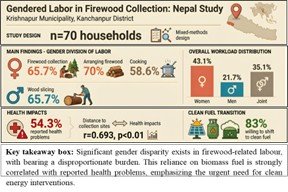
Traditional biomass remains a dominant household energy source in many low- and middle-income countries, yet its gendered labour implications remain insufficiently examined at local scales. This study investigates the gendered division of labour and associated health burdens in firewood-dependent households in Krishnapur Municipality, Kanchanpur district, Nepal. A mixed-methods cross-sectional design was applied combining household surveys (n = 70), focus group discussions, and key informant interviews with forest user groups and ward officials. Quantitative data were analyzed using descriptive statistics, correlation tests and cross-tabulations, while qualitative data provided contextual explanations of labour norms and decision-making. Results revealed a persistent gender asymmetry in firewood-related tasks: women accounted for 65.7% of collection, 70% of arranging, and 58.6% of cooking activities, whereas men predominated in wood slicing (65.7%) and mechanized transportation. Overall, women contributed 43.1% to total workload compared to 21.7% for men and 35.1% jointly. More than half (54.3%) reported health problems linked to carrying and burning firewood, and distance to collection sites was strongly correlated with health complaints (r = 0.693, p < 0.01). Despite high reliance on firewood, 83% of households expressed willingness to shift to cleaner fuels, constrained primarily by economic limitations and forest access. The study contributes empirical evidence to gender-energy scholarship by quantifying task-specific labour burdens and linking them to health risks and time poverty. Findings highlight the need for gender-responsive clean cooking policies, improved financing mechanisms, and targeted community forestry interventions to reduce women’s workload and accelerate equitable energy transitions.
Downloads
References
Acharya, B., & Marhold, K. (2019) Determinants of household energy use and fuel switching behavior in Nepal. Energy, 169, 1132-1138. https://doi.org/10.1016/j.energy.2018.12.109
Agarwal, B. (2009). Gender and forest conservation: The impact of women’s participation in community forest governance. Ecological Economics, 68(11), 2785–2799. https://doi.org/10.1016/j.ecolecon.2009.04.025
Ang’u, C., Muthama, N.J., Mutuku, M.A., M’IKiugu, M.H. (2023). Determinants of the sustained use of household clean fuels and technologies: Lessons from Vihiga county, Kenya. Energy Reports, 9, 1990-2001. https://doi.org/10.1016/j.egyr.2023.01.026
Blackden, C. M., & Wodon, Q. (Eds.). (2006). Gender, time use, and poverty in sub-Saharan Africa. World Bank. https://doi.org/10.1596/978-0-8213-6561-8
Ibe, K. K., & Kollur, S.P. (2024). Challenges towards the adoption and use of sustainable cooking methods: socio-economic and technical perspectives. Sustainable Environment, 10, 1, 2362509. https://doi.org/10.1080/27658511.2024.2362509
IEA, International Energy Agency. (2022). Tracking SDG 7: The energy progress report 2022. IEA, World Bank, IRENA, WHO. https://www.iea.org/reports/tracking-sdg7-2022
Kadota, J. L., McCoy, S.I., Bates, M.N., Mnyippembe, A., Njau, P.F., Prata, N., & Harris-Adamson, C. (2020). The Impact of Heavy Load Carrying on Musculoskeletal Pain and Disability Among Women in Shinyanga Region, Tanzania. Annals of Global Health, 86(1), 1-13. https://doi.org/10.5334/aogh.2470
Lamm, K. W., Lamm, A. J., & Edgar, D. (2020). Scale Development and Validation: Methodology and Recommendations. Journal of International Agricultural and Extension Education, 27(2), 24-35. https://doi.org/10.5191/jiaee.2020.27224
Laudari, H. K., Sapkota, L.M., Maraseni, T., Subedi, P., Pariyar, S., Kaini, T.R., Lopchan, S.B., Weston, C., Volkova, L. (2024). Community forestry in a changing context: A perspective from Nepal’s mid-hill. Land Use Policy, 138, 107018. https://doi.org/10.1016/j.landusepol.2023.107018
Pachauri, S., & Rao, N. D. (2013). Gender impacts and determinants of energy poverty: Evidence from India. Current Opinion in Environment Sustainability, 5(2), 205–215. https://doi.org/10.1016/j.cosust.2013.04.006
Pokharel, T. R., & Rijal, H. B. (2021). Energy Transition toward Cleaner Energy Resources in Nepal. Sustainability, 13(8), 4243. https://doi.org/10.3390/su13084243
Ramirez, C., Khavari, B., Oberholzer, A., Ghimire, B.R., Mishra, B., Sinclair-Lecaros, S., Mentis, D., Gurung, A., Khatiwada, D., Nerini, F.F., (2024). Achieving Nepal’s clean cooking ambitions: a geospatial and policy analysis. The Lancet Planetary Health, 8(10), E754-E765. https://doi.org/10.1016/S2542-5196(24)00209-2
Ranabhat, C.L., Kim, C.B., Kim, C.S., Jha, N., Deepak, K.C., & Connel, F.A. (2015). Consequence of indoor air pollution in rural area of Nepal: a simplified measurement approach. Frontier in Public Health, 26(3)5. https://doi.org/10.3389/fpubh.2015.00005
Rodgers, Y. V. der M. (2024). Time Poverty: Conceptualization, Gender Differences, and Policy Solutions. Social Philosophy and Policy, 40(1),79-102. https://doi.org/10.2139/ssrn.4286895
Schwinger, C., Kvestad, I., Chandyo, R.K., Ulak, M., Shrestha, M., Ranjitkar, S., Strand, T.A. (2022). The association between biomass fuel use for cooking and linear growth in young children in Bhaktapur, Nepal. Environment International, 161, 107089. https://doi.org/10.1016/j.envint.2022.107089
Sharma, L. K., & Baral, A. K. (2025). Firewood dependency and the shift to biogas in rural Nepal: Evidence from Koshi Province. Journal of Development and Administrative Studies, 33(1), 1–6. https://doi.org/10.3126/jodas.v33i1.80787
Stroud, L., Green, E., & Cronje, J. (2020). A revision process that bridges qualitative and quantitative assessment. Psychology, 11(03), 436. https://doi.org/10.4236/psych.2020.113029
Tornel-Vázquez, R., Iglesias, E., & Loureiro, M. (2024). Adoption of clean energy cooking technologies in rural households: the role of women. Environment and Development Economics, 29(6), 499-517. https://doi.org/10.1017/S1355770X24000226
WHO, World Health Organization. (2021). Household air pollution and health. https://www.who.int/news-room/fact-sheets/detail/household-air-pollution-and-health
Downloads
Published
How to Cite
Issue
Section
License
Copyright (c) 2026 Agriculture and Environmental Science Academy

This work is licensed under a Creative Commons Attribution-NonCommercial 4.0 International License.