Impact of agricultural subsidy on maize farming in Rukum-west of Nepal
DOI:
https://doi.org/10.26832/24566632.2026.110102Keywords:
Agricultural technologies, Maize productivity, Marginalized farmers, Subsidy receiversAbstract
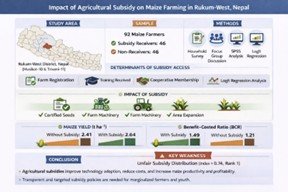
This study was conducted to access the status, impact, and factors affecting access of agricultural subsidies among maize farmers in Rukum-west of Nepal. The data was collected from 92 farmers; 46 subsidy receivers and 46 subsidy non-receivers using purposive multi-stage sampling technique. The major determinants of subsidy access identified through logit regression model were found to be farm registration, training, and co-operative membership. This study revealed positive impact of subsidy in adoption of agricultural technologies like certified seeds and machinery and increase in maize cultivation area. Total cost of cultivation was found to be $163.58 (NRs 23773) for subsidy receivers and $179.27 (NRs 26054) for subsidy receivers significant at 1% with p- value 0.0004. Agricultural subsidy for maize farming was effective in reduction of cost of land preparation, sowing, and shelling was found significant with p- value 0.03, 0.04 and 0.003, respectively. Maize productivity and benefit-cost ration for subsidy receivers was found to be 2.64 t/ha and 1.49, respectively, which was higher compared to non-receivers found to be 2.41 t/ha and 1.21, respectively. Farmers ranked unfair distribution with index 0.74 as the major weakness in current subsidy model. This study suggests input subsidies as an important policy medium to increase maize yield and economic return, thereby contributing towards growing demand for food and feed. However, concerned policy makers should develop strategic transparent framework for subsidy distribution targeting youths and marginalized farmers to ensure long-term food security in the country.
Downloads
References
Adhikari, S., Timsina, K., Brown, P., Ghimire, Y., & Lamichhane, J. (2018). Technical efficiency of hybrid maize production in eastern terai of Nepal: A stochastic frontier approach. Journal of Agriculture and Natural Resources, 1, 189–196. https://doi.org/10.3126/janr.v1i1.22234
Adhikari, B., Gupta, D., Pandey, P., & Fischer, H. (2023). Learning from adversity: Small-scale commercial farming in Nepal amidst COVID-19 pandemic. New Angle: Nepal Journal of Social Science and Public Policy, 8(1), 90–110. https://doi.org/10.53037/9k8k4854
Bhandari, T. (2023). Assessment of Government Policies, Farm Subsidies, and Agriculture Growth. State, Society and Development: PMPD Perspectives, 1(1), 125–136. https://doi.org/10.3126/ssd.v1i1.58475
Bharati, S., Bhandari, T., Panta, H. K., & Thapa, B. (2025). Understanding allocation and farmers’ access to varied levels of agricultural input subsidies from different tiers of government: A case study in Kavrepalanchowk District, Nepal. Agriculture Development Journal, 17(1). https://doi.org/10.3126/adj.v17i1.66445
Bista, R. D., Dhungel, S., & Adhikari, S. (2016). Status of fertiliizer and seed subsidy in Nepal: review and reommendation. Nepal Journals Online, 17. https://doi.org/10.3126/aej.v17i0.19854
Chaulagai, B., Nepal, I., Yadav, S., Shrestha, P., Parajuli, A., & Shrestha, S. (2025). Assessment on Impact of Agricultural Subsidies on Potato Production: Evidence from Syangja, Nepal. Agro Environmental Sustainability, 3(2), 100–110. https://doi.org/10.59983/s2025030202
Ciaian, Pavel & Swinnen, Johan F.M. (2008). Credit Market Imperfections and the Distribution of Policy Rents, 2008 International Congress, August 26-29, 2008, Ghent, Belgium 44050, European Association of Agricultural Economists https://ideas.repec.org/p/ags/eaae08/44050.html
Chhetri, S., Adhikari, P., Bhattarai, S., & Ghimire, S. (2024). Differential economic assessment of maize grain and seed production in the maize zone of Rukum West, Nepal. The Lumbini Agriculture Journal, 3, 121–138.
Dlamini, S.G., Ogunniyi, L.T., Vilane, F.M. and Fanifosi, G.E. (2019). Impact of agricultural input subsidy on productivity of small-scale maize farmers in the Hhohho Region of Eswatini. International Journal of Development and Sustainability, 8(12), 785-794. https://isdsnet.com/ijds-v8n12-02.pdf
Dame, E., SMM // Marketing Communications: Web // University of Notre. (2024). Does Subsidizing Seed Help Farmers? Pulte Study Examines Nepal’s Rice Seed Subsidies // Pulte Institute for Global Development // University of Notre Dame. Pulte Institute for Global Development. https://pulte.nd.edu/news/does-subsidizing-seed-help-farmers-pulte-study-examines-nepals-rice-seed-subsidies/
Dhakal, S., Pandey, S., Chapagain, S., Devkota, Y., Sunar, M., & Khanal, S. (2024). Factors affecting the adoption of farm mechanization in Rupandehi, Nepal. Archives of Agriculture and Environmental Science, 9(3), 409–413. https://doi.org/10.26832/24566632.2024.090301
Dhakal, S., Sah, S. K., Amgain, L. P., & Dhakal, K. H. (2022). Maize Cultivation: Present Status, Major Constraints and Farmer’s Perception at Madichaur, Rolpa. Journal of Agriculture and Forestry University, 5, 125–132. https://doi.org/10.3126/jafu.v5i1.48454
Field, A. (2018). Discovering statistics using IBM SPSS statistics. 5th Edition, Sage, Newbury Park.
Garrett, H. E., & Woodworth, R. S. (1969). Statistics in psychology and education (6th ed.). Vakils, Feffer and Simons. https://arunodayauniversity.ac.in/wp-content/uploads/2025/01/Statistics-In-Psychology-And-Education-Garrett.pdf
Gautam, S., Choudhary, D., & Rahut, D. B. (2022). Behavior of Private Retailers in a Regulated Input Market: An Empirical Analysis of the Fertilizer Subsidy Policy in Nepal. Asian Development Review, 39(02), 175–199. https://doi.org/10.1142/S0116110522500135
Ghimire, S. Subedi, Y. N., & Devkota, D. (2018). Socio-economic assessment on maize production and adoption of open pollinated improved varieties in Dang, Nepal. Journal of Maize Research and Development, 3(1), 17–27. https://doi.org/10.3126/jmrd.v3i1.18916
Isaac, M., Wachira, A., & Mwenda, L. (2019). Effects of government input subsidy program on maize production in Uazin-Gishu. https://api.semanticscholar.org/CorpusID:195520376
Joshi, B., Adhikari, G. M., & Rai, H. (2024). Food Insecurity, Food Grain Imports, and Agricultural Exports in Nepal: A Data Analysis Comparison (1990–2023). Patan Prospective Journal, 4(2). https://doi.org/10.3126/ppj.v4i2.79146
Karki, N.A., Choudhary, D., Pandit, N.R., & Khanal, N. (2025) Impact of training and digital extension services on agricultural technology adoption and rice yields. PLoS One, 20(12): e0337456. https://doi.org/10.1371/journal.pone.0337456
Kodmaya, S. (2011). Agricultural Policies and Food Security of Smallholder Farmers in Zambia. African Study Monograph, 42, 19-39. https://repository.kulib.kyoto-u.ac.jp/bitstream/2433/139286/1/ASM_S_42_19.pdf
Khatri, N., Dhungana, S. M., Devkota, R., & Budhathoki, P. (2025). Impact of agricultural subsidy on three cereal crops cultivated in Dailekh district, Nepal. Archives of Agriculture and Environmental Science, 10(2), 210–215. https://doi.org/10.26832/24566632.2025.100203
Kumar, A., Takeshima, H., Thapa, G., Adhikari, N., Saroj, S., Karkee, M., & Joshi, P. K. (2020). Adoption and diffusion of improved technologies and production practices in agriculture: Insights from a donor-led intervention in Nepal. Land Use Policy, 95(C). https://ideas.repec.org//a/eee/lauspo/v95y2020ics0264837719318587.html
McHugh, M. L. (2013). The chi-square test of independence. Biochemia Medica, 23(2), 143–149. https://doi.org/10.11613/BM.2013.018
MOALD (2022). Statistical Information on Nepalese Agriculture, 2079/80 (2022/23). https://giwmscdnone.gov.np/media/pdf_upload/MOALD-Statical-Book-Magre-2081-Final_wgfs8ph.pdf
Neupane, H., Paudel, K. P., Adhikari, M., & He, Q. (2022). Impact of cooperative membership on production efficiency of smallholder goat farmers in Nepal. Annals of Public and Cooperative Economics, 93(2), 337–356. https://doi.org/10.1111/apce.12371
Neupane, P., & Devkota, N. P. (2025). Comparative Economic Analysis of Maize Seed and Grain Production in Gulmi, Nepal. Agribusiness Management in Developing Nations, 3(1), 20–25. https://doi.org/10.26480/amdn.01.2025.20.25
Panta, H. K., Thapa, S., Poudel, S., GC, A., & Regmi, K. (2023). Effect of agricultural subsidy on farm income of commercial vegetable farmers of Makwanpur and Dhading districts, Nepal. International Journal of Research and Review, 10(9), 280–289. https://doi.org/10.52403/ijrr.20230940
Si, C., Li, Y., & Jiang, W. (2023). Effect of Insurance Subsidies on Agricultural Land-Use. International Journal of Environmental Research and Public Health, 20(2), 1493. https://doi.org/10.3390/ijerph20021493
Subedi, S., Ghimire, Y. N., & Devkota, D. (2017). Socio-economic assessment on maize production and adoption of open pollinated improved varieties in Dang, Nepal. Journal of Maize Research and Development, 3(1), 17-27. doi: http://dx.doi.org/10.3126/jmrd.v3i1.18916
Thapa, R. (2021). A Detail Review on Status and Prospect of Maize Production in Nepal. Food and Agri Economics Review, 1(1), 52–56. https://doi.org/10.26480/faer.01.2021.52.56
Thapa, S., Panta, H. K., Poudel, S., Gc, A., Regmi, K., & Basnet, M. (2023). Factors Affecting Farmers’ Access to Agricultural Subsidy in Makwanpur and Dhading Districts of Nepal. SAARC Journal of Agriculture, 21(2), 263–276. https://doi.org/10.3329/sja.v21i2.68550
Timsina, K. P., Ghimire, Y. N., & Lamichhane, J. (2016). Maize production in mid hills of Nepal: From food to feed security. Journal of Maize Research and Development, 2(1). https://doi.org/10.3126/jmrd.v2i1.1621
Tranmer, M., & Elliot, M. J. (2016). Binary Logistic Regression Mark Tranmer Mark Elliot. https://hummedia.manchester.ac.uk/institutes/cmist/archive-publications/working-papers/2008/2008-20-binary-logistic-regression.pdf
Yogi, L., Thalal, T., & Bhandari, S. (2025). The Role of Agriculture in Nepal’s Economic Development: Challenges, Opportunities, and Pathways for Modernization. Heliyon, 11, e41860. https://doi.org/10.1016/j.heliyon.2025.e41860
Zafar, S., Aarif, M., & Tarique, Md. (2023). Input subsidies, public investments and agricultural productivity in India. Future Business Journal, 9(1), 54. https://doi.org/10.1186/s43093-023-00232-1
Downloads
Published
How to Cite
Issue
Section
License
Copyright (c) 2026 Agriculture and Environmental Science Academy

This work is licensed under a Creative Commons Attribution-NonCommercial 4.0 International License.