Impact of human activities on Ganga River water during Kanwar Mela 2024 in Rishikesh-Haridwar region, Uttarakhand, India
DOI:
https://doi.org/10.26832/24566632.2025.1002016Keywords:
Anthropogenic activity, Mass bathing, Microbiological parameter, Physico-chemical parameter, Water qualityAbstract
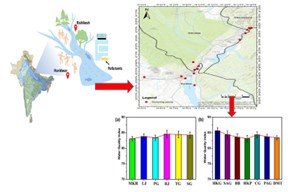
The present investigation was conducted to study the water quality of the Ganga River during Kanwar Mela 2024 concerning physicochemical and microbiological characteristics in the Rishikesh-Haridwar region. Water samples were collected from fifteen designated sites, including six in Rishikesh, seven in Haridwar, and two outlet points—one from the main river stream and one from the Ganga canal. Among all sites, Har ki Pauri Ghat (HKP) exhibited the highest average levels of several key indicators of pollution: TDS (125.04 ± 34.18 mg/l), pH (7.52 ± 0.14), alkalinity (94.06 ± 10.31 mg/ml), total hardness (117.56 ± 16.43 mg/ml) BOD (2.41 ± 0.58 mg/l), COD (7.41 ± 0.87 mg/l). This site also recorded the lowest average level of DO (9.81 ± 0.63 mg/l) and the highest microbial contamination, with total coliform (2008.81 ± 188.25 MPN/100ml) and E. coli (884.8 ± 57.62 MPN/100ml), marking it as the most polluted location. The second most polluted site, Purnanand Ghat (PG) in Rishikesh, showed the highest concentration of fluoride (0.10 ± 0.09 mg/l). These findings indicated that mass bathing and associated religious activities during the Kanwar Mela significantly impacted the water quality of the Ganga River, particularly in densely visited pilgrimage zones, contributing to elevated levels of pollution. The outcomes of this study underscore the urgent need for robust water quality monitoring, public health risk assessment, and the implementation of sustainable water management policies during mass gatherings to protect the ecological integrity of the river and safeguard the health of millions who rely on it for religious, domestic, and agricultural purposes.
Downloads
References
APHA. (2022). Standard Methods for the Examination of Water and Wastewater. American Public Health Association, 24th edition, Washington, DC: APHA Press; 2023. https://www.standardmethods.org/24theditioncitation
BIS. (2021). Bureau of Indian Standards Specification for drinking water. IS: 10500:2012, Amendment No. 3. Bureau of Indian Standards, New Delhi, India. https://www.scribd.com/document/656107401/10500A3
Bhutiani, R., Tyagi, P., & Ruhela, M. (2012). Assessment of water quality of River Ganges during Kumbh Mela 2010. Environment Conservation Journal, 13(3), 165–169. https://doi.org/10.36953/ECJ.2012.130327
Haritash, A. K., Gaur, S., & Garg, S. (2016). Assessment of water quality and suitability analysis of river Ganga in Rishikesh, India. Applied Water Science, 6(4), 383–392. https://doi.org/10.1007/s13201-014-0235-1
Kansal, A., Siddiqui, N. A., & Gautam A. (2013). Assessment of heavy metals and their interrelationships with some physics-co-chemical parameters in eco-efficient rivers of Himalayan Region. Environmental Monitoring and Assessment, 185(3), 2553–63. https://doi.org/10.1007/s10661-012-2730-x
Khandi, R. M., & Srivastava, S. (2016). Impact of tourism on water quality characteristics of Lidder Stream at Pahalgam, (J&K), India. Archives of Agriculture and Environmental Science, 1(1), 37–42. https://doi.org/10.20935/AcadEnergy7556
Kumar, V., & Chopra, A. K. (2012). Hydrological characteristics of abandoned Old Ganga Canal at Haridwar (Uttarakhand) India. Journal of Chemistry and Pharmaceutical Research, 4(11), 4774–4782. https://api.semanticscholar.org/CorpusID:54929608
Kumar, V., Kumar, S., Srivastava, S., Singh, J., & Kumar, P. (2018). Water quality of River Ganga with reference to physico-chemical and microbiological characteristics during Kanwar Mela 2017, at Haridwar, India: A case study. Archives of Agriculture and Environmental Science, 3(1), 58–63. https://doi.org/10.26832/24566632.2018.030108
Mohamed, S., & Ahmed, A.W. (2011). Water pollution and riverbank filtration for water supply along River Nile, Egypt. In: Riverbank Filtration for Water Security in Desert Countries, 5C. Ray and M. Shamrukh (eds.), 1–25.
https://doi.org/10.1007/978-94-007-0026-0_2
Oladeji, S. O. (2017). Evaluation of nickel levels in wastewater, soil and vegetable samples grown along Kubanni stream channels in Zaria, Kaduna State, Nigeria. Archives of Agriculture and Environmental Science, 2(3), 141–147.
https://journals.aesacademy.org/index.php/aaes/article/view/02-03-02
Ramakrishnaiah, C.R., Sadashivaiah, C., & Ranganna G. (2009). Assessment of water quality index for the groundwater in Tumkur Taluk, Karnataka State, India. E-Journal of Chemistry, 6(2), 523–530. https://doi.org/10.1155/2009/757424
Singh, M., & Singh, A. K. (2007). Bibliography of environmental studies in natural characteristics and anthropogenic influences on the Ganga River. Environmental Monitoring and Assessment, 129, 421–432. https://doi.org/10.1007/s10661-006-9374-7
Simeonov, V., Stratis, J. A., Samara, C., Zachariadis, G., Voutsa, D., Anthemidis, A., Sofoniou, M., & Kouimtzis, T. (2003). Assessment of the surface water quality in Northern Greece. Water Research, 37, 4119–4124. https://doi.org/10.1016/S0043-1354(03)00398-1
Yadav, S., & Bhatia R.K. (2020). Assessment of mass bathing on River Ganga water quality during Kumbh Mela 2019 in Prayagraj, Uttar Pradesh, India. International Research Journal of Engineering and Technology, 7(7), 4757–4762. https://doi.org/10.1016/j.gsd.2022.100750
Yasir & Srivastava, S. (2016). Monitoring of ground water quality in the province of district Dehradun, (Uttarakhand), India. Archives of Agriculture and Environmental Science, 1(1), 43–48. https://journals.aesacademy.org/index.php/aaes/article/view/aaes-01-01-06
Downloads
Published
How to Cite
Issue
Section
License
Copyright (c) 2025 Agriculture and Environmental Science Academy

This work is licensed under a Creative Commons Attribution-NonCommercial 4.0 International License.