Farmer’s perception and adaptation strategies to climate change on potato farming in Narayan Municipality of Dailekh district, Nepal
DOI:
https://doi.org/10.26832/24566632.2025.1002018Keywords:
Climate change, Farmers adaptation, Respondents, Education and trainingAbstract
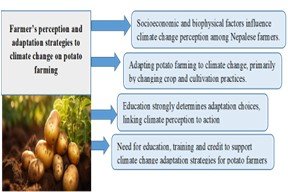
This study was aimed to assess farmer’s perceptions of climate change and their adaptations in potato farming in Dailekh District, Nepal. A total of 97 randomly selected respondents were selected for the study. Primary data was collected through focus group discussions, direct observation, semi-structured questionnaires while secondary data was collected through review of relevant literature. The data was analyzed using descriptive statistics, time series regression, Logit, and Seemingly Unrelated Regression model (SUR). By analyzing the farmer perception of climate change, 75.26% of the respondent experience climate change. In contrast to 84.5% farmer perceived increased temperature, 94.85% believed decrease rainfall duration with increase in rainfall intensity. The key variables determining the climate change perception of farmer were: socio-economic variables (education, farming experience, and family size) and bio-physical variables (increase in drought, change in insect pests and diseases and lack of irrigation). Based on the study, 58.76% of the farmers adopted climate adaptations. Farmers primarily adapted to climate change through changing potato variety (61.86%),
adjusting planting/harvesting time (64%), changing planting method (71.13%), pest’s management, irrigation, fertilizers, and crop rotation. Logistic regression revealed higher education and attainment of training increased adaptation by 9% and 18.54%, respectively. A link was found between farmers’ perception of climate change and the implementation of some adaptation options. Thus, socioeconomic and biophysical variables have a significant association with adaptation, as well as investment in education, extension training, and access to credit, and can be considered to increase climate change adaptation to improve farmers' well-being.
Downloads
References
AITC. (2019). Krishi Diary. Retrieved from https://aitc.gov.np/uploads/documents/agriculture-duary-2076-46662pdf-7084-940-1694580900.pdf
Amadou, T., Falconnier, G. N., Mamoutou, K., Georges, S., Alassane, B. A., François, A., Michel, G., & Benjamin, S. (2022). Farmers’ perception and adaptation strategies to climate change in central Mali. Weather, Climate, and Society, 14(1), 95–112. https://doi.org/10.1175/WCAS-D-21-0003.1
Asrat, P., & Simane, B. (2018). Farmers’ perception of climate change and adaptation strategies in the Dabus watershed, north-west Ethiopia. Ecological Processes, 7(1), 7. https://doi.org/10.1186/s13717-018-0118-8
Ayanlade, A., Oladimeji, A. A., Okegbola, O. M., Eludoyin, A. O., Eslamian, S., Ayinde, A. F. O., & Perkins, P. E. (2022). Effect of climate change on water availability and quality: An assessment of socio-resilience in Nigeria. In S. Eslamian & F. Eslamian (Eds.), Disaster Risk Reduction for Resilience (pp. 245–262). Springer International Publishing. https://doi.org/10.1007/978-3-030-99063-3_11
Bessah, E., Raji, A. O., Taiwo, O. J., Agodzo, S. K., Ololade, O. O., Strapasson, A., & Donkor, E. (2021). Gender-based variations in the perception of climate change impact, vulnerability and adaptation strategies in the Pra River Basin of Ghana. International Journal of Climate Change Strategies and Management, 13(4/5), 435–462. https://doi.org/10.1108/IJCCSM-02-2020-0018
Boansi, D., Tambo, J. A., & Müller, M. (2017). Analysis of farmers’ adaptation to weather extremes in West African Sudan Savanna. Weather and Climate Extremes, 16, 1–13. https://doi.org/10.1016/j.wace.2017.03.001
Chemeda, B. A., Wakjira, F. S., & Birhane, E. (2023). Determinants of perception of climate change and adaptation strategies of coffee-based agroforestry farmers in western Ethiopia. Emerald Open Research, 1(6). https://doi.org/10.1108/EOR-06-2023-0010
Guan, K., Sultan, B., Biasutti, M., Baron, C., & Lobell, D. B. (2017). Assessing climate adaptation options and uncertainties for cereal systems in west Africa. Agricultural and Forest Meteorology, 232, 291–305. https://doi.org/10.1016/j.agrformet.2016.07.021
Gujrati, D. N. (2003). Basic Econometrics. In D. N. Gujarati. USA: The McGraw-Hili Companies. https://zalamsyah.staff.unja.ac.id/wp-content/uploads/sites/286/2019/11/7-Basic-Econometrics-4th-Ed.-Gujarati.pdf
Hue, V. T. M., Shin, H.-J., & Tien Da, N. (2023). Farmers’ awareness and adaptation measures to climate change in Lai Chau Province, Vietnam. FFTC Agricultural Policy Platform (FFTC-AP). Retrieved from https://ap.fftc.org.tw/article/3413
Jirel, S., Sharma, R., & Gyawali, S. (2018). Factors affecting the adoption of improved maize cultivation practices in Sindhupalchowk district, Nepal. Journal of Maize Research and Development, 4(1), 60-69.
Kulkarni, A., Patwardhan, S., Kumar, K. K., Ashok, K., & Krishnan, R. (2013). Projected Climate Change in the Hindu Kush–Himalayan Region By Using the High-resolution Regional Climate Model PRECIS. Mountain Research and Development, 33(2), 142–151. https://doi.org/10.1659/MRD-JOURNAL-D-11-00131.1
Kuponiyi, E., Ogunlade, F. A., & Jo, O. (2010). Farmers perception of impact of climate changes on food crop production in Ogbomosho agricultural zone of Oyo State, Nigeria. Global Journal of Human Social Science, 10, 33-40.
Liu, Z., Smith, W. J., & Safi, A. S. (2014). Rancher and farmer perceptions of climate change in Nevada, USA. Climatic Change, 122(1–2), 313–327. https://doi.org/10.1007/s10584-013-0979-x
Maddison, D.J. (2007). The Perception of and Adaptation to Climate Change in Africa. World Bank Policy Research Working Paper No. 4308. https://papers.ssrn.com/sol3/papers.cfm?abstract_id=1005547.
Mairura, F. S., Musafiri, C. M., Kiboi, M. N., Macharia, J. M., Ng’etich, O. K., Shisanya, C. A., Okeyo, J. M., Mugendi, D. N., Okwuosa, E. A., & Ngetich, F. K. (2021). Determinants of farmers’ perceptions of climate variability, mitigation, and adaptation strategies in the central highlands of Kenya. Weather and Climate Extremes, 34, 100374. https://doi.org/10.1016/j.wace.2021.100374
MoALD. (2024) Statistical Information on Nepali Agriculture FY 2023/24 Singhadurbar, Kathmandu, Nepal. https://giwmscdnone.gov.np/media/pdf_upload/MOALD-Statical-Book-Magre-2081-Final_wgfs8ph.pdf
Ndambiri, H. K., Ritho, C. N., & Mbogoh, S. G. (2013). An evaluation of farmers’ perceptions of and adaptation to the effects of climate change in Kenya. International Journal of Food and Agricultural Economics, 1, 75-96. https://doi.org/10.22004/AG.ECON.156144
Nhemachena, C., & Hassan. (2007). Micro-level analysis of farmers’ adaptation to climate change in southern Africa. Retrieved from https://www.researchgate.net/publication/5056602_Micro-Level_Analysis_of_Farmers'_Adaptation_to_Climate_Change_in_Southern_Africa
Rai, R., Zhang, Y., Paudel, B., Yan, J., & Khanal, N. R. (2023). Analysis of farmers’ perceptions of climate changes and adaptation strategies in the transboundary Gandaki River Basin. Land, 12(11), 2054. https://doi.org/10.3390/land12112054
Risal, A., Urfels, A., Srinivasan, R., Bayissa, Y., Shrestha, N., Paudel, G. P., & Krupnik, T. J. (2022). Impact of climate change on water resources and crop production in western Nepal: Implications and adaptation strategies. Hydrology, 9(8), 132. https://doi.org/10.3390/hydrology9080132
Sengupta, T. (1967). A simple adoption scale for selection of high yielding varieties programme on rice. Indian Journal of Extension Education, 3, 107-115.
Sharma, O., & Shrestha, K. (2023). Exploring agroecological farming for Karnali Province, Nepal—ICIMOD. https://www.icimod.org/article/agroecological-farming-karnali-nepal/
Sultan, B., & Gaetani, M. (2016). Agriculture in west Africa in the twenty-first century: Climate change and impacts scenarios, and potential for adaptation. Frontiers in Plant Science, 7, 1262. https://doi.org/10.3389/fpls.2016.01262
Tamm, O., Saaremäe, E., Rahkema, K., Jaagus, J., & Tamm, T. (2023). The intensification of short-duration rainfall extremes due to climate change – Need for a frequent update of intensity–duration–frequency curves. Climate Services, 30, 100349. https://doi.org/10.1016/j.cliser.2023.100349
Taylor, C. M., Belušić, D., Guichard, F., Parker, D. J., Vischel, T., Bock, O., Harris, P. P., Janicot, S., Klein, C., & Panthou, G. (2017). Frequency of extreme Sahelian storms tripled since 1982 in satellite observations. Nature, 544(7651), 475–478. https://doi.org/10.1038/nature22069
Timilsina, R. H., Ojha, G. P., Nepali, P. B., & Tiwari, U. (2019). Agriculture land use in Nepal Prospects and impacts on food security. Journal of Agriculture and Forestry University, 3, 1-9.
Walker, S., & Ogindo, H. O. (2003). The water budget of rainfed maize and bean intercrop. Physics and Chemistry of the Earth, Parts A/B/C, 28(20–27), 919–926. https://doi.org/10.1016/j.pce.2003.08.018
Downloads
Published
How to Cite
Issue
Section
License
Copyright (c) 2025 Agriculture and Environmental Science Academy

This work is licensed under a Creative Commons Attribution-NonCommercial 4.0 International License.