Integrated nutrient management for watermelon (Citrullus lanatus Thunb) cultivation in Rapti riverbed, Dang, Nepal
DOI:
https://doi.org/10.26832/24566632.2025.1002026Keywords:
Chemical fertilizer, INM, Neem seed cake powder, Watermelon cv. MastanaAbstract
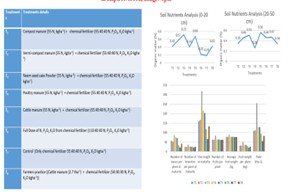
A field experiment was conducted at riverbed of Rapti River, Dang, Nepal from January to June, 2019 to assess the integrated nutrients management (INM) for watermelon cultivation at riverbed. The experiment was laid out in Randomized Complete Block Design with three replications and eight treatments (compost manure + chemical fertilizer, vermicompost + chemical fertilizer, neem seedcake powder+ chemical fertilizer, poultry manure+ chemical fertilizer, cattle manure+ chemical fertilizer, 100% from chemical fertilizer alone, control, and farmers practice).“Mastana” variety of watermelon was used for evaluating various combination of organic and inorganic fertilizer for yield, nutrient uptake and residual soil nutrient status. Among these treatments, neem seedcake powder (55 N kgha-1) + N, P2O, K2O (55:40:40 kgha-1) from inorganic fertilizer was better with growth parameters such as vine length, number of branches, number of leaves and yield parameters like fruit weight/plant and yield (tha-1) than other treatments and significantly superior to control plot. Effect of INM on soil parameters like soil pH, total nitrogen (%), available phosphorus (kgha-1) and available potassium (kgha-1) at 0-20 and 20-50 cm depth and organic manure (%) at soil depth 20-50 cm were non-significant. The organic manure content at 0-20 cm depth was highest when neem seedcake powder+ chemical fertilizer was applied which was statistically similar with other treatments of INM but significantly higher than full dose of NPK from chemical fertilizer and control. Therefore, integration of neem seedcake powder (55N kgha-1) with chemical fertilizer NPK (55: 40: 40 kgha-1) would be best fitted for watermelon, in riverbed cultivation.
Downloads
References
Aguyoh, J. N., Audi, W., Saidi, M., & Gao-Qiong, L. (2010). Growth, yield and quality response of watermelon (Citrullus lanatus [thunb] mansf. & nakai) cv. crimson sweet) subjected to different levels of tithonia manure. International Journal of Science and Nature, 1(1), 7–11. http://www.scienceandnature.org/IJSN/IJSN_V1(1)_S2010/IJSN-2.pdf
Arora, A. (2024). Most Watermelon Producing Country in the World. https://currentaffairs.adda247.com/most-watermelon-producing-country-in-the-world/
Asafa, R.F., Ojeleye, A.E., & Akanbi, W.B. (2022). Impact of fertilizer sources and water supplies on the growth and yield of watermelon varieties in Oyo State, Nigeria. Trends in Agricultural Sciences, 1(2), 51-64. https://doi.org/10.17311/tas.2022.51.64
Brar, B. S., Singh, M. V., Dhillon, N. S., & Benipal, D. S. (2004). Soil quality, crop productivity and sustainable experiences under long-term maize-wheat-cowpea cropping. In Inseptisol research bulletin (pp. 1-90.). Department of soil, Punjab Agricultural University, Ludhiana, Punjab, India.
Chopra, A.K., Payum, T., Srivastava, S., & Kumar, V. (2017). Effects of integrated nutrient management on agronomical attributes of tomato (Lycopersicon esculentum L.) under field conditions. Archives of Agriculture and Environmental Science, 2(2). 86-91. https://journals.aesacademy.org/index.php/aaes/article/view/02-02-05
Devadas, V. S., & Kuriakose, K. P. (2005). Evaluation of different organic manures on yield and quality of pineapple var. Mauritius. Acta Horticulturae, 666, 185–189. https://doi.org/10.17660/ActaHortic.2005.666.17
Eifediyi, E. K., Mohammed, K. O., & Remison, S. U. (2015). Effects of neem (Azadirachta indica L.) seed cake on the growth and yield of okra (Abelmoschus esculentus (L.) Moench). Poljoprivreda, 21(1), 46–52. https://doi.org/10.18047/poljo.21.1.8
Eifediyi, E.K., Ahamefule, H. E., Remison, S. U., Aliyu, T. H., & Akanbi, N. (2017). Effects of neem seed cake and NPK Fertilizer on the growth and yield of sesame (Sesamum indicum L.). Cercetari Agronomice in Moldova, 2(170), 57–72. https://doi.org/10.1515/cerce-2017-0015
Gaur, A. C., Neelakantan, S., & Dargah, K. S. (1992). Organic manures. India Council of Agricultural Research, New Delhi. Available from: https://archive.org/details/organicmanures00unse
Huh, Y., Solmaz, I., & N, S. (2014). Morphological characterization of Korean and Turkish watermelon germplasm. Korean Journal of Agricultural Science, 41(4), 309-314. https://doi.org/10.7744/cnujas.2014.41.4.309
ICIMOD. (2013). Riverbed farming. In Natural Resource Management Approaches and Technologies in Nepal: Technology – Riverbed farming (pp. 1–4). ICIMOD, Kathmandu, Nepal. file:///C:/Users/journ/Downloads/Technology%20(9).pdf
Korah, P. A., & Shingte, A. K. (1968). The effect of non edible oil cakes on the respiratory activity of soil. Agricultural Research Journal of Kerala, India, 6, 95–97.
Kumar, V. (2016). Use of integrated nutrient management to enhance soil fertility and crop yield of hybrid cultivar of brinjal (Solanum melongena L.) under field conditions. Advances in Plants & Agriculture Research, 4(2), 00130. https://doi.org/10.15406/apar.2016.04.00130
Kumari, R., Sharma, A., Bhagta, S., & Kumar, R. (2018). River bed cultivation: A kind of vegetable forcing for remunerative returns. International Journal of Current Microbiology and Applied Sciences, 7(04), 359–365. https://doi.org/10.20546/ijcmas.2018.704.041
Maduagwuna, A. E., Asiegbu, J. E., & Onyeonagu, C. C. (2021). Responses of okra (Abelmoschus esculentus (L.) Moench) varieties to photoperiod.Direct Research Journal of Agriculture and Food Science, 9, 242-252. https://doi.org/10.26765/DRJAFS190385269
MOALD. (2022). Agricultural Statistics Pocket book 2023 | Ministry of Agriculture and Livestock Development. https://moald.gov.np/publication/agricultural-statistics-pocket-book-2023/
MOALD. (2023). Statistical information on nepalese agriculture 2079/80 (2022/2023). Ministry of Agriculture and Livestock Department. https://moald.gov.np/content/42/statistical-information-on-nepalese-agriculture
Pati, A., Subhadarsini, S., Patnaik, L., Raut, D., Nayak, S., & Ganguly, I. (2016). Physico-Chemical Characterization Of Mahanadi River Soil At Dhabaleshwar, Mancheswar, Prasanapur, Kansaripatra, Kundakhai Pathar And Mendhakhia Patha, Cuttack [Odisha]. International Journal of Science, Environment and Technology, 5(1), 119–132.
Paul, G. C., & Mannan, M. A. (2006). Integrated Nutrient Management in Sugarcane to Enhance Sugar Productivity. Proceedings of International Symposium on Technologies to Improve Sugar Productivity in Developing Countries, Gullin, September 2006, 108-121.
Ramesh, S., Gowda, B., Raghu, H. B., & Shivakumar, B. C. (2009). Manurial value of byproducts of bio-fuel feed stocks on finger millet grain and dry fodder productivity. Journal of Applied and Natural Science, 1(2), 241–244. https://doi.org/10.31018/jans.v1i2.64
Schippers, R. (2002). African Indigenous Vegetables. An Overview of the Cultivated Species. Natural Resources Institute/ACP-EU Technical Centre for Agricultural and Rural Cooperation, Chatham, 214.
Sharma, J. P., Rattan, P., & Kumar, S. (2012). Response of vegetable crops to use of integrated nutrient management practices. SABB Journal of Food and Agriculture Science, 2(1), 15–19. https://doi.org/10.5897/ISAAB-JFAS11.029
Sheoran, S., Prakash, D., Yadav, P.K. et al. (2024). Long-term application of FYM and fertilizer N improve soil fertility and enzyme activity in 51st wheat cycle under pearl millet-wheat. Scientific Report, 14, 21695. https://doi.org/10.1038/s41598-024-72076-w
Thakur, D. R., Manuja, S., Mankotia, B. S., Seth, M., & Singh, S. (2020). Efficacy of neem coated urea (NCU) for enhancing productivity of low land rice (Oryza sativa L.). Journal of Crop and Weed, 16(3), 73-77. https://doi.org/10.22271/09746315.2020.v16.i3.1368
Yu, J., Li, Y., Han, G., Zhou, D., Fu, Y., Guan, B., Wang, G.,Ning, K., Wu, H., & Wang, J. (2014a). The spatial distribution characteristics of soil salinity in coastal zone of the Yellow River Delta. Environment and Earth Science, 72, 589–599. https://doi.org/10.1007/s12665-013-2980-0
Yu, J., Qu, F., Wu, H., Meng, L., Du, S., & Xie, B. (2014b). Soil phosphorus forms and profile distributions in the tidal river network region in the yellow river delta estuary. The Scientific World Journal, 912083. https://doi.org/10.1155/2014/912083
Downloads
Published
How to Cite
Issue
Section
License
Copyright (c) 2025 Agriculture and Environmental Science Academy

This work is licensed under a Creative Commons Attribution-NonCommercial 4.0 International License.