Growth performance of Eucalyptus camaldulensis across two distinct sites in Sindhuli district of Nepal
DOI:
https://doi.org/10.26832/24566632.2025.100209Keywords:
Above ground biomass, Flat land vs terrace land, Soil properties, TopographyAbstract
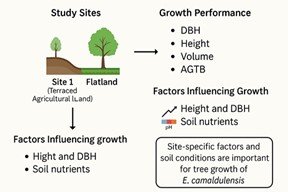
This study evaluated the site-specific growth performance of Eucalyptus camaldulensis plantations in Nepal’s Sindhuli district, comparing -terraced agricultural land (Site 1) and flatland (Site 2) over nine years. The aim was to quantify differences in growth parameters and soil properties to perform sustainable plantation management. Diameter at breast height (DBH), height, basal area, volume, and above-ground total biomass (AGTB) were measured for 314 trees, alongside soil nutrients analysis (pH, organic carbon, N, P, K) from 43 plots. Statistical analyses (Welch’s t-test, regression) were employed to assess site variations. Results revealed significantly (p < 0.001) superior growth in Site 2, with higher mean DBH (9.00 ± 2.61 cm vs. 6.95 ± 3.71 cm), height (7.88 ± 0.80 m vs. 7.01 ± 1.97 m), and AGTB (26.96 ± 17.11 kg vs. 20.48 ± 34.16 kg) compared to Site 1. Volume distribution also significantly (p < 0.001) favored at Site 2 across all diameter classes (e.g., >15 cm: 0.16 m³ vs. 0.12 m³). Soil pH was significantly lower in Site 2 (4.72 vs. 5.48, p < 0.05), likely due to Eucalyptus litter acidity, though other nutrients remained comparable. Regression confirmed DBH and height as robust predictors of volume (R² = 0.955). The findings highlighted the flatland topography as optimal for E. camaldulensis productivity, driven by favorable microclimatic and edaphic conditions. Therefore, this study recommends strategic site selection prioritizing flatlands and pH-adjusted soil management to enhance carbon sequestration and timber yields, offering actionable insights for agroforestry resilience in Nepal’s mid-hills.
Downloads
References
Aleksic Sabo, V., & Knezevic, P. (2019). Antimicrobial activity of Eucalyptus camaldulensis Dehn. plant extracts and essential oils: A review. Industrial Crops and Products, 132, 413–429, https://doi.org/10.1016/j.indcrop.2019.02.051
Alemayehu, A., & Melka, Y. (2022). Small scale eucalyptus cultivation and its socioeconomic impacts in Ethiopia: A review of practices and conditions. Trees, Forests and People, 8, 100269, https://doi.org/10.1016/j.tfp.2022.100269
Bekele, T. (2015). Integrated utilization of Eucalyptus globulus grown on the Ethiopian Highlands and its contribution to rural livelihood: A case study of Oromia, Amhara and Southern Nations Nationalities and People’s Regional State Ethiopia, International Journal of Basic and Applied Sciences, 4, 80–87.
Bellink, M., & Verburg, R. W. (2023). A system lock-in blocks the uptake of mixed sustainable Eucalyptus plantations in Brazil. Land Use Policy, 134, 106882, https://doi.org/10.1016/j.landusepol.2023.106882
Brooker, M. I. H., & Hopper, S. D. (2002). Taxonomy of species deriving from the publication of Eucalyptus subseries Cornutae (Myrtaceae). Nuytsia—Journal of the Western Australian Herbarium, 14, 325–360, https://doi.org/10.58828/nuy00367
Chaturvedi, A. N. (1989). Silvicultural requirements of Eucalyptus for small farms. In Proceedings of the International Workshop on Multipurpose Tree Species for Small Farms. Winrock International Institute for Agricultural Development; International Development Research Centre of Canada.
Chavan, S. B., Dhillon, R. S., Sirohi, C., Uthappa, A. R., Jinger, D., Jatav, H. S., Chichaghare, A. R., Kakade, V., Paramesh, V., Kumari, S., Yadav, D. K., Minkina, T., & Rajput, V. D. (2023). Carbon sequestration potential of commercial agroforestry systems in Indo-Gangetic Plains of India: Poplar and Eucalyptus-based agroforestry systems. Forests, 14(3), 559, https://doi.org/10.3390/f14030559
Chave, J., Andalo, C., Brown, S., Cairns, M. A., Chambers, J. Q., Eamus, D., Fölster, H., Fromard, F., Higuchi, N., Kira, T., Lescure, J.-P., Nelson, B. W., Ogawa, H., Puig, H., Riéra, B., & Yamakura, T. (2005). Tree allometry and improved estimation of carbon stocks and balance in tropical forests. Oecologia, 145(1), 87–99, https://doi.org/10.1007/s00442-005-0100-x
Cortez, N., & Madeira, M. (1998). The effect of Eucalyptus globulus plantations on soil nutrient status. In Proceedings of the XVI World Congress of Soil Science. Montpellier, France.
Ghimire, M., Khanal, A., Bhatt, D., Dahal, D., & Giri, S. (2024). Agroforestry systems in Nepal: Enhancing food security and rural livelihoods – A comprehensive review. Food and Energy Security, 13, e524, https://doi.org/10.1002/fes3.524
Gupta, P., Asheshwar Mandal, R., & Bhakta Mathema, A. (2019). Comparing growth of Eucalyptus camaldulensis according to sites in Sagarnath Forestry Development Project, Nepal. Annals of Ecology and Environmental Science, 3(4), 1–13, https://doi.org/10.22259/2637-5338.0304001
Hutapea, F. H., Weston, C. J., Mendham, D., & Volkova, L. (2023). Sustainable management of Eucalyptus pellita plantations: A review. Forest Ecology and Management, 537, 120941, https://doi.org/10.1016/j.foreco.2023.120941
Jacobs, M. R. (1955). Growth habits of the eucalypts. Government Printer.
Khanal, S. N. (1996). Eucalyptus plantations in Nepal (RAP Publication). Food and Agriculture Organization. https://www.fao.org/4/AC772E/ac772e0f.htm
Kiran, T. M., Pal, S., Chand, P., & Kandpal, A. (2023). Carbon sequestration potential of agroforestry systems in Indian agricultural landscape: A meta-analysis. Ecosystem Services, 62, 101537, https://doi.org/10.1016/j.ecoser.2023.101537
Laclau, J. P., Ranger, J., De Moraes Gonçalves, J. L., Maquère, V., Krusche, A. V., M’Bou, A. T., Nouvellon, Y., Saint-André, L., Bouillet, J.-P., De Cassia Piccolo, M., & Deleporte, P. (2010). Biogeochemical cycles of nutrients in tropical Eucalyptus plantations. Forest Ecology and Management, 259(9), 1771–1785, https://doi.org/10.1016/j.foreco.2009.06.010
MacDicken, K. (1997). A guide to monitoring carbon storage in forestry and agroforestry projects. Winrock International Institute for Agricultural Development. https://www.scirp.org/%28S%28351jmbntv-nsjt1aadkposzje%29%29/reference/referencespapers?referenceid=3228909
Mariño Macana, Y. A., Corrêa, R. S., & de Toledo, F. H. S. F. (2022). Soil fertility, root growth, and eucalypt productivity in response to lime and gypsum applications under soil water deficit. New Forests, 54(5), 833–852, https://doi.org/10.1007/s11056-022-09943-9
Martins, R. D. S., Faria, J. M. R., Rossini, B. C., Marino, C. L., Dos Santos, L. D., & José, A. C. (2020). Proteomic analyses unraveling water stress response in two Eucalyptus species originating from contrasting environments for aridity, Molecular Biology Reports, 47(7), 5191–5205, https://doi.org/10.1007/s11033-020-05594-1
Mengistu, B., Amayu, F., Bekele, W., & Dibaba, Z. (2022). Effects of Eucalyptus species plantations and crop land on selected soil properties. Geology, Ecology and Landscapes, 6(4), 277–285, https://doi.org/10.1080/24749508.2020.1833627
Muthuri, C. W., Kuyah, S., Njenga, M., Kuria, A., Öborn, I., & Noordwijk, M. (2023). Agroforestry’s contribution to livelihoods and carbon sequestration in East Africa: A systematic review. Trees, Forests and People, 14, 100432, https://doi.org/10.1016/j.tfp.2023.100432
Nawaz, M.F. (2017). Carbon sequestration and production of Eucalyptus camaldulensis plantations on marginal sandy agricultural lands. Pakistan Journal of Agricultural Sciences, 54(2), 335–342, https://doi.org/10.21162/PAKJAS/17.4432
Rahman, M. A., Das, A. K., & Al Riyadh, Z. (2024). Eucalyptus in agriculture: Friend or foe? Analyzing its impact on crop yields, soil dynamics, and farmers’ perceptions in Bangladesh. Agroforestry Systems, 98(7), 3109–3128, https://doi.org/10.1007/s10457-024-01077-5
Santoro, A., Venturi, M., Bertani, R., & Agnoletti, M. (2020). A review of the role of forests and agroforestry systems in the FAO Globally Important Agricultural Heritage Systems (GIAHS) Programme. Forests, 11(8), 860, https://doi.org/10.3390/f11080860
Santos, F. M., Chaer, G. M., Diniz, A. R., & de Carvalho Balieiro, F. (2017). Nutrient cycling over five years of mixed-species plantations of Eucalyptus and Acacia on a sandy tropical soil. Forest Ecology and Management, 384, 110–121.
Sharma, E., & Pukkala, T. (1990). Volume equations and biomass prediction of forest trees in Nepal. Forest Survey and Statistics Division, 47, 1–16.
Shrestha, B., Sharma, B. K., & Yadav, R. K. P. (2022). Tree-related microhabitats and trees outside forest along the urban-rural gradient in Kathmandu Valley. Journal of Plant Resources, 20(2), 12–28, https://doi.org/10.3126/bdpr.v20i2.56949
Singh, V., & Toky, O. P. (1995). Biomass and net primary productivity in Leucaena, Acacia and Eucalyptus, short rotation, high density (‘energy’) plantations in arid India. Journal of Arid Environments, 31(3), 301–309, https://doi.org/10.1016/S0140-1963(05)80034-5
Srivastav, A. (2022). Suitability of Eucalyptus clones on salt affected areas of Eastern Gangetic Plains, India. Indian Journal of Forestry, 45(2), 87–91, https://doi.org/10.54207/bsmps1000-2022-S31VNM
Tang, X., Lei, P., You, Q., Liu, Y., Jiang, S., Ding, J., Chen, J., & You, H. (2023). Monitoring seasonal growth of Eucalyptus plantation under different forest age and slopes based on multi-temporal UAV stereo images. Forests, 14(11), 2231, https://doi.org/10.3390/f14112231
Teshome, T. (2009). Is Eucalyptus ecologically hazardous tree species. *Ethiopian E-Journal for Research and Innovation Foresight, 1, 1–8. https://www.researchgate.net/publication/389189354_Is_Eucalyptus_Ecologically_Hazardous_Tree_Species
Titshall, L., Dovey, S., & Rietz, D. (2013). A review of management impacts on the soil productivity of South African commercial forestry plantations and the implications for multiple-rotation productivity. Southern Forests: A Journal of Forest Science, 75(3), 169–183, https://doi.org/10.2989/20702620.2013.858210
Zhang, X., Li, Q., Zhong, Z., Huang, Z., Bian, F., Yang, C., & Wen, X. (2022). Changes in soil organic carbon fractions and fungal communities, subsequent to different management practices in Moso bamboo plantations. Journal of Fungi, 8(6), 640, https://doi.org/10.3390/jof8060640
Downloads
Published
How to Cite
Issue
Section
License
Copyright (c) 2025 Agriculture and Environmental Science Academy

This work is licensed under a Creative Commons Attribution-NonCommercial 4.0 International License.