Exploring the drivers of commercial farming adoption among farmers in Mymensingh, Bangladesh
DOI:
https://doi.org/10.26832/24566632.2026.1101011Keywords:
Commercial farming, Drivers of adoption, Econometric methods, Extension services, Rice farmingAbstract
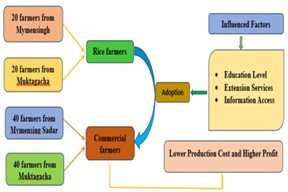
This study investigates the drivers influencing the adoption of commercial farming as rice farms transition into diversified commercial enterprises. A sample of 120 respondents was randomly selected for primary data collection from Mymensingh Sadar and Muktagachha upazilas in the Mymensingh district of Bangladesh, and they were chosen for their notable adoption of commercial farming. Among the respondents, 40 were engaged in rice farming, while 80 were involved in commercial farming due to its higher prevalence. The analysis utilized both descriptive statistics and econometric methods, particularly binary logistic regression. The findings reveal that 98.8% of commercial farmers fell within the age range of 30 to 64 years, with only 1.2% exceeding 64 years. Moreover, commercial farmers exhibited a higher level of education compared to their rice farming counterparts. The econometric analysis indicated that education, access to extension services, and access to information significantly and positively influence the adoption of commercial farming. This underscored the critical importance of prioritizing education, extension services, and information accessibility to facilitate the swift adoption of commercial farming. This study proposing effective policy recommendations aimed at enhancing diversified commercial farming practices and optimizing land use for the increased profitability of rural farmers.
Downloads
References
Ahmed, N., Zander, K. K., & Garnett, S. T. (2011). Socioeconomic aspects of rice-fish farming in Bangladesh: Opportunities, challenges, and production efficiency. Australian Journal of Agricultural and Resource Economics, 55(2). https://doi.org/10.1111/j.1467-8489.2011.00535.x
Akter, T., Parvin, M. T., Mila, F. A., & Nahar, A. (2019). Factors determining the profitability of rice farming in Bangladesh. Journal of the Bangladesh Agricultural University, 17(1). https://doi.org/10.3329/jbau.v17i1.40668
Anisuzzaman, M., Islam, M., Rahman, K., & Shetu, M. (2016). Shifting from rice production to shrimp culture in coastal zones of Khulna: Determination of the determinants. Journal of Bangladesh Agricultural University, 13(2). zhttps://doi.org/10.3329/jbau.v13i2.28787
Barros, A. J. D., & Hirakata, V. N. (2003). Alternatives for logistic regression in cross-sectional studies: An empirical comparison of models that directly estimate the prevalence ratio. BMC Medical Research Methodology, 3. https://doi.org/10.1186/1471-2288-3-21
BBS. (2020). Yearbook of Agricultural Statistics, Bangladesh Bureau of Statistics, Statistics and Informatics Division, Ministry of Planning, Government of the People’s Republic of Bangladesh.
BBS. (2021). Yearbook of Agricultural Statistics, Bangladesh Bureau of Statistics, Statistics and Informatics Division, Ministry of Planning, Government of the People’s Republic of Bangladesh.
BBS. (2022). Population and Housing Census, Bangladesh Bureau of Statistics, Statistics and Informatics Division (SID), Ministry of Planning, Government of the People’s Republic of Bangladesh. https://doi.org/https://bbs.portal.gov.bd/
Béné, C., Waid, J., M., J., A., B., Chowdhury, M., Skarin V., Rahman A., Islam N., Mamnun N., Mainuddin, K., A., & S.M.A., A. (2015). Impact of climate-related shocks and stresses on nutrition and food security in selected areas of rural Bangladesh. International Household Survey Network, World Food Programme. https://catalog.ihsn.org/citations/54247
Bhende, M. J. (2006). Production and cost of broiler meat: a study covering Andhra Pradesh, Karnataka, Maharashtra and West Bengal. Agricultural and Food Sciences, Economics. https://www.semanticscholar.org/paper/Bhende/74055feee8c2778f5473181eef5854d6d4f27421
Bishwajit, G., Barmon, R., & Ghosh, S. (2014). Reviewing the status of agricultural production in Bangladesh from a food security perspective. Russian Journal of Agricultural and Socio-Economic Sciences, 25(1), 19–27. https://doi.org/10.18551/rjoas.2014-01.04
Browder, J. O., Pedlowski, M. A., & Summers, P. M. (2004). Land use patterns in the Brazilian Amazon: Comparative farm-level evidence from Rondônia. Human Ecology, 32(2). https://doi.org/10.1023/B:HUEC.0000019763.73998.c9
Brown, D. G., Robinson, D. T., French, N. H. F., & Reed, B. C. (2013). Land use and the carbon cycle: advances in integrated science, management, and policy. Cambridge University Press.
Dasgupta, S., Hossain, M. M., Huq, M., & Wheeler, D. (2015). Climate change and soil salinity: The case of coastal Bangladesh. Ambio, 44(8). https://doi.org/10.1007/s13280-015-0681-5
Dixon, J., Gulliver, A., & Gibbon, D. (2001). Farming Systems and Poverty: Improving Farmers’ Livelihoods in a Changing World. In FAO, Rome; World Bank, Washington, D.C.
Ebanyat, P., de Ridder, N., de Jager, A., Delve, R. J., Bekunda, M. A., & Giller, K. E. (2010). Drivers of land use change and household determinants of sustainability in smallholder farming systems of Eastern Uganda. Population and Environment, 31(6). https://doi.org/10.1007/s11111-010-0104-2
Gurung, K., Bhandari, H., & Paris, T. (2016). Transformation from Rice Farming to Commercial Aquaculture in Bangladesh: Implications for Gender, Food Security, and Livelihood. Gender, Technology and Development, 20(1). https://doi.org/10.1177/0971852415618747
Harris, J. K. (2019). Statistics with R: solving problems using real-world data.
Hosmer, D. W., Lemeshow, S., & Sturdivant, R. X. (2000). Applied Logistic Regression ed 2 New York. NY: Wiley.
Hossain, M. (2004). Rural non-farm economy in Bangladesh: A view from household surveys. Centre for Policy Dialogue (CPD).
Hossain, M., & Bayes, A. (2009). Rural economy and livelihoods: Insights from Bangladesh. AH Development Publishing House.
Hossain, M. F., Chen, W., & Zhang, Y. (2015). Bulk density of mineral and organic soils in the Canada’s arctic and sub-arctic. Information Processing in Agriculture, 2(3–4), 183–190.
Hossain, M., Lewis, D., Bose, M. L., & Chowdhury, A. (2007). Rice research, technological progress, and poverty: The Bangladesh case. Agricultural Research, Livelihoods, and Poverty: Studies of Economic and Social Impacts in Six Countries, 56–102.
Islam, M. M., Jannat, A., Dhar, A. R., & Ahamed, T. (2020). Factors determining conversion of agricultural land use in Bangladesh: farmers’ perceptions and perspectives of climate change. GeoJournal, 85, 343–362. https://doi.org/10.1007/s10708-018-09966-w
Islam, M. R., & Hassan, M. Z. (2012). Land use changing pattern and challenges for agricultural land: A Study on Rajshahi District. Journal of Life and Earth Science, 6, 69–74. https://doi.org/10.3329/jles.v6i0.9724
Jabbar, M. A. (2005). Policy and scale factors influencing efficiency in dairy and poultry production in Bangladesh. ILRI (aka ILCA and ILRAD).
Jain, A. K., Meiyappan, P., & Richardson, T. (2013). Carbon emissions from land-use change: model estimates using three different data sets. In Land use and the carbon cycle: advances in integrated science, management, and policy (p. 241). Cambridge University Press, Cambridge.
Kamal, M. S., & Ali, M.A., Alam, M. F. (2014). Socio-economic status and problems of banana growers in Bangladesh. International Journal of Natural and Social Sciences, 1(2), 91-99.
Labrecque, J. A., Hunink, M. M. G., Ikram, M. A., & Ikram, M. K. (2021). Do Case-Control Studies Always Estimate Odds Ratios? American Journal of Epidemiology, 190(2), 318-332. https://doi.org/10.1093/aje/kwaa167
Lambin, E. F., Turner, B. L., Geist, H. J., Agbola, S. B., Angelsen, A., Bruce, J. W., Coomes, O. T., Dirzo, R., Fischer, G., Folke, C., George, P. S., Homewood, K., Imbernon, J., Leemans, R., Li, X., Moran, E. F., Mortimore, M., Ramakrishnan, P. S., Richards, J. F., Skånes, H., & Xu, J. (2001). The causes of land-use and land-cover change: Moving beyond the myths. Global Environmental Change, 11(4), 261–269. https://doi.org/10.1016/S0959-3780%2801%2900007-3
Mondal, G. (2008). Effects of land use changes on livelihood pattern of small farmers. A case study of Madertala village under Dumuria upazila in Khulna District. BRAC University Journal, 2, 93–99.
Perz, S. G. (2001). Household demographic factors as life cycle determinants of land use in the Amazon. Population Research and Policy Review, 20, 159–186. https://doi.org/10.1023/A:1010658719768
Ruhul Amin, M., Zhang, J., & Yang, M. (2015). Effects of climate change on the yield and cropping area of major food crops: A case of Bangladesh. Sustainability, 7(1), 898-915. https://doi.org/10.3390/su7010898
Sarker, F., Biswas, J., & Maniruzzaman, M. (2015). Climate change adaptation and economic profitability: Crop land shifting to mango orchard in Rajshahi region. Bangladesh Rice Journal, 18(1–2), 8–17. https://doi.org/10.3329/brj.v18i1-2.22995
Uddin, M. (2015). Causal Relationship between Agriculture, Industry and Services Sector for GDP Growth in Bangladesh: An Econometric Investigation. Journal of Poverty, Investment and Development, 8, 124–129. https://api.semanticscholar.org/CorpusID:56321941
Wang, X., Wu, S., & Gao, F. (2010). The relationship between economic growth and agricultural growth: The case of China. Proceedings of the International Conference on E-Business and E-Government, ICEE 2010. https://doi.org/10.1109/ICEE.2010.1330
Weir, S. (1999). The Effects of Education on Farmer Productivity in Rural Ethiopia. Centre for the Study of African Economies Department of Economics, University of Oxford.
Xu, X., Du, Z., & Zhang, H. (2016). Integrating the system dynamic and cellular automata models to predict land use and land cover change. International Journal of Applied Earth Observation and Geoinformation, 52, 568-579. https://doi.org/10.1016/j.jag.2016.07.022
Downloads
Published
How to Cite
Issue
Section
License
Copyright (c) 2026 Agriculture and Environmental Science Academy

This work is licensed under a Creative Commons Attribution-NonCommercial 4.0 International License.