Performance of two rice varieties in different numbers of seedlings hill-1 at Khairahani, Chitwan, Nepal
DOI:
https://doi.org/10.26832/24566632.2026.1101017Keywords:
Biological yield, Harvest index, Rice varieties, Seedling densityAbstract
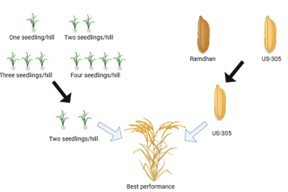
A field experiment was conducted from June to October 2022 at Khairahani Municipality, Chitwan, Nepal, to evaluate the effects of the number of seedlings (one, two, three, and four) hill -1 and rice varieties (US-305 and Ramdhan) on rice yield. The number of seedlings hill-1 is one of the most important factors for determining rice yield. Farmers need to know the appropriate number of seedlings hill-1 needed for different rice varieties. Thus, we aimed to evaluate the performance of two rice varieties under different numbers of seedlings hill-1, to determine the optimum number of seedlings hill-1 or improving rice yield at Khairahani, Chitwan, Nepal. The experiment was conducted in a randomized complete block design with three replications. Seedlings of both varieties were planted at a spacing of 20×20 cm. The study focused on various growth and yields, attributing parameters of rice, including plant height, tiller number, effective tillers, thousand grain weight, grain yield per hectare, and biological yield per hectare. The number of seedlings hill-1 was found to have the highest impact on yield attributing characters. The highest plant height (124.72 cm), effective tiller per square meter (342), panicle length (28.65 cm), number of filled grains per panicle (120.43), economic yield, biological yield, and HI were found in two seedlings, hill-1. Whereas one seedling hill-1 had the highest effective grains per panicle (142.66), test weight (24.23g), and straw yield (10.63 t/ha). Thus, US-305 had better growth and yield attributes, suggesting farmers of Khairahani can combine two seedlings of US 305.
Downloads
References
Ali Khan Imran, A., Ali Shah Inamullah, F., & Zada Muhammad Naeem Muhammad Nouman Khan, L. (2015). Phenological traits of rice as influenced by seedling age and number of seedlings per hill under the temperate region. Journal of Biology, Agriculture and Healthcare 5(3). http://www.iiste.org/Journals/index.php/JBAH/article/view/20197/20672
Bai, F., Ma, H., Cai, Y., Shahid, M. Q., Zheng, Y., Lang, C., Chen, Z., Wu, J., Liu, X., & Wang, L. (2023). Natural allelic variation in grain size and weight 3 of wild rice regulates the grain size and weight. Plant Physiology, 193(1), 502–518. https://doi.org/10.1093/plphys/kiad320
Banjare, A. K., Verma, R. K., Shrivastava, R., Gupta, V. K., Meshram, P., John, S., Khute, I. K., Tiwari, A., & Rohit. (2023). Association study and direct - indirect effects of characters for yield in rice (Oryza sativa L.). International Journal of Environment and Climate Change, 13(9), 163–167. https://doi.org/10.9734/ijecc/2023/v13i92219
Berhanu, A. A. (2017). Effect of planting density on growth, yield and yield attributes of rice (Oryza sativa L.). African Journal of Agricultural Research, 12(35), 2713–2721. https://doi.org/10.5897/ajar2014.9455
Bin Rahman, A. N. M. R., & Zhang, J. (2023). Trends in rice research: 2030 and beyond. Food and Energy Security 12(2). https://doi.org/10.1002/fes3.390
Chen, K., Łyskowski, A., Jaremko, Ł., & Jaremko, M. (2021). Genetic and molecular factors determining grain weight in rice. Frontiers in Plant Science, 12. https://doi.org/10.3389/fpls.2021.605799
Chidambaranathan, P., Balasubramaniasai, C., Behura, N., Purty, M., Samantaray, S., Subudhi, H., Ngangkham, U., Devanna, B. N., Katara, J. L., Kumar, A., & Behera, L. (2021). Effects of high temperature on spikelet sterility in rice (Oryza sativa L.): association between molecular markers and allelic phenotypic effect in field conditions. Genetic Resources and Crop Evolution, 68(5), 1923–1935. https://doi.org/10.1007/s10722-021-01106-7
Dejen, T. (2018). Effect of plant spacing and number of seedlings per hill to transplanted rice (Oryza Sativa X Oryza glaberrima) under irrigation in middle Awash, Ethiopia. Journal of Applied Life Sciences International, 17(4), 1–9. https://doi.org/10.9734/jalsi/2018/42081
Deng, F., Li, B., Yuan, Y., He, C., Zhou, X., Li, Q., Zhu, Y., Huang, X., He, Y., Ai, X., Tao, Y., Zhou, W., Wang, L., Cheng, H., Chen, Y., Wang, M., & Ren, W. (2022). Increasing the number of seedlings per hill with reduced number of hills improves rice grain quality by optimizing canopy structure and light utilization under shading stress. Field Crops Research, 287. https://doi.org/10.1016/j.fcr.2022.108668
Dhungana, R., Bhandari, R., Paudel, R., Paudel, P., Bakabal, M., Bohora, S. L., & Bista, B. (2020). Effect of age and number of seedlings in productivity of rice, Dang, Nepal. Tropical Agroecosystems, 2(1), 06–11. https://doi.org/10.26480/taec.01.2021.06.11
Donald, C. M., & Hamblin, J. (1976). The biological yield and harvest index of cereals as agronomic and plant breeding criteria. Advances in Agronomy, 28(C), 361–405. https://doi.org/10.1016/S0065-2113(08)60559-3
FAO. (2023). The State of Food Security and Nutrition in the World 2023. https://openknowledge.fao.org/items/445c9d27-b396-4126-96c9-50b335364d01
Gomez, K. A., & Gomez, A. A. (1984). Statistical procedures for agricultural research. John Wiley & Sons. https://books.google.com/books?id=abc123
Gunasekaran, A., Seshadri, G., Ramasamy, S., Muthurajan, R., & Karuppasamy, K. S. (2023). Identification of newer stable genetic sources for high grain number per panicle and understanding the gene action for important panicle traits in rice. Plants, 12(2). https://doi.org/10.3390/plants12020250
Gurjar, G. N., Swami, S., & Meena, N. K. (2018). Effect of age of seedling and number of seedlings per hill on growth and yield of low land rice cultivation in Asia – A review. International Journal of Current Microbiology and Applied Sciences, 7(06), 3751–3760. https://doi.org/10.20546/ijcmas.2018.706.439
Hasan-Ud-Daula, M., & Sarker, U. (2020). Variability, heritability, character association, and path coefficient analysis in advanced breeding lines of rice (Oryza sativa L.). Genetika, 52(2), 711–726. https://doi.org/10.2298/GENSR2002711H
Hossain, M. M., Gain, P., Mannan, M. A., & Islam, M. M. (2022). Effect of seedling age and seedling number per hill on yield and yield attributes of transplanted Aman rice (br23). Khulna University Studies, 294–299. https://doi.org/10.53808/kus.2007.8.2.0609-l
Hu, Q., Zhu, H., Gu, Y., Wei, H., & Zhang, H. (2025). Increasing plant density increased rice (Oryza sativa) yield but decreased lodging resistance when grown under wheat (Triticum aestivum) straw using unmanned aerial seeding technology. Crop & Pasture Science, 76. https://doi.org/https://doi.org/10.1071/CP24267
Huang, L., Sun, F., Yuan, S., Peng, S., & Wang, F. (2018). Different mechanisms underlying the yield advantage of ordinary hybrid and super hybrid rice over inbred rice under low and moderate N input conditions. Field Crops Research, 216, 150–157. https://doi.org/https://doi.org/10.1016/J.FCR.2017.11.019
Khatun, Most. M., Ashrafuzzaman, M., & Sarwar, A. K. M. G. (2022). Performance of Purple rice cultivar under different hill density. Archives of Agriculture and Environmental Science, 7(3), 355–359. https://doi.org/10.26832/24566632.2022.070308
Li, J., Zhou, J., Zhang, Y., Yang, Y., Pu, Q., & Tao, D. (2020). New insights into the nature of interspecific hybrid sterility in rice. Frontiers in Plant Science, 11. https://doi.org/10.3389/fpls.2020.555572
Li, R., Li, M., Ashraf, U., Liu, S., & Zhang, J. (2019). Exploring the relationships between yield and yield-related traits for rice varieties released in China from 1978 to 2017. Frontiers in Plant Science, 10. https://doi.org/10.3389/fpls.2019.00543
Liao, C., Fang, S., Zhang, H., Liu, L., Xie, J., Li, X., Cao, F., Chen, J., & Huang, M. (2024). Grain yield and yield attributes of currently popular hybrid rice varieties compared to representative super hybrid rice varieties in subtropical environments. Agronomy, 14(2). https://doi.org/10.3390/agronomy14020318
Mahato, M., Pokhrel, K., Singh, S., & Raj Poudel, P. (2018). Effect of Age and Number of Seedlings Per Hill on Production of Rice in Sub-Tropical Region of Nepal. American Journal of Agricultural Science, 5(4), 55–58. http://www.aascit.org/journal/ajas
Masum, S. M., Ali, M. H., Hasanuzzaman, M., Chowdhury, I. F., Mandal, H., & Jerin, R. (2014a). Response of variety and population density on yield attributes and yield of boro rice (Oryza sativa). Annals of Agricultural Research 35 (4). https://epubs.icar.org.in/index.php/AAR/article/view/46887
MAU, K., SM, R., MN, H., MR, slam, & A, H. (2022). Effect of number of seedlings hill-1 and weeding on the yield of aus rice cv.BR16. Journal of Agriculture, Food and Environment, 03(04), 22–26. https://doi.org/10.47440/jafe.2022.3404
MOALD. (2021). Statistical Information on Nepalese Agriculture 2020/21, Ministry of Agriculture and Livestock Development, Government of Nepal. Kathmandu. https://moald.gov.np/content/42/statistical-information-on-nepalese-agriculture/
MOALD. (2023). Statistical Information on Nepalese Agriculture 2022/23, Ministry of Agriculture and Livestock Development, Government of Nepal. Kathmandu. https://moald.gov.np/content/42/statistical-information-on-nepalese-agriculture/
Nachiketha, T. K., Jakkeral, S. A., Dushyanthakumar, B. M., Thippeshappa, G. N., & Jayashree, S. (2024). Association Studies in Red Rice Mutant Lines of IRGA-318-11-6-9-2B. International Journal of Environment and Climate Change, 14(2), 79–86. https://doi.org/10.9734/ijecc/2024/v14i23922
Nanda, K., Bastia, D., & Nanda, A. (2019). Character association and path coefficient analysis for yield and its component traits in slender grain rice (Oryza sativa L.). Electronic Journal of Plant Breeding. https://doi.org/10.5958/0975-928x.2019.00124.8.
Ngawang, Dendup, C., & Tshomo, S. (2022). Assessment of Seedling Rate per Hill for Irrigated Rice in a Wet Sub-Tropical Condition of Bhutan. Bhutanese Journal of Agriculture, 5(1), 29–38. https://doi.org/10.55925/btagr.22.5103
Okello, D. M., Bonabana-Wabbi, J., & Mugonola, B. (2019). Farm level allocative efficiency of rice production in Gulu and Amuru districts, Northern Uganda. Agricultural and Food Economics, 7(1). https://doi.org/10.1186/s40100-019-0140-x
Oladosu, Y., Rafii, M. Y., Magaji, U., Abdullah, N., Miah, G., Chukwu, S. C., Hussin, G., Ramli, A., & Kareem, I. (2018). Genotypic and phenotypic relationship among yield components in rice under tropical conditions. BioMed Research International, 2018. https://doi.org/10.1155/2018/8936767
Paudel, H., Dhakal, S., Shrestha, K., Paudel, H., & Khatiwada, D. (2021). Effect of number of seedlings per hill on performance and yield of spring rice (Oryza sativa L.) in Rajapur, Bardiya, Nepal. International Journal of Agricultural and Applied Sciences, 2(1), 61–67. https://doi.org/10.52804/ijaas2021.217
Perween, S., Kumar, A., Adan, F., & Danish, Md. (2020). The inter-relationship among yield and yield attributing traits of rice (Oryza sativa L.) under Irrigated condition through correlation coefficient studies and path analysis. International Journal of Chemical Studies, 8(2), 1409–1414. https://doi.org/10.22271/chemi.2020.v8.i2v.8960
Pokharel, S., Amgain, L. P., Sapkota, B., Khanal, A., & Gurung, T. B. (2018). Effect of spacing and number of seedling hill-1 on grain yield and other agronomic traits of hybrid rice (U.S. 312) on late transplantation. Juniper Online Journal Material Science 5(1). https://doi.org/10.19080/JOJMS.2018.04.555652
Postma, J. A., Hecht, V. L., Hikosaka, K., Nord, E. A., Pons, T. L., & Poorter, H. (2021). Dividing the pie: A quantitative review on plant density responses. Plant Cell and Environment, 44 (4), 1072–1094. Blackwell Publishing Ltd. https://doi.org/10.1111/pce.13968
Poudel, A., Chaudhary (Dhami), M. S., Adhikari, A., & Shrestha, J. (2023). Detection of superior rice genotypes through evaluating growth and yield parameters. Nepal Agriculture Research Journal, 15(1), 66–74. https://doi.org/10.3126/narj.v15i1.51086
Rajasekhar, J., Lavanya, G. R., Purushotham, G., & Kumar, D. P. (2022). Character association and path coefficient analysis in upland rice (Oryza sativa L.) for grain yield and quality characters. International Journal of Plant & Soil Science, 410–419. https://doi.org/10.9734/ijpss/2022/v34i2331605
Rajput, P., Singh, A., Kumar, M., Vivek, Yadav, R. B., & Shahi, U. P. (2023). Effect of planting density and micronutrient application on growth, physiological parameters and yield of rice (Otyza sativa). Indian Journal of Agricultural Sciences, 93(11), 1175–1179. https://doi.org/10.56093/ijas.v93i11.111426
Sah, U., Sah, S. K., Marhatta, S., & Neupane, M. P. (2022). Effects of varieties and fertilizer levels on yield and economics of hybrid rice at Hardinath, Nepal. In Journal of Agriculture and Forestry University (Vol. 5). https://doi.org/10.3126/jafu.v5i1.48460
Saha, S. R., Hassan, L., Haque, Md. A., Islam, M. M., & Rasel, Md. (2019). Genetic variability, heritability, correlation and path analyses of yield components in traditional rice (Oryza sativa L.) landraces. Journal of the Bangladesh Agricultural University, 17(1), 26–32. https://doi.org/10.3329/jbau.v17i1.40659
Sarker, B. C., & Nahar, N. (2022). Effect of number of seedlings per hill and spacing on growth and yield of transplanted Aman rice. Khulna University Studies, 27–38. https://doi.org/10.53808/kus.2017.14.1and2.1620-l
Shamshiri, R., Ibrahim, B., Balasundram, S., Taheri, S., & Weltzien, C. (2019). Evaluating system of rice intensification using a modified transplanter: A smart farming solution toward sustainability of paddy fields in Malaysia. International Journal of Agricultural and Biological Engineering. https://doi.org/10.25165/IJABE.V12I2.2999
Shi, W., Li, X., Schmidt, R. C., Struik, P. C., Yin, X., & Jagadish, S. V. K. (2018). Pollen germination and in vivo fertilization in response to high temperature during flowering in hybrid and inbred rice. Plant Cell and Environment, 41(6), 1287–1297. https://doi.org/10.1111/pce.13146
Singh Yadav, S. P., Bhandari, S., Ghimire, N. P., Mehata, D. K., Majhi, S. K., Bhattarai, S., Shrestha, S., Yadav, B., Chaudhary, P., & Bhujel, S. (2024). Genetic variability, character association, path coefficient, and diversity analysis of rice (Oryza sativa L.) genotypes based on agro-morphological traits. International Journal of Agronomy, https://doi.org/10.1155/2024/9946332
Sun, H., Yao, Q., Hai, M., Li, T., Sun, J., Liu, Z., Ang, Y., Zhao, Y., Zhang, Y., Cheng, X., Huang, T., Chang, Y., Du, M., & Liu, E. (2025). Elite alleles of EPE1 identified via genome-wide association studies increase panicle elongation length in rice. Rice, 18(1). https://doi.org/10.1186/s12284-025-00759-7
Thapa, S., Thapa, K., Shrestha, J., & Chaudhary, A. (2019). Effect of seedling age, seeding density and nitrogen fertilizer on growth and grain yield of rice (Oryza sativa L.). International Journal of Applied Biology, 3. https://doi.org/https://doi.org/10.20956/ijab.v3i1.6688
TIAN, J. yu, LI, S. ping, CHENG, S., LIU, Q. yuan, ZHOU, L., TAO, Y., XING, Z. peng, HU, Y. jie, GUO, B. wei, WEI, H. yan, & ZHANG, H. cheng. (2023). Increasing the appropriate seedling density for higher yield in dry direct-seeded rice sown by a multifunctional seeder after wheat-straw return. Journal of Integrative Agriculture, 22(2), 400–416. https://doi.org/10.1016/j.jia.2022.08.064
Wang, S., Wu, H., Lu, Z., Liu, W., Wang, X., Fang, Z., & He, X. (2023). Combining ability analysis of yield-related traits of two elite rice restorer lines in Chinese hybrid rice. International Journal of Molecular Sciences, 24(15). https://doi.org/10.3390/ijms241512395
Watson, D. J. (1947). Comparative physiological studies on the growth of field crops: I. Variation in net assimilation rate and leaf area between species and varieties, and within and between Years. Annals of Botany, 11, 41. https://www.jstor.org/stable/42907002
WEI, H. he, YANG, Y. lin, SHAO, X. yu, SHI, T. yi, MENG, T. yao, LU, Y., TAO, Y., LI, X. yue, DING, E. hao, CHEN, Y. long, & DAI, Q. gen. (2020). Higher leaf area through leaf width and lower leaf angle were the primary morphological traits for the yield advantage of japonica/indica hybrids. Journal of Integrative Agriculture, 19(2), 483–494. https://doi.org/10.1016/S2095-3119(19)62628-6
Wei, X., Zhou, H., Xie, D., Li, J., Yang, M., Chang, T., Wang, D., Hu, L., Xie, G., Wang, J., & Wang, L. (2021). Genome-wide association study in rice revealed a novel gene in determining plant height and stem development, by encoding a WRKY transcription factor. International Journal of Molecular Sciences, 22(15). https://doi.org/10.3390/ijms22158192
Wu, X., Xie, D., Xu, A., Yuan, P., Huang, J., & Jiang, L. (2025). Interactive effects of seedling number per hill and plant spacing on source-sink dynamics and yield formation in rice. Frontiers in Plant Science, 16. https://doi.org/10.3389/fpls.2025.1707882
Yang, J., & Zhang, J. (2010). Crop management techniques to enhance harvest index in rice. Journal of Experimental Botany, 61, 12, 3177–3189. https://doi.org/10.1093/jxb/erq112
Yoshida, S. (1973). Effects of temperature on growth of the rice plant (Oryza sativa L.) in a controlled environment. Soil Science and Plant Nutrition, 19(4), 299–310. https://doi.org/10.1080/00380768.1973.10432599
Yun, Y. (2023). Changes in the growth and yield of an extremely early-maturing rice variety according to transplanting density. Agriculture (Switzerland), 13(3). https://doi.org/10.3390/agriculture13030717
Zhang, H., Jiang, S., Du, B., Zhou, Q., Wu, Q., & Zhu, J. (2023). Tillage intensity and planting density significantly affected photosynthesis, growth, and yield of rice. Journal of Plant Growth Regulation, 42, (4), 2662–2671. https://doi.org/10.1007/s00344-022-10735-w
Zhong, X., Zhao, B., Huang, M., Hussain, H. A., Hussain, S., Cai, L., Yun, H., He, G., & Zhang, C. (2020). Comparison of growth and yield characteristics of mid-season hybrid rice under different yield levels. Agronomy, 10(12). https://doi.org/10.3390/agronomy10121876
Zhu, H., Lu, X., Zhang, K., Xing, Z., Wei, H., Hu, Q., & Zhang, H. (2023). Optimum basic seedling density and yield and quality characteristics of unmanned aerial seeding rice. Agronomy, 13(8). https://doi.org/10.3390/agronomy13081980
Downloads
Published
How to Cite
Issue
Section
License
Copyright (c) 2026 Agriculture and Environmental Science Academy

This work is licensed under a Creative Commons Attribution-NonCommercial 4.0 International License.