Industry compliance in national micronutrient food fortification programmes: A systematic review with lessons for Uganda
DOI:
https://doi.org/10.26832/24566632.2026.1101019Keywords:
Food fortification, Industry compliance, Micronutrient deficiencies, Regulatory monitoringAbstract
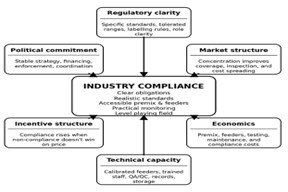
Large-scale food fortification remains a critical strategy for reducing micronutrient deficiencies, but its effectiveness depends on whether industries consistently fortify foods to standard. This review synthesizes global evidence on industry compliance across major food vehicles, including salt, wheat flour, maize flour, edible oil, sugar, and condiments, and applies the findings to Uganda’s programme improvement agenda. A systematic review was conducted using peer-reviewed articles, programme evaluations, policy analyses, survey reports, and Uganda-specific regulatory documents retrieved from academic databases and institutional sources. The synthesis incorporated evidence from Africa, Asia, and Latin America, including Uganda and comparator settings such as Senegal, Tanzania, Kenya, Nigeria, Malawi, Mozambique, Bangladesh, India, Indonesia, Chile, and Costa Rica. The evidence shows that compliance is shaped by regulatory clarity, market structure, premix and equipment costs, quality assurance, external monitoring, political commitment, and credible enforcement. Compliance tends to be stronger in centralized industries such as wheat flour and edible oil, but weaker in fragmented maize markets and among smaller millers. Across countries, a persistent fortification quality gap remains between foods that are legally covered or reportedly fortified and foods that are adequately fortified at production, market, and household levels. Uganda reflects this broader pattern: although the legal and policy framework is established, compliance remains uneven across food vehicles, with stronger adherence among salt, wheat flour, and edible oil producers than among maize millers. Therefore, Uganda should strengthen production-based verification, improve inter-agency coordination, adopt differentiated compliance strategies by processor scale and vehicle, and invest in practical monitoring and enforcement systems that make sustained compliance feasible.Downloads
References
Begum, R., Hasan, M. R., Akter, S., & Rahman, M. N. (2024). Fortified edible oils in Bangladesh: A study on vitamin A fortification and physicochemical properties. Heliyon, 10(3), e25489. https://doi.org/10.1016/j.heliyon.2024.e25489
Boen, T. R., Soeiro, B. T., Pereira-Filho, E. R., & Lima-Pallone, J. A. (2008). Folic acid and iron evaluation in Brazilian enriched corn and wheat flours. Journal of the Brazilian Chemical Society, 19(1), 53–59. https://doi.org/10.1590/S0103-50532008000100009
Coomson, J. B., Smith, N. W., & McNabb, W. (2025). Impacts of Food Fortification on Micronutrient Intake and Nutritional Status of Women of Reproductive Age in Africa—A Narrative Review. Advances in Nutrition, 16(7), 100463. https://doi.org/10.1016/j.advnut.2025.100463
Durotoye, T., Ilegbune, I., Schofield, D., Ajieroh, V., & Ezekannagha, O. (2023). Industry Self-Regulation of Food Fortification Compliance: Piloting the Micronutrient Fortification Index in Nigeria. Food and Nutrition Bulletin, 44(1_suppl), S74–S84. https://doi.org/10.1177/03795721221132610
Faye, M. H., Diémé, M. M. A., Nkhoma, P. M., Diouf, A., Panagides, D., Badiane, A., Tsang, B. L., Mama, O. M., De Souza, M. A., & Dossou, N. I. (2025). Assessing the Fortification Quality of Refined Vegetable Oil with Vitamin A, Wheat Flour with Iron, and Salt with Iodine: Findings from a Market Assessment in Senegal, West Africa. Current Developments in Nutrition, 9(5), 0–13. https://doi.org/10.1016/j.cdnut.2025.107440
Fiedler, J. L., & Afidra, R. (2010). Vitamin A fortification in Uganda: Comparing the feasibility, coverage, costs, and cost-effectiveness of fortifying vegetable oil and sugar. Food and Nutrition Bulletin, 31(2), 193–205. https://doi.org/10.1177/156482651003100202
Fiedler, J. L., Afidra, R., Mugambi, G., Tehinse, J., Kabaghe, G., Zulu, R., Lividini, K., Smitz, M. F., Jallier, V., Guyondet, C., & Bermudez, O. (2014). Maize flour fortification in Africa: Markets, feasibility, coverage, and costs. Annals of the New York Academy of Sciences, 1312(1), 26–39. https://doi.org/10.1111/nyas.12266
Fiedler, J. L., Lividini, K., & Bermudez, O. I. (2015). Estimating the impact of vitamin A-fortified vegetable oil in Bangladesh in the absence of dietary assessment data. Public Health Nutrition, 18(3). https://doi.org/10.1017/S1368980014000640
Fothergill, A., Fonesca Centeno, Z. Y., Ocampo Téllez, P. R., & Pachón, H. (2019). Consumption of fortified wheat flour and associations with anemia and low serum ferritin in Colombia. Perspectivas En Nutrición Humana, 21(2), 159–171. https://doi.org/10.17533/udea.penh.v21n2a03
GAIN. (2017). Fortification Assessment Coverage Tool (FACT) Survey in Uganda, 2015. https://www.gainhealth.org/resources/reports-and-publications/fortification-assessment-coverage-toolkit-fact-survey-uganda
Hernández-Vásquez, A., Vargas-Fernández, R., & Azañedo, D. (2021). Factors associated with the consumption of table salt with inadequate iodine concentrations: a population analysis at a Peruvian household level. Public Health Nutrition, 24(16), 5498–5505. https://doi.org/10.1017/S1368980021000380
Issa-Zacharia, A., & Mareni, G. B. (2024). Compliance Level and Stability of Micronutrients in Fortified Maize Flour in Tanzania. International Journal of Food Science, 2024. https://doi.org/10.1155/2024/7746750
Jha, R. K., Das, S., Dey, S., Dutta, S., Khan, N., Lakshminarayanan, S., Pillai, A., Raut, M. K., Reddy, J. C., & Varghese, M. (2023). National and Sub-National Estimates of Household Coverage of Iodized Salt and Urinary Iodine Status among Women of Reproductive Age in India: Insights from the India Iodine Survey, 2018–19. Journal of Nutrition, 153(9), 2717–2725. https://doi.org/10.1016/j.tjnut.2023.06.037
Jungjohann, S. M., Ara, G., Pedro, C., Friesen, V. M., Khanam, M., Ahmed, T., Neufeld, L. M., & Mbuya, M. N. N. (2021). Vitamin a fortification quality is high for packaged and branded edible oil but low for oil sold in unbranded, loose form: Findings from a market assessment in Bangladesh. Nutrients, 13(3), 1–13. https://doi.org/10.3390/nu13030794
Karapanou, V., de Laiglesia, J. R., & Makhmudov, T. (2024). Regulatory governance of large-scale food fortification: Literature review Theoretical and empirical foundations for developing a measurement framework. April, 1–86. https://one.oecd.org/document/GOV/RPC(2024)4/ANN1/en/pdf
Khamila, S., Sila, D. N., & Makokha, A. (2020). Compliance status and stability of vitamins and minerals in Fortified Maize Flour in Kenya. Scientific African, 8. https://doi.org/10.1016/j.sciaf.2020.e00384
Kiwango, F. A., Chacha, M., & Raymond, J. (2020). Adequacy of micronutrient fortification in the mandatory fortified food vehicles in Tanzania. Nutrition and Food Science, 51(4), 653–663. https://doi.org/10.1108/NFS-04-2020-0141
Kyamuhangire, W., Lubowa, A., Kaaya, A., Kikafunda, J., Harvey, P. W. J., Rambeloson, Z., Dary, O., Dror, D. K., & Allen, L. H. (2013). The importance of using food and nutrient intake data to identify appropriate vehicles and estimate potential benefits of food fortification in Uganda. Food and Nutrition Bulletin, 34(2), 131–142. https://doi.org/10.1177/156482651303400202
Lema, D. C., Mahiti, G. R., & Sunguya, B. F. (2024). Factors influencing the implementation of food fortification regulation among small and medium-scale corn millers in Dar es Salaam Tanzania: A qualitative study. BMJ Nutrition, Prevention and Health, 7(2). https://doi.org/10.1136/bmjnph-2024-000940
Luthringer, C. L., Rowe, L. A., Vossenaar, M., & Garrett, G. S. (2015). Regulatory monitoring of fortified foods: Identifying barriers and good practices. Global Health Science and Practice, 3(3), 446–461. https://doi.org/10.9745/GHSP-D-15-00171
Makonda, L. J., Nipassa, O., & Salvador, E. M. (2026). The role of policy on fortification in food processing and value addition in Malawi and Mozambique—a systematic review. Frontiers in Nutrition, 13(February). https://doi.org/10.3389/fnut.2026.1765596
Mark, H. E., Assiene, J. G., Luo, H., Nankap, M., Ndjebayi, A., Ngnie-Teta, I., Tarini, A., Pattar, A., Killilea, D. W., Brown, K. H., & Engle-Stone, R. (2019). Monitoring of the National Oil and Wheat Flour Fortification Program in Cameroon Using a Program Impact Pathway Approach. Current Developments in Nutrition, 3(8), 1–16. https://doi.org/10.1093/cdn/nzz076
Marks, K., Luthringer, C., & Ruth, L. (2018). Review of Grain Fortification Legislation, Standards, and Monitoring Documents. 354–369.
Martorell, R., Ascencio, M., Tacsan, L., Alfaro, T., Young, M. F., Addo, O. Y., Dary, O., & Flores-Ayala, R. (2015). Effectiveness evaluation of the food fortification program of Costa Rica: Impact on anemia prevalence and hemoglobin concentrations in women and children. American Journal of Clinical Nutrition, 101(1), 210–217. https://doi.org/10.3945/ajcn.114.097709
Mejia, L. A., & Bower, A. M. (2015). The global regulatory landscape regarding micronutrient fortification of condiments and seasonings. Annals of the New York Academy of Sciences, 1357(1), 1–7. https://doi.org/10.1111/nyas.12854
Mkambula, P., Mbuya, M. N. N., Rowe, L. A., Sablah, M., Friesen, V. M., Chadha, M., Osei, A. K., Ringholz, C., Vasta, F. C., & Gorstein, J. (2020). The unfinished agenda for food fortification in low- and middle-income countries: Quantifying progress, gaps and potential opportunities. Nutrients, 12, 2. MDPI AG. https://doi.org/10.3390/nu12020354
MOH. (2011). The Food and Drugs (Food Fortification) (Amendment) Regulations, 2011. Arrangement of Regulation Regulation. 30, 385–387. https://www.health.go.ug/wp-content/uploads/2023/07/The-Food-and-Drugs-Food-Fortification-Regulations-2011-Amendement.pdf
MOH. (2017). Uganda National Industrial Food Fortification Strategy 2017-2022. August 2017. https://www.health.go.ug/wp-content/uploads/2023/07/Uganda-National-Food-Fortification-Strategy-2017-2022.pdf
MOH & FFI. (2021). A Rapid Assessment of the Impact of COVID-19 on Food Fortification Regulation Compliance in Uganda. May. https://static1.squarespace.com/static/5e1df234eef02705f5446453/t/60afacfbd33efb6090f6d63e/1622125819910/Uganda+Rapid+Assessment+of+the+Impact+of+COVID-FINAL+Report.pdf
Nandeep, E. R., Mahajan, H., Mummadi, M. K., Sairam, C., Venkatesh, K., Kadiyam, J., Meshram, I., Pagidoju, S., Reddy, V. R., Panda, H., Pullakandham, R., Geddam, J. J. B., Gavaravarapu, S. M., Hemalatha, R., & Samarasimha Reddy, N. (2024). Implementation, delivery, and utilization of iron fortified rice supplied through public distribution system across different states in India: An exploratory mixed-method study. PLOS Global Public Health, 4(8), 1–18. https://doi.org/10.1371/journal.pgph.0003533
Neufeld, L. M., Baker, S., Garrett, G. S., & Haddad, L. (2017). Coverage and utilization in food fortification programs: Critical and neglected areas of evaluation. Journal of Nutrition, 147(5), 1015S-1019S. https://doi.org/10.3945/jn.116.246157
NPA. (2025). Fourth National Development Plan 2025/26 -2029/30. March. https://npa.go.ug/wp-content/uploads/2025/12/Fourth-National-Development-Plan-NDPIV.pdf?x56883
Ogunmoyela, O. A., Adekoyeni, O., Aminu, F., & Umunna, L. O. (2013). A Critical Evaluation of Survey Results of Vitamin A and Fe Levels in the Mandatory Fortified Food Vehicles and Some Selected Processed Foods in Nigeria. Nigerian Food Journal, 31(2), 52–62. https://doi.org/10.1016/s0189-7241(15)30077-1
Olson, R., Gavin-Smith, B., Ferraboschi, C., & Kraemer, K. (2021). Food fortification: The advantages, disadvantages and lessons from sight and life programs. Nutrients, 13(4). https://doi.org/10.3390/nu13041118
Osendarp, S. J. M., Martinez, H., Garrett, G. S., Neufeld, L. M., De-Regil, L. M., Vossenaar, M., & Darnton-Hill, I. (2018). Large-Scale Food Fortification and Biofortification in Low- and Middle-Income Countries: A Review of Programs, Trends, Challenges, and Evidence Gaps. Food and Nutrition Bulletin, 39(2), 315–331. https://doi.org/10.1177/0379572118774229
Rohner, F., Leyvraz, M., Konan, A. G., Esso, L. J. C. E., Wirth, J. P., Norte, A., Adiko, A. F., Bonfoh, B., & Aaron, G. J. (2016). The potential of food fortification to add micronutrients in young children and women of reproductive age - Findings from a cross-sectional survey in Abidjan, Côte d’Ivoire. PLoS ONE, 11(7). https://doi.org/10.1371/journal.pone.0158552
Rohner, F., Raso, G., Aké-Tano, S. O. P., Tschannen, A. B., Mascie-Taylor, C. G. N., & Northrop-Clewes, C. A. (2016). The effects of an oil and wheat flour fortification program on pre-school children and women of reproductive age living in Côte d’Ivoire, a malaria-endemic area. Nutrients, 8(3), 1–11. https://doi.org/10.3390/nu8030148
Rohner, F., Wirth, J. P., Zeng, W., Petry, N., Donkor, W. E. S., Neufeld, L. M., Mkambula, P., Groll, S., Mbuya, M. N., & Friesen, V. M. (2023). Global Coverage of Mandatory Large-Scale Food Fortification Programs: A Systematic Review and Meta-Analysis. Advances in Nutrition, 14(5), 1197–1210. https://doi.org/10.1016/j.advnut.2023.07.004
Rowe, L. A. (2020). Addressing the fortification quality gap: A proposed way forward. In Nutrients, 12(2), 1–17. https://doi.org/10.3390/nu12123899
Saha, A., Guariso, D., Mbuya, M. N. N., & Ebata, A. (2021). Firm’s compliance behaviour towards food fortification regulations: Evidence from oil and salt producers in Bangladesh. Food Policy, 104. https://doi.org/10.1016/j.foodpol.2021.102143
SPRING. (2018). The State of Maize Flour Fortification in Uganda. April, 1–48. https://www.spring-nutrition.org/sites/default/files/publications/reports/spring_report_uganda_maize_fortification_status.pdf
Tang, K., Tadesse, H., Moges, T., Kebebe, T., Battcock, G., Becher, E., Gashu, D., Ahmed, A., Abera, W., de Pee, S., Tessema, M., & Knight, F. (2025). Potential Contributions of Edible Oil and Wheat Flour Fortification on Reducing Inadequate Micronutrient Intake in Ethiopia. Annals of the New York Academy of Sciences, 1553(1), 270–282. https://doi.org/10.1111/nyas.70088
UNICEF. (2023). Fortification of wheat Flour in Indonesia. Romanian Biotechnological Letters, 14(2), 4300–4306. https://www.unicef.org/indonesia/media/20966/file/Briefing notes fortification of wheat flour - eng.pdf
UNICEF and FFI. (2014). Monitoring of Flour Fortification : The Case of Chile. https://ffinetwork.org/wp-content/uploads/2025/04/ChileCS.pdf
UNICEF and Ministry of National Development Planning (BAPPENAS). (2024). Landscape Analysis of Large-Scale Food Fortification In Indonesia. 108. https://www.unicef.org/indonesia/media/20376/file/Landscape analysis large-scale food fortification.pdf
USAID. (2023). Mapping the Food Fortification Regulatory Monitoring Systems and Processes for Quality and Safety of Fortified Foods in Uganda. USAID Advancing Nutrition, June. https://www.advancingnutrition.org/sites/default/files/2023-10/uganda_regulatory_monitoring_report_final_2023.pdf
van den Wijngaart, A., Bégin, F., Codling, K., Randall, P., & Johnson, Q. W. (2013). Regulatory monitoring systems of fortified salt and wheat flour in selected ASEAN countries. Food and Nutrition Bulletin, 34(2 Suppl), 102–111. https://doi.org/10.1177/15648265130342s112
Van Jaarsveld, P. J., Faber, M., & Van Stuijvenberg, M. E. (2015). Vitamin A, iron, and zinc content of fortified maize meal and bread at the household level in 4 areas of South Africa. Food and Nutrition Bulletin, 36(3), 315–326. https://doi.org/10.1177/0379572115597588
Venkatesh Mannar, M. G., & Sankar, R. (2004). Micronutrient fortification of foods - Rationale, application and impact. Indian Journal of Pediatrics, 71(11), 997–1002. https://doi.org/10.1007/bf02828115
Vosti, S., Baker, E., Moorthy, D., Mazinga, M., & Dary, O. (2024). Firm-Level and Public-Sector Costs Make Small-Scale Maize Flour Fortification Challenging in Uganda. Food and Nutrition Bulletin. https://doi.org/10.1177/03795721231223052
Wirth, J. P., Laillou, A., Rohner, F., Northrop-Clewes, C. A., Macdonald, B., & Moench-Pfanner, R. (2012). Lessons learned from national food fortification projects: experiences from Morocco, Uzbekistan, and Vietnam. Food and Nutrition Bulletin, 33(4 Suppl), 281–292. https://doi.org/10.1177/15648265120334s304
Yusufali, R., Sunley, N., de Hoop, M., & Panagides, D. (2012). Flour fortification in South Africa: post-implementation survey of micronutrient levels at point of retail. Food and Nutrition Bulletin, 33(4 Suppl). https://doi.org/10.1177/15648265120334s308
Downloads
Published
How to Cite
Issue
Section
License
Copyright (c) 2026 Agriculture and Environmental Science Academy

This work is licensed under a Creative Commons Attribution-NonCommercial 4.0 International License.