Nutrition governance in Uganda’s food fortification programme: A systematic review of regulatory frameworks, institutional capacity, financing mechanisms and programme evaluation
DOI:
https://doi.org/10.26832/24566632.2026.1101020Keywords:
Food fortification, Industry compliance, Institutional capacity, Nutrition governance, UgandaAbstract
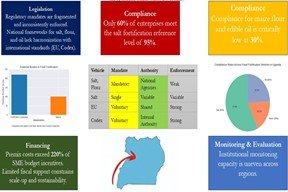
Uganda’s food fortification programme presents a paradox of strong legislative intent but weak implementation, with significant implications for public health and nutrition governance. Despite mandatory regulations enacted in 2005 and amended in 2011, compliance remains uneven only 30% of maize flour and 50% of cooking oil meet national fortification standards, compared to 95% for salt. This review synthesizes findings from over 220 documents spanning policy and institutional performance to assess Uganda’s fortification landscape. Key challenges include fragmented institutional mandates among UNBS, NDA, and MoH, and limited enforcement capacity with weak penalties and infrequent inspections. Comparative analysis with countries like South Africa, Bangladesh, and Vietnam reveals that clear mandates, fiscal incentives, and robust monitoring systems are critical to success. Uganda’s placement in the lower-left quadrant of the global Fortification Performance Matrix characterized by low compliance and immature policy systems underscores the need for integrated reforms. These include revising legislation, expanding fiscal incentives, strengthening institutional capacity, and aligning food vehicles with consumption data. The review concludes that without strategic investment in governance and enforcement, Uganda risks missing the full potential of food fortification to combat micronutrient malnutrition and achieve its national nutrition targets.Downloads
References
Aaron, G. J., Friesen, V. M., Jungjohann, S., Garrett, G. S., Neufeld, L. M., & Myatt, M. (2017). Coverage of large-scale food fortification of edible oil, wheat flour, and maize flour varies greatly by vehicle and country but is consistently lower among the most vulnerable: Results from coverage surveys in 8 countries. Journal of Nutrition, 147(5), 984S-994S. https://doi.org/10.3945/jn.116.245753
Allen, L., de Benoist, B., Dary, O., & Hurrell, R. (2006). Guidelines on food fortification with micronutrients. Geneva: World Health Organization and Food and Agriculture Organization of the United Nations. https://www.who.int/publications/i/item/9241594012
Bell, V., Rodrigues, A. R., Ferrão, J., Varzakas, T., & Fernandes, T. H. (2024). The Policy of Compulsory Large-Scale Food Fortification in Sub-Saharan Africa. In Foods (Vol. 13, Issue 15, pp. 1–30). https://doi.org/10.3390/foods13152438
Bobrek, K. S., Broersen, B., Aburto, N. J., Garg, A., Serdula, M., Beltrán Velázquez, F., Wong, E. C., & Pachón, H. (2021). Most national, mandatory flour fortification standards do not align with international recommendations for iron, zinc, and vitamin B12 levels. Food Policy, 99. https://doi.org/10.1016/j.foodpol.2020.101996
Bourassa, M. W., Atkin, R., Gorstein, J., & Osendarp, S. (2023). Aligning the Epidemiology of Malnutrition with Food Fortification: Grasp Versus Reach. Nutrients, 15(9), 1–9. https://doi.org/10.3390/nu15092021
Bustreo, F., Harding, A., & Axelsson, H. (2003). Can developing countries achieve adequate improvements in child health outcomes without engaging the private sector? Bulletin of the World Health Organization, 81, 886–895.
Darwar, R., Rowe, L. A., Chadha, M., Rosas, A. M. S., & Arabi, M. (2023). A blueprint for fortification planning and programming: Lessons learned from an analytical review of existing fortification frameworks. Maternal and Child Nutrition, https://doi.org/10.1111/mcn.13571
Labadarios, D., Swart, E., & Maunder, E. (2008). Executive summary of the National Food Consumption Survey Fortification Baseline (NFCS-FB-I), South Africa, 2005. Pretoria: Department of Health, Republic of South Africa.
Ebata, A., Thorpe, J., Islam, A., Sultana, S., Mbuya, M. N. N., Mkambula, P., Mbuya, M. N. N., Rowe, L. A., Sablah, M., Friesen, V. M., Chadha, M., Osei, A. K., Ringholz, C., Vasta, F. C., Gorstein, J., Olson, R., Gavin-Smith, B., Ferraboschi, C., Kraemer, K., Laviolette, L. (2021). Regulatory monitoring of fortified foods: Identifying barriers and good practices. Nutrients, 12(2), 880–888. https://doi.org/10.3390/nu13041118
FAO. (2023). The State of Food Security and Nutrition in the World 2023. In The State of Food Security and Nutrition in the World 2023. https://doi.org/10.4060/cc3017en
GAIN & CDC (2017). Fortification Assessment Coverage Tool (FACT) survey in Uganda, 2015. Geneva: Global Alliance for Improved Nutrition. https://www.gainhealth.org/resources/reports/fortification-assessment-coverage-tool-fact-survey-uganda-2015
GAIN, & PHC. (2018). Regulatory monitoring of national food fortification programs: A policy guidance document. Geneva: Global Alliance for Improved Nutrition. https://www.gainhealth.org/resources/reports/regulatory-monitoring-national-food-fortification-programs
García-Casal, M. N. (2014). Planning and Implementing Food Fortification Programs to Combat Micronutrient Malnutrition: Iron. Food and Nutrition Sciences, 05(10), 880–888. https://doi.org/10.4236/fns.2014.510097
Hoogendoorn, A., Luthringer, C., Parvanta, I., & Garrett, G. S. (2016). Food Fortification Global Mapping Study 2016: Technical assistance for strengthening capacities in food fortification. 211.
Jadhav, M. H., Mannar, M. G. V., & Wesley, A. S. (2019). A case study on the scaling-up of double fortified salt through the public distribution system of a food security program in Uttar Pradesh, India: experiences, challenges, and achievements. Journal of Global Health Reports, 3, e2019075.
Karki, R., Karki, K., Bashyal, A., Parajuli, R., Rai, D., Adhikari, A., Jha, S., Bhattarai, S., Dhakal, S., & Jonchhe, S. (2025). Biobased Fortification: Current Challenges and Perspectives. Sustainable Food Fortification: Biobased Approaches and Strategies, 1–52.
Kyamuhangire, W., Lubowa, A., Kaaya, A., Kikafunda, J., Harvey, P. W. J., Rambeloson, Z., Dary, O., Dror, D. K., & Allen, L. H. (2013). The importance of using food and nutrient intake data to identify appropriate vehicles and estimate potential benefits of food fortification in Uganda. 34(2), 131–142. https://doi.org/10.1177/156482651303400202
Laviolette, L. (2018). Financing and Sustainability of Food Fortification. In Food Fortification in a Globalized World. Elsevier Inc. https://doi.org/10.1016/b978-0-12-802861-2.00009-2
Luthringer, C. L., Rowe, L. A., Vossenaar, M., & Garrett, G. S. (2015). Regulatory monitoring of fortified foods: Identifying barriers and good practices. Global Health Science and Practice, 3(3), 446–461. https://doi.org/10.9745/GHSP-D-15-00171
MAAIF & MOH. (2003). Uganda Food and Nutrition Policy. Kampala: Government of Uganda.
Mannar, M. G. V., Garrett, G. S., & Hurrell, R. F. (2018). Future Trends and Strategies in Food Fortification. In Food Fortification in a Globalized World (pp. 375–381). Elsevier. https://doi.org/10.1016/b978-0-12-802861-2.00040-7
Mannar, M. G. V., & Hurrell, R. F. (2018). Food Fortification. In Food Fortification in a Globalized World (pp. 3–11). Elsevier. https://doi.org/10.1016/B978-0-12-802861-2.00001-8
Martorell, R., Ascencio, M., Tacsan, L., Alfaro, T., Young, M. F., Addo, O. Y., Dary, O., & Flores-Ayala, R. (2015). Effectiveness evaluation of the food fortification program of Costa Rica: Impact on anemia prevalence and hemoglobin concentrations in women and children. American Journal of Clinical Nutrition, 101(1), 210–217. https://doi.org/10.3945/ajcn.114.097709
Micronutrient Initiative. (2003, September). Fortification rapid assessment tool (FRAT). Developed by PATH Canada under contract to the Micronutrient Initiative. Ottawa, Canada: Micronutrient Initiative. https://www.nutritionintl.org/resources/fortification-rapid-assessment-tool-frat
Mkambula, P., Mbuya, M. N. N., Rowe, L. A., Sablah, M., Friesen, V. M., Chadha, M., Osei, A. K., Ringholz, C., Vasta, F. C., & Gorstein, J. (2020). The unfinished agenda for food fortification in low- and middle-income countries: Quantifying progress, gaps and potential opportunities. Nutrients, 12(2). https://doi.org/10.3390/nu12020354
MOH, Ministry of Health. (2011). The Food and Drugs (Food Fortification) (Amendment) Regulations, 2011. Arrangement of Regulation. 30, 385–387.
MOH, Ministry of Health. (2017). Uganda industrial food fortification Strategy 2017-2022. August 2017.
MOH, & FFI, Ministry of Health and Food Fortification Initiative. (2021). A Rapid Assessment of the Impact of COVID-19 on Food Fortification Regulation Compliance in Uganda. May, 2021.
Namugumya, B. S., Candel, J. J. L., Talsma, E. F., & Termeer, C. J. A. M. (2020). Towards concerted government efforts? Assessing nutrition policy integration in Uganda. Food Security, 12(2), 355–368. https://doi.org/10.1007/s12571-020-01010-5
Neufeld, L. M., Baker, S., Garrett, G. S., & Haddad, L. (2017). Coverage and utilization in food fortification programs: Critical and neglected areas of evaluation. Journal of Nutrition, 147(5), 1015S-1019S. https://doi.org/10.3945/jn.116.246157
NPA, National Planning Authority. (2011). Uganda nutrition action plan 2011-2016. Scaling Up Multi-Sectoral Efforts to Establish a Strong Nutrition Foundation for Uganda’s Development, 1, 64.
NPA, National Planning Authority. (2020). Third National Development Plan (NDPIII) 2020/21-2024/25. Uganda Vision 2040, Third, 341.
Olson, R., Gavin-Smith, B., Ferraboschi, C., & Kraemer, K. (2021). Food fortification: The advantages, disadvantages and lessons from sight and life programs. Nutrients, 13(4). https://doi.org/10.3390/nu13041118
OPM, Office of the Prime Minister. (2020). Uganda Nutrition Action Plan (2020-2025): Leaving no-one behind in scaling up nutrition actions. 1–108.
Pachón, H., & Dary, O. (2018). Consumption Monitoring: Coverage, Provision, and Utilization. Food Fortification in a Globalized World, 291–297. https://doi.org/10.1016/B978-0-12-802861-2.00030-4
Pena-Rosas, J. P., Parvanta, I., Van Der Haar, F., & Chapel, T. J. (2008a). Monitoring and evaluation in flour fortification programs: Design and implementation considerations. Nutrition Reviews, 66(3), 148–162. https://doi.org/10.1111/j.1753-4887.2008.00019.x
Rowe, L. A. (2020). Addressing the fortification quality gap: A proposed way forward. In Nutrients (Vol. 12, Issue 12, pp. 1–17). MDPI AG. https://doi.org/10.3390/nu12123899
Rowe, L. A., Luthringer, C. L., & Garrett, G. S. (2018). Regulatory Monitoring of Mandatory Fortification Programs. In Food Fortification in a Globalized World (pp. 283–290). Elsevier. https://doi.org/10.1016/b978-0-12-802861-2.00029-8
SPRING, Strengthening Partnerships, Results, and Innovations in Nutrition Globally. (2018a). The state of maize flour fortification in Uganda (pp. 1–48). Arlington, VA: SPRING Project.https://dec.usaid.gov/dec/content/Detail.aspx?docID=KRCTF-01273
SPRING, Strengthening Partnerships, Results, and Innovations in Nutrition Globally. (2018b, May). Uganda: Final country report. Arlington, VA: SPRING Project. https://www.spring-nutrition.org/publications/reports/uganda-final-country-report
Taylor, J. R., Ferruzzi, M. G., Ndiaye, C., Traoré, D., Mugalavai, V. K., De Groote, H., & Hamaker, B. R. (2023). Entrepreneur-led food fortification: A complementary approach for nutritious diets in developing countries. Global Food Security, 36, 100674. https://doi.org/https://doi.org/10.1016/j.gfs.2023.100674
Teachout, E., Rowe, L. A., Pachon, H., Tsang, B. L., Yeung, L. F., Rosenthal, J., Razzaghi, H., Moore, M., Panagides, D., Milani, P., & Cannon, M. J. (2021). Systematic process framework for conducting implementation science research in food fortification programs. Global Health Science and Practice, 9(2), 412–421. https://doi.org/10.9745/GHSP-D-20-00707
Thakur, S., Singh, A., Insa, B., & Sharma, S. (2023). Food fortification in India as malnutrition concern: a global approach. Sustainable Food Technology, 1(5), 681–695. https://doi.org/10.1039/d3fb00079f
Theriault, V., Kirimi, L., Wineman, A., Kinyumu, E., & Tschirley, D. (2024). Assessment of the policy enabling environment for large-scale food fortification: A novel framework with an application to Kenya. PLOS Global Public Health, 4(5), e0003211. https://doi.org/10.1371/journal.pgph.0003211
UBOS, Uganda Bureau of Statistics. (2020). Uganda National Panel Survey report 2019/2020 (pp. 1–76). Kampala, Uganda: Uganda Bureau of Statistics. https://doi.org/10.48529/nqzx-f196
UNICEF, United Nations Children’s Fund. (2020). Advancing large-scale food fortification: UNICEF’s vision and approach for persisting micronutrient deficiencies. New York, NY: UNICEF.
USAID, United States Agency for International Development. (2022a). Landscape analysis of food fortification in Uganda. Gomal University Journal of Research, 38(04). https://doi.org/10.51380/gujr-38-04-01
USAID, United States Agency for International Development. (2022b). Report for the review of food fortification marketing strategies, and promotional messages, materials and interventions. Washington, DC: USAID. Retrieved from https://dec.usaid.gov
USAID, United States Agency for International Development. (2023a). Mapping the food fortification regulatory monitoring systems and processes for quality and safety of fortified foods in Uganda. Washington, DC: USAID Advancing Nutrition. Retrieved from https://dec.usaid.gov
USAID, United States Agency for International Development. (2023b). The National Working Group on Food Fortification: Terms of reference. Washington, DC: USAID. Retrieved from https://dec.usaid.gov
van der Meer, L. N., & Schebesta, H. (2020). The internal market, incomplete: EU, Dutch and Belgian legislation on maximum food fortification with micronutrients. European Food and Feed Law Review, 15(3), 212–230. https://doi.org/10.2139/ssrn.3624024
Vosti, S., Baker, E., Moorthy, D., Mazinga, M., & Dary, O. (2024). Firm-Level and Public-Sector Costs Make Small-Scale Maize Flour Fortification Challenging in Uganda. Food and Nutrition Bulletin. https://doi.org/10.1177/03795721231223052
Vosti, S., Jarvis, M., Johnson, Q., Some, J., Somda, H., Tarini, A., Engle-Stone, R., & Adams, K. (2022). Estimating the Costs of Alternative Large-Scale Food Fortification Programs in Burkina Faso: A MINIMOD Tool for Informing Policy Discussions. Current Developments in Nutrition, 6(Supplement_1), 612–612. https://doi.org/10.1093/cdn/nzac060.070
WHO & FAO. (2006). Implementing effective and sustainable food fortification programs. Guidelines on Food Fortification with Micronutrients, 341.
Wirth, J. P., Laillou, A., Rohner, F., Northrop-Clewes, C. A., Macdonald, B., & Moench-Pfanner, R. (2012). Lessons learned from national food fortification projects: experiences from Morocco, Uzbekistan, and Vietnam. Food and Nutrition Bulletin, 33(4 Suppl), 281–292. https://doi.org/10.1177/15648265120334s304
Downloads
Published
How to Cite
Issue
Section
License
Copyright (c) 2026 Agriculture and Environmental Science Academy

This work is licensed under a Creative Commons Attribution-NonCommercial 4.0 International License.