Host preference dynamics of rice weevil (Sitophilus oryzae L.) in stored cereals
DOI:
https://doi.org/10.26832/24566632.2026.110103Keywords:
Grain damage, Free choice, No choice, Sitophilus oryzae, Storage pestAbstract
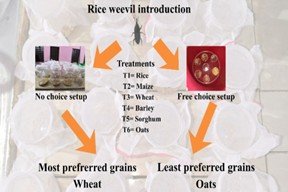
The study aimed to evaluate the host preference of rice weevil (Sitophilus oryzae L.) among six different cereals viz., rice, maize, wheat, barley, sorghum, and oats and assess their resistance to infestation. The experiment was conducted at the Entomology laboratory of Rampur Campus, Chitwan, from May to August 2025 under both free-choice and no-choice conditions using completely randomized design (CRD) with four replications. Each treatment consists of one hundred grains with fifteen pairs of newly emerged rice weevils from the stock culture, introduced under no-choice conditions and fifty pairs per replication under free-choice conditions. The assessed parameters were grain damage percentage, weight loss percentage, and germination percentage before and after the treatment. Under free-choice conditions, wheat recorded the highest grain damage (28.25%) and weight loss (20.01%), whereas oats showed the lowest damage (3.25%) and weight loss (1.52%); greatest reduction in germination was also in wheat (20%) and the smallest in oats (3%). Under no-choice conditions, wheat again had the highest grain damage (14.50%) and weight loss (17.44%), both significantly greater at the 0.1% level, while oats had the lowest damage (4.75%) and weight loss (2.21%); correspondingly, the highest reduction in germination occurred in wheat (18%) and the lowest in oats (3%). This study suggests that wheat is a highly preferred host, while oats exhibit higher resistance against rice weevils. It also suggests that integrating resistant grains and targeted pest management strategies can reduce post-harvest loss.
Downloads
References
Ahmad, R., Hassan, S., Dar, S. A., Nighat, S., Devi, Y. K., Javeed, K., Usmani, S., Ansari, M. J., Erturk, S., Alkan, M., & Hussain, B. (2022). Stored grain pests and current advances for their management. In Postharvest Technology – Recent Advances, New Perspectives and Applications (pp. 1–38). Intech Open. https://doi.org/10.5772/intechopen.101503
Arafah, N. S., Jun, C. Y., Shariff, S. S., Noor, N. Q., & Zaharudin, N. (2023). Effects of selected plants against rice weevil (Sitophilus oryzae). Malaysian Applied Biology, 52(4), 113-118. https://doi.org/10.55230/mabjournal.v52i4.d044
Awadallah, S. S. I., Ata, T. E., Hashem, A. S., & Shetefa, M. F. (2024). Influence of Different Stored Grains on Adult Emergence Rates and Weight Loss by the Rice Weevil Sitophilus oryzae (Coleoptera: Curculionidae). Journal of Plant Protection and Pathology, 15(1), 45-49. https://doi.org/10.21608/jppp.2024.258681.1201
Bhargude, A. R., Patil, S. K., & Bhede, B. V. (2021). Susceptibility of selected cereal crops in storage to rice weevil, Sitophilus oryzae (Linnaeus). The Pharma Innovation Journal, 10(1), 570–575. https://doi.org/10.25174/2582-2675/2025/172796
Chandaragi, M. K., Prajapati, A. R., & Shinde, M. (2022). Stored grain insect pests and their management: A review. In K. Alexander, M. K. Chandaragi, & A. R. Prajapati (Eds.), New Frontiers in Entomology (Vol. 1, pp. 119–143). Advent Publications. Dahal, N., Ghimire, S., & Poudel, R. (2022). A Study on Dynamics of Major Cereal Crop Production in Nepal. International Journal of Social Sciences and Management, 9(1), 13–18. https://doi.org/10.3126/ijssm.v9i1.42716
Davis, J. M., & Stamps, J. A. (2004). The effect of natal experience on habitat preferences. Trends in Ecology & Evolution, 19(8), 411–416. https://doi.org/10.1016/S0169‑5347(04)00116‑8
Doherty, E. M., Sun, Q., & Wilson, B. E. (2023). Stored rice varietal resistance towards Sitophilus oryzae. Crop Protection, 165, 106162. https://doi.org/10.1016/j.cropro.2022.106162
Emery, R., & Cousins, D. (2019). Insect pests stored grain. Agriculture and Food, Department of Primary Industries and Regional Development, 8. https://agric.wa.gov.au/n/1167
FAO. (2013). Manual of the prevention of post-harvest grain losses: The fundamentals of storage. Food and Agriculture Organization of the United Nations. https://www.fao.org/3/i3324e/i3324e.pdf
Germinara, G. S., De Cristofaro, A., & Rotundo, G. (2008). Behavioral responses of adult Sitophilus granarius to individual cereal volatiles. Journal of Chemical Ecology, 34(4), 523–529. https://doi.org/10.1007/s108860089454y
Gvozdénac, S., Tanaskovic, S., Vukajlović, F., Prvulovic, D., Ovuka, J., & Visacki, V. (2020). Host and ovipositional preference of rice weevil (Sitophilus oryzae) depending on feeding experience. Applied Ecology and Environmental Research, 18, 6663–6673. https://doi.org/10.15666/aeer/1805_66636673
ISTA, International Seed Testing Association. (2023). Chapter 5: The germination test. In International Rules for Seed Testing, 2023 (pp. i-5–58). ISTA. https://doi.org/10.15258/istarules.2023
Kandel, P. (2021). Assessment of postharvest pest management practices in Nepal and efficacy of hypoxia for controlling Sitophilus oryzae L. (Coleoptera: Curculionidae) [master’s thesis, Purdue University]. Purdue University Repository. https://docs.lib.purdue.edu/dissertations/AAI30504980/.
Kärkönen, A., Korpinen, R., Järvenpää, E., Aalto, A., & Saranpää, P. (2022). Properties of oat and barley hulls and suitability for food packaging materials. Journal of natural fibers, 19(16), 13326-13336. https://doi.org/10.1080/15440478.2022.2091709
Khanal, D., Neupane, S. B., Bhattarai, A., Khatri-Chhetri, S., Nakarmi, N., & Sapkota, S. (2021). Evaluation of botanical powders for the management of rice weevil (Sitophilus oryzae L. Coleoptera: Curculionidae) in Rupandehi, Nepal. Advances in Agriculture, 6624307. https://doi.org/10.1155/2021/8878525
Koehler, P. G. (2021). Rice weevil, Sitophilus oryzae (Coleoptera: Curculionidae) (ENY-261/IG120). University of Florida IFAS Extension. https://doi.org/10.32473/edis-ig120-1994
Odeyemi, O., & Daramola, A. (2000). Storage practices in the tropics: Food storage and pest problems (Vol. 1, p. 235). Dave Collins Publication.
Law-Ogbomo, K. E., & Enobakhare, D. A. (2006). Efficacy of rubber seed oil, palm oil, and palm kernel oil as grain protectants against Sitophilus zeamais (Mots.) (Coleoptera: Curculionidae) in three maize varieties. Journal of Entomology, 3, 40–47. https://doi.org/10.3923/je.2006.40.47
Lu, S., Zhang, L., Lu, Y., Chen, M., & Wang, Z. (2024). Host volatiles potentially drive two evolutionarily related weevils to select different grains. Insects, 15(5), 300. https://doi.org/10.3390/insects15050300
Lucas, É., & Riudavets, J. (2002). Biological and mechanical control of Sitophilus oryzae (Coleoptera: Curculionidae) in rice. Journal of Stored Products Research, 38(3), 293–304. https://doi.org/10.1016/S0022-474X(01)00033-9
Majd-Marani, S., Naseri, B., Hassanpour, M., Razmjou, J., & Jalaeian, M. (2023). Life history and life table parameters of the rice weevil, Sitophilus oryzae L. (Coleoptera: Curculionidae), fed on 10 rice cultivars and lines in Iran. Journal of Stored Products Research, 102, 102118. https://doi.org/10.1016/j.jspr.2023.102118
Manjhu, A., Lekha, Mahla, M. K., Chhangani, G., & Kumar, K. (2022). Host preference studies of rice weevil, Sitophilus oryzae L. on various cereals. The Pharma Innovation Journal,11(1),1363–1367.
Mason, L., & McDonough, M. (2012). Biology, behavior, and ecology of stored grain and legume insects. In J. F. Campbell, S. W. Phillips, D. W. Hagstrum, & E. J. Rees (Eds.), Stored product protection (Ch. 2). Kansas State University. https://entomology.k-state.edu› doc›s156-ch-02-biol-stored-gr-ins-mar1
Mehta, V., Kumar, S., & Jayaram, S. (2021). Damage potential, effect on germination, and development of Sitophilus oryzae (Coleoptera: Curculionidae) on wheat grains in Northwestern Himalayas. Journal of Insect Science, 21(3), 8. https://doi.org/10.1093/jisesa/ieab042
Pal, M., Tiwari, S., Regmi, R., & Ali, F. M. (2021). Varietal screening of rice genotypes for the rice weevil, Sitophilus oryzae (Linnaeus) (Curculionidae: Coleoptera) at laboratory conditions. Journal of Agriculture and Environment, 22, 51–60. https://doi.org/10.3126/AEJ.V22I0.46785
Pecio, Ł., Wawrzyniak-Szołkowska, A., Oleszek, W., & Stochmal, A. (2013). Rapid analysis of avenacosides in grain and husks of oats by UPLC–TQ–MS. Food Chemistry, 141(3), 2300–2304. https://doi.org/10.1016/j.foodchem.2013.04.094
Raffrenato, E., Fievisohn, R., Cotanch, K. W., Grant, R. J., Chase, L. E., & Van Amburgh, M. E. (2017). Effect of lignin linkages with other plant cell wall components on in vitro and in vivo neutral detergent fiber digestibility and rate of digestion of grass forages. Journal of Dairy Science, 100(10), 8119–8131. https://doi.org/10.3168/jds.2016-12364
Rajendran, S., & Sriranjini, V. (2008). Plant products as fumigants for stored-product insect control. Journal of Stored Products Research, 44(2), 126–135. https://doi.org/10.1016/j.jspr.2007.08.003
Rosentrater, K., & Bucklin, R. (2022). Structural, physical, and engineering properties of cereal grains and grain products. In Handbook of cereal science and technology (pp. 135–178). Elsevier. https://doi.org/10.1016/B978-0-12-812758-2.00019-2
Saeed, M. B., & Laing, M. D. (2023). Biocontrol of maize weevil, Sitophilus zeamais Motschulsky (Coleoptera: Curculionidae), in maize over a six-month storage period. Microorganisms, 11, 1261. https://doi.org/10.3390/microorganisms11051261
Subedi, S., GC, Y. D., Thapa, R. B., & Rijal, J. P. (2009). Rice weevil (Sitophilus oryzae L.) host preference of selected stored grains in Chitwan, Nepal. Journal of Institute of Agriculture and Animal Science, 30, 151–158.
Talukder, F. A. (2017). Plant products as potential stored-product insect stored management agents: A mini review. Emirates Journal of Food and Agriculture, 18(1), 17-32. https://doi.org/10.9755/ejfa.v12i1.5221
Trematerra, P., Lupi, C., & Athanassiou, C. (2013). Does natal habitat preference modulate cereal kernel preferences in the rice weevil? Arthropod-Plant Interactions, 7(3), 287–297. https://doi.org/10.1007/s11829‑012‑9243‑y
USDA, United States Department of Agriculture. (2016). Stored grain insects reference. Federal Grain Inspection Service. U.S. Department of Agriculture. https://https://www.ams.usda.gov/sites/default/files/media/StoredGrainInsectsReference2017.pdf?
Varga, M., Jójárt, R., Fónad, P., Mihály, R., & Palágyi, A. (2018). Phenolic composition and antioxidant activity of colored oats. Food Chemistry, 268, 153–161. https://doi.org/10.1016/j.foodchem.2018.06.035.
Yadav, M. K., Bhargava, M. C., Choudhary, M. D., & Choudhary, S. (2018). Relative susceptibility of different wheat varieties against rice weevil, Sitophilus oryzae (Linn.). Journal of Entomology and Zoology Studies, 6(2), 2877–2879. https://doi.org/10.1007/s42690-020-00253-1
Downloads
Published
How to Cite
Issue
Section
License
Copyright (c) 2026 Agriculture and Environmental Science Academy

This work is licensed under a Creative Commons Attribution-NonCommercial 4.0 International License.