Effects of different botanicals for substrate sterilization in oyster (Pleurotus ostreatus) mushroom production
DOI:
https://doi.org/10.26832/24566632.2026.110107Keywords:
Oyster mushroom, Pleurotus ostreatus, Substrate sterilization , Botanicals, Biological efficiencyAbstract
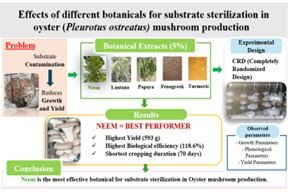
Effective sterilization of substrate is a crucial step for successful oyster mushroom production, yet the use of eco-friendly options to energy-intensive and chemical sterilization methods remains limited in Nepal. Therefore, this experiment was carried out from November 2024 to February 2025 at Prithu Technical College, Deukhuri, Dang, Nepal to evaluate the effectiveness of a few selected plant extracts as sterilizing agents in Pleurotus ostreatus production. This research aimed to identify a suitable plant-based alternative that could improve yield parameters. Six treatments: Neem (Azadirachta indica), Lantana (Lantana camara), Papaya (Carica
papaya), Fenugreek (Trigonella foenum-graecum), and Turmeric (Curcuma longa) at 5% concentration were evaluated in a completely randomized design (CRD) with three replications. Data were recorded up to the third flush for phenological, growth, and yield parameters. The result showed significant variation among the assigned treatments. Neem-treated substrate performed best, exhibiting the shortest cropping duration (70 days), the shortest time for pinhead formation (29 days) and fruiting body formation (37 days), the highest total yield (593 g per bag), and the highest biological efficiency (118.6%). While fenugreek and turmeric treatments delayed developmental processes and resulted in decreased yield. There were no significant differences in the number of fruiting bodies and leaves per fruiting body among the treatments. Overall, Neem extract was the most effective botanical for substrate sterilization, offering a sustainable, eco-friendly alternative to conventional methods, improving yield and growth efficiency in oyster mushroom production.
Downloads
References
Biswas, M. K. (2015). Effect of botanicals on the incidence of competitor moulds and biological efficiency of grey oyster mushroom (Pleurotus ostreatus). The Bioscan, 10(2), 511-515.
Biswas, M., Kuiry, S., & Ghosh, T. (2018). Use of plant extracts for substrate sterilization and its effect on competitor moulds and biological efficiency of oyster mushroom. European Journal of Medicinal Plants, 22(4), 1-8. https://doi.org/10.9734/EJMP/2018/40411
Chang, S. T., & Miles, P. G. (2004). Book review by Solomon P. Wasser. International Journal of Medicinal Mushrooms, 6, 389-392. https://doi.org/10.1615/IntJMedMushr.v6.i4.100
Frimpong-Manso, J., Obodai, M., Dzomeku, M., & Apetorgbor, M. M. (2011). Influence of rice husk on biological efficiency and nutrient content of Pleurotus ostreatus (Jacq. ex. Fr.) Kummer. https://csirspace.foodresearchgh.site/handle/1/331
Fufa, B. K., Tadesse, B. A., & Tulu, M. M. (2021). Cultivation of Pleurotus ostreatus on agricultural wastes and their combination. International Journal of Agronomy, 2021(1), 1465597. https://doi.org/10.1155/2021/1465597
Girmay, Z., Gorems, W., Birhanu, G., & Zewdie, S. (2016). Growth and yield performance of Pleurotus ostreatus (Jacq. Fr.) Kumm (oyster mushroom) on different substrates. Amb Express, 6(1), 87. https://doi.org/10.1186/s13568-016-0265-1
Grimm, D., Sonntag, E., & Rahmann, G. (2024). Evaluation of different pasteurization and sterilization methods for oyster mushroom substrates. Journal of Microbiology, Biotechnology and Food Sciences, 13(5), e10428-e10428. https://doi.org/10.55251/jmbfs.10428
Jarial, R. S., Jarial, K., & Bhatia, J. N. (2024). Comprehensive review on oyster mushroom species (Agaricomycetes): Morphology, nutrition, cultivation and future aspects. Heliyon, 10(5). https://doi.org/10.1016/j.heliyon.2024.e26539
Kumar, D., Kashyap, S., & Gupta, S. (2024). Mushrooms as Functional Foods: Trends and Innovations. In Mushroom Magic (pp. 307-322). CRC Press.
Malik, K., Khadka, P., Luthra, S., & Gupta, P. (2025). Comprehensive Study on Supplements Significance and Their Impact on Contamination, Growth and Yield of Oyster Mushrooms. Journal of Advances in Biology & Biotechnology, 28(6), 1060-1068. https://dx.doi.org/10.9734/jabb/2025/v28i62464
Mejía, S. J., & Albertó, E. (2013). Heat treatment of wheat straw by immersion in hot water decreases mushroom yield in Pleurotus ostreatus. Revista Iberoamericana de Micologia, 30(2), 125-129. https://doi.org/10.1016/j.riam.2012.11.004
Miles, P. G., & Chang, S. T. (1997). Mushroom biology: concise basics and current developments. World Scientific. https://doi.org/10.1142/3296
Modeste, H. (2022). Effects of grain spawn and substrates on growth and yield of oyster mushroom grown under different cropping shelters. African Journal of Plant Science, 16(6), 125-137.https://doi.org/10.5897/AJPS2022.2244
Muswati, C., Simango, K., Tapfumaneyi, L., Mutetwa, M., & Ngezimana, W. (2021). The effects of different substrate combinations on growth and yield of oyster mushroom (Pleurotus ostreatus). International Journal of Agronomy, 2021(1), 9962285. https://doi.org/10.1155/2021/9962285
Nongthombam, J., Kumar, A., Ladli, B. G. V. V. S. N., Madhushekhar, M., & Patidar, S. (2021). A review on study of growth and cultivation of oyster mushroom. Plant Cell Biotechnology and Molecular Biology, 22(5&6), 55-65.
Park, C., Lim, J. S., Lee, Y., Lee, B., Kim, S. W., Lee, J., & Kim, S. (2007). Optimization and morphology for decolorization of reactive black 5 by Funalia trogii. Enzyme and Microbial Technology, 40(7), 1758-1764. https://doi.org/10.1016/j.enzmictec.2006.12.005
Qu, J., Huang, C., & Zhang, J. (2016). Genome-wide functional analysis of SSR for an edible mushroom Pleurotus ostreatus. Gene, 575(2), 524-530. https://doi.org/10.1016/j.gene.2015.09.027
Ramachela, K., & Sihlangu, S. M. (2016). Effects of various hormonal treated plant substrates on development and yield of Pleurotus ostreatus. Cogent Food & Agriculture, 2(1), 1276510. https://doi.org/10.1080/23311932.2016.1276510
Rathod, M. G., Dhotare, J. M., Kamble, G. T., Dhawale, R. I., Dhuldhaj, U. P., Chakke, A. B., & Pathak, A. P. (2023). Influence of various substrate treatment methods on yield and biological efficiency of Pleurotus florida mushroom. World Journal of Advanced Engineering Technology and Sciences, 8, 216-224. https://doi.org/10.30574/wjaets.2023.8.1.0035
Shrestha, S., Bhattarai, S., Shrestha, R. K., & Shrestha, J. (2021). Effect of different substrate sterilization methods on performance of oyster mushroom (Pleurotus ostreatus). https://doi.org/10.15159/jas.21.03
Tekeste, N., Dessie, K., Taddesse, K., & Ebrahim, A. (2020). Evaluation of different substrates for yield and yield attributes of oyster mushroom (Pleurotus ostreatus) in crop-livestock farming system of northern Ethiopia. The Open Agriculture Journal, 14(1). http://dx.doi.org/10.2174/1874331502014010030
Thongklang, N., & Luangharn, T. (2016). Testing agricultural wastes for the production of Pleurotus ostreatus. Mycosphere, 7(6), 766-772. https://doi.org/10.5943/mycosphere/7/6/6
Vajna, B., Szili, D., Nagy, A., & Márialigeti, K. (2012). An improved sequence-aided T-RFLP analysis of bacterial succession during oyster mushroom substrate preparation. Microbial Ecology, 64(3), 702-713. https://doi.org/10.1007/s00248-012-0063-5
Vendruscolo, F., Albuquerque, P. M., Streit, F., Esposito, E., & Ninow, J. L. (2008). Apple pomace: a versatile substrate for biotechnological applications. Critical reviews in biotechnology, 28(1), 1-12. https://doi.org/10.1080/07388550801913840
Vera, N. S., Ndam, T. W., Veyeh, N. M., & Rosemary, K. T. (2022). The effect of substrates on the growth, yield, nutritional and phytochemical components of Pleurotus ostreatus supplemented with four medicinal plants. African Journal of Biotechnology, 21(6), 292-304. https://doi.org/10.5897/AJB2022.17466
Wei, J., Wang, Y. X., Guan, T. K., Wang, Q. Y., Zhang, J., Zhang, J. Y., & Zhang, G. Q. (2024). Bacterial communities during composting cultivation of oyster mushroom Pleurotus floridanus using broken eggs as the nitrogen source and study of agronomic and nutritional properties. Frontiers in Microbiology, 14, 1274032.https://doi.org/10.3389/fmicb.2023.1274032
Wiafe-Kwagyan, M. (2023). Role of Mushroom Pathogen Trichoderma harzianum Rafai in the Reduction of Growth Yield, Nutrient Quality, and Morphometric Measurements of the Fruiting Body of Pleurotus ostreatus EM-1 From Seven Oyster Mushroom Cultivation Farms in Ghana. Journal of Food Science & Technology, 4(1), 1-12. https://doi.org/10.47485/2834-7854.1021
Yin, Y., Chen, B., Xu, S., Zuo, J., Xu, Y., Xiong, S., & Chen, F. (2025). Investigation of crop straw for edible and medicinal fungi cultivation: Assessment of lignocellulose preprocessing and spent substrate biofuel properties. Industrial Crops and Products, 223, 120004. https://doi.org/10.1016/j.indcrop.2024.120004
Downloads
Published
How to Cite
Issue
Section
License
Copyright (c) 2026 Agriculture and Environmental Science Academy

This work is licensed under a Creative Commons Attribution-NonCommercial 4.0 International License.