Effect of various mulching materials on different varieties of watermelon under eastern Nepal agro-climatic conditions
DOI:
https://doi.org/10.26832/24566632.2026.1102011Keywords:
Citrullus lanatus, Mulching, Parameters, Saraswati, Sweet HoneyAbstract
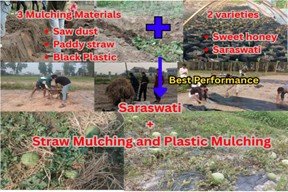
Watermelon (Citrullus lanatus) production is often limited by soil moisture stress and low resource-use efficiency, making mulching an effective strategy for improving crop performance. This study evaluated the effects of different mulching materials on growth, yield, and fruit quality of two watermelon varieties under the agro-climatic conditions of eastern Nepal. The experiment was conducted in a two-factor factorial Randomized Complete Block Design (RCBD) with eight treatment combinations and three replications. Two varieties (Sweet Honey and Saraswati) were evaluated under three mulching materials (straw, sawdust, and black plastic mulch) along with a non-mulched control. Mulching significantly (p<0.05) affected plant height, number of leaves, number of branches, titratable acidity, and yield. Black plastic mulch recorded the highest plant height (3.44 m) and yield (22.35 t ha⁻¹), while straw mulch produced highest number of leaves (131.77) and branches (10.06). Among varieties, Saraswati showed higher firmness (9.03 kg cm⁻²) and leaf number (101.51), whereas Sweet Honey produced heavier fruits (2.74 kg). Significant interaction effects were observed for leaves, branches, titratable acidity, and firmness. The highest leaf number (138.75), branch number (11.75), and firmness (9.73 kg cm⁻²) were recorded in Sweet Honey × Straw mulch, Saraswati × Straw mulch, and Saraswati × Sawdust mulch, respectively. No significant effects were observed on pH, total soluble solids, node diameter, pulp weight, and fruit diameter. Therefore, black plastic mulch maximizes yield, while straw mulch enhances vegetative growth and provides a sustainable, low-cost alternative. Integration of suitable mulching practices with the Saraswati variety can improve watermelon productivity under eastern Nepal conditions.Downloads
References
AOAC (2019). Official Methods of Analysis of the Association of Official Analytical Chemists: Official Methods of Analysis of AOAC International. 21st Edition, AOAC, Washington DC.
Bahari, M., Rafii, M. Y., Saleh, G. B., & Latif, M. A. (2012). Combining ability analysis in complete diallel cross of watermelon (Citrullus lanatus (Thunb.) Matsum. & Nakai). The Scientific World Journal, 543158. https://doi.org/10.1100/2012/543158
Díaz-Pérez, J. C. (2022). Plant growth and fruit yield of watermelon as influenced by colored plastic film mulch. International Journal of Vegetable Science, 29(1), 84–92. https://doi.org/10.1080/19315260.2022.2117756
Dube, J., Ddamulira, G., & Maphosa, M. (2021). Watermelon production in Africa: Challenges and opportunities. International Journal of Vegetable Science, 27(3), 211-219. https://doi.org/10.1080/19315260.2020.1716128
Elbagory, M., Abd El-Aziz, M. A., Omara, A. E.-D., Abou Fayssal, S., & Kumar, V. (2025). Assessment of potentially toxic elements in four melon fruit varieties grown in the Ganges and Yamuna River Basin. Horticulturae, 11(2), 216. https://doi.org/10.3390/horticulturae11020216
Gomez, K. A., & Gomez, A. A. (1984). Statistical procedures for agricultural research (2nd ed.). John Wiley & Sons.
Kumar, V. (2026). Agronomical performance of upright hybrid F1 Chili (Capsicum annuum L.) fertilized with sugarcane pressmud compost. Communications in Soil Science and Plant Analysis, 57(6), 491-506. https://doi.org/10.1080/00103624.2026.2622311
Malambane, G., Madumane, K., Sewelo, L. T., & Batlang, U. (2023). Drought stress tolerance mechanisms and their potential common indicators to salinity, insights from the wild watermelon (Citrullus lanatus): A review. Frontiers in Plant Science, 13, 1074395. https://doi.org/10.3389/fpls.2022.1074395
Parmar, H. N., Polara, N. D., & Viradiya, R. R. (2013). Effect of mulching material on growth, yield and quality of watermelon (Citrullus lanatus Thunb.). Universal Journal of Agricultural Research, 1(2), 30–37. https://doi.org/10.13189/ujar.2013.010201
Reddy, M., Ayyanagowdar, M. S., Patil, M. G., Polisgowdar, B. S., Nemichandrappa, M., Anantachar, M., & Balanagoudar, S. R. (2017). Water use efficiency and economic feasibility of drip irrigation for watermelon (Citrullus lanatus). International Journal of Pure and Applied Bioscience, 5(3), 1058-1064. https://doi.org/10.18782/2320-7051.2794
Regmi, R., Bhusal, N., & Neupane, S. (2021). Efficacy of mulching materials on growth performance and yield characters of summer squash (Cucurbita pepo cv. Shlesha 1214) in Mahottari, Nepal. International Journal for Research in Applied Sciences and Biotechnology, 8(1), 62–66. https://doi.org/10.31033/ijrasb.8.1.8
Singh, A., Jaiswal, M., Vibhute, M., & Kumar, S. (2019). Impact of mulching on growth and yield of watermelon (Citrullus lanatus Thunb.) cv. Madhuri. Progressive Horticulture, 51(1), 77–80. https://doi.org/10.5958/2249-5258.2019.00012.5
Singha, M., Topno, S.E., & Kerketta, A. (2023). Effect of different mulching material on watermelon [Citrullus Lanatus (Thunb.)] hybrid under Prayagraj agro-climatic condition. International Journal of Environment and Climate Change 13 (9), 3205-14. https://doi.org/10.9734/ijecc/2023/v13i92567
Vijay, K. A., Chandra, M. G., Ramulu, V., & Kumar, A. K. (2012). Effects of drip irrigation levels and mulches on growth and yield. Journal of Research ANGRAU, 40(4), 73–74.
Downloads
Published
How to Cite
Issue
Section
License
Copyright (c) 2026 Agriculture and Environmental Science Academy

This work is licensed under a Creative Commons Attribution-NonCommercial 4.0 International License.