Bridging the gluten-free gap: A critical review of grain amaranth as a functional ingredient in global and east African food systems
DOI:
https://doi.org/10.26832/24566632.2026.1102016Keywords:
Food and nutrition security, Functional foods, Gluten-free, Grain amaranth, Processing technologiesAbstract
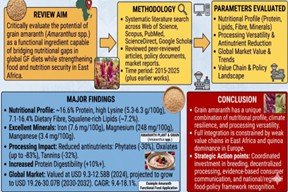
This critical review explores the possibilities of incorporating grain amaranth (Amaranthus spp.) as a functional ingredient to bridge gaps in the nutritional status of global gluten-free diets, thus enhancing food and nutritional security in East Africa. A comprehensive literature search was conducted across Web of Science, Scopus, PubMed, ScienceDirect and Google Scholar on peer reviewed papers, government policies and reports covering years 2015-2025, including some seminal earlier publications. The grains have ~16.6% protein content in the dry matter, contain high amounts of lysine (5.3-6.3 g/100g protein), ~7.2% lipids that consist of significant amounts of squalene (2-8% of total oil) and a high concentration of dietary fibre (7.1-16.4%), as well as extremely high amounts of iron (7.6 mg/100g), magnesium (248 mg/100g) and manganese (3.4 mg/100g). Processing methods like germination, extrusion, fermentation and Instant Controlled Pressure Drop decrease phytate levels by ~30%, oxalate levels up to 83% and tannin levels by ~32%, and increase protein digestibility in vitro to greater than 83% compared to 76%. Global market analysis shows that the industry is worth USD 9.3-12.58 billion (2024) and expected to grow to USD 19.26-30.07 billion by 2030-2032 (CAGR 9.4-18.1%). Unique nutritional benefits, climate resistance, processibility and other properties make the grain ideal for use, but its widespread adoption remains hindered by poor value chains in East Africa and competitive positioning of quinoa in Europe. Strategic investments in breeding, decentralized processing, informed communications, and formal inclusion in food policies are necessary for promoting amaranth as a functional ingredient.
Downloads
References
360iResearch. (2025). Amaranth market - Global forecast 2025-2030. 360iResearch.
Aderibigbe, O. R., Ezekiel, O. O., Owolade, S. O., Korese, J. K., Sturm, B., and Hensel, O. (2022). Exploring the potentials of underutilized grain amaranth (Amaranthus spp.) along the value chain for food and nutrition security: A review. Critical Reviews in Food Science and Nutrition, 62(3), 656-669.
African Union. (2017). Africa Agriculture Status Report 2017: The business of smallholder agriculture in Sub-Saharan Africa. Alliance for a Green Revolution in Africa (AGRA).
Akande, O. A., Nakimbugwe, D., and Mukisa, I. M. (2020). Nutritional quality and acceptability of a complementary porridge formulated from amaranth grain, orange-fleshed sweet potato, soybean and pumpkin seed. Food Science and Nutrition, 8(11), 6024-6035.
Akin-Idowu, P. E., Ademoyegun, O. T., Olagunju, Y. O., Aduloju, A. O., and Adebo, U. G. (2017). Phytochemical content and antioxidant activity of five grain amaranth species. American Journal of Food Science and Technology, 5(6), 249-255.
Alegbejo, J. O. (2013). Nutritional value and utilization of amaranth (Amaranthus spp.): A review. Bayero Journal of Pure and Applied Sciences, 6(1), 136-143.
Alemayehu, F. R., Bendevis, M. A., and Jacobsen, S. E. (2015). The potential for utilizing the seed crop amaranth (Amaranthus spp.) in East Africa as an alternative crop to support food security and climate-change mitigation. Journal of Agronomy and Crop Science, 201(5), 321-329.
Alvarez-Jubete, L., Arendt, E. K., and Gallagher, E. (2010). Nutritive value of pseudocereals and their increasing use as functional gluten-free ingredients. Trends in Food Science and Technology, 21(2), 106-113.
Baraniak, J., and Kania-Dobrowolska, M. (2022). The dual nature of amaranth - Functional food and potential medicine. Foods, 11(4), 618.
Becker, R., Wheeler, E. L., Lorenz, K., Stafford, A. E., Grosjean, O. K., Betschart, A. A., and Saunders, R. M. (1981). A compositional study of amaranth grain. Journal of Food Science, 46(4), 1175-1180.
Bressani, R., and Garcia-Vela, L. A. (1990). Protein fractions in amaranth grain and their chemical characterization. Journal of Agricultural and Food Chemistry, 38(5), 1205-1209.
Cai, Y. Z., Sun, M., and Corke, H. (2005). Characterization and application of betalain pigments from plants of the Amaranthaceae. Trends in Food Science and Technology, 16(9), 370-376.
Caio, G., Volta, U., Sapone, A., Leffler, D. A., De Giorgio, R., Catassi, C., and Fasano, A. (2019). Celiac disease: A comprehensive current review. BMC Medicine, 17(1), 142.
Caselato-Sousa, V. M., and Amaya-Farfan, J. (2012). State of knowledge on amaranth grain: A comprehensive review. Journal of Food Science, 77(4), R93-R104.
CBI - Centre for the Promotion of Imports from Developing Countries. (2022). The European market potential for quinoa.
Chavez-Jauregui, R. N., Silva, M. E. M. P., and Areas, J. A. G. (2000). Extrusion cooking process for amaranth (Amaranthus caudatus L.). Journal of Food Science, 65(6), 1009-1015.
Chemat, F., Rombaut, N., Sicaire, A. G., Meullemiestre, A., Fabiano-Tixier, A. S., and Abert-Vian, M. (2017). Ultrasound assisted extraction of food and natural products: Mechanisms, techniques, combinations, protocols and applications - A review. Ultrasonics Sonochemistry, 34, 540-560.
Das, S. (2016). Amaranthus: A promising crop of future. Springer.
De la Barca, A. M., Rojas-Martinez, M. E., Islas-Rubio, A. R., and Cabrera-Chavez, F. (2010). Gluten-free breads and cookies of raw and popped amaranth flours with attractive technological and nutritional qualities. Plant Foods for Human Nutrition, 65(3), 241-246.
Dinssa, F. F., Hanson, P., Dubois, T., Tenkouano, A., Thoennissen, J., and Hughes, J. (2019). AVRDC - The World Vegetable Centers women-oriented improvement and development program for traditional African vegetables. European Journal of Horticultural Science, 84(2), 122-130.
East African Community. (2022). EAC bioeconomy strategy 2022-2032.
European Commission. (2018). Regulation (EU) 2015/2283 of the European Parliament and of the Council of 25 November 2015 on novel foods. Official Journal of the European Union, L 327, 1-22.
FAO. (2023). The state of food security and nutrition in the world 2023: Urbanization, agrifood systems transformation and healthy diets across the rural-urban continuum. Food and Agriculture Organization of the United Nations.
Farmers Review Africa. (2023). Kenya selects finger millet and amaranth as strategy crops for securing food diversity and nutrition. Farmers Review Africa.
Gamel, T. H., Linssen, J. P., Mesallam, A. S., Damir, A. A., and Shekib, L. A. (2006). Effect of seed treatments on the chemical composition of two amaranth species: Oil, sugars, fibres, minerals and vitamins. Journal of the Science of Food and Agriculture, 86(1), 82-89.
Gebremariam, M. M., Zarnkow, M., and Becker, T. (2014). Teff (Eragrostis tef) as a raw material for malting, brewing and manufacturing of gluten-free foods and beverages: A review. Journal of Food Science and Technology, 51(11), 2881-2895.
Gelaye, Y. (2023). A review of amaranth crop as a potential solution to Ethiopias nutritional crisis. Nutrition and Dietary Supplements, 15, 101-110.
Gupta, R. K., Gangoliya, S. S., and Singh, N. K. (2015). Reduction of phytic acid and enhancement of bioavailable micronutrients in food grains. Journal of Food Science and Technology, 52(2), 676-684.
He, H. P., and Corke, H. (2003). Oil and squalene in Amaranthus grain and leaf. Journal of Agricultural and Food Chemistry, 51(27), 7913-7920.
Jamalluddin, N., Massawe, F. J., Mayes, S., Ho, W. K., and Symonds, R. C. (2022). Genetic diversity analysis and marker-trait associations in Amaranthus species. PLOS ONE, 17(5), e0267752.
Janssen, M., Busch, C., Rodiger, M., and Hamm, U. (2016). Motives of consumers following a vegan diet and their attitudes towards animal agriculture. Appetite, 105, 643-651.
Jimoh, M. O., Afolayan, A. J., and Lewu, F. B. (2018). Suitability of Amaranthus species for alleviating human dietary deficiencies. South African Journal of Botany, 115, 65-73.
Lawless, H. T., and Heymann, H. (2010). Sensory evaluation of food: Principles and practices (2nd ed.). Springer.
Mabhaudhi, T., Chimonyo, V. G. P., Chibarabada, T. P., and Modi, A. T. (2017). Developing a roadmap for improving neglected and underutilized crops: A case study of South Africa. Frontiers in Plant Science, 8, 2143.
Market Data Forecast. (2024). Europe gluten-free products market: Analysis and forecast (2024-2033). Market Data Forecast.
Martinez-Lopez, A., Millan-Linares, M. C., Rodriguez-Martin, N. M., Millan, F., and Montserrat-de la Paz, S. (2020). Nutraceutical value of kiwicha (Amaranthus caudatus L.). Journal of Functional Foods, 65, 103735.
Martinez-Lopez, A., Rivero-Pino, F., Villanueva, A., Millan-Linares, M. C., Montserrat-de la Paz, S., and Millan, F. (2021). Amaranth protein: A review of its functional properties and applications in the food industry. Plant Foods for Human Nutrition, 76, 397-408.
Macharia-Mutie, C. W., Van de Wiel, A. M., Moreno-Londono, A. M., Mwangi, A. M., and Brouwer, I. D. (2011). Sensory acceptability and factors predicting the consumption of grain amaranth in Kenya. Ecology of Food and Nutrition, 50(5), 375-392.
Melini, V., and Melini, F. (2019). Gluten-free diet: Gaps and needs for a healthier diet. Nutrients, 11(1), 170.
Mlakar, S. G., Turinek, M., Jakop, M., Bavec, M., and Bavec, F. (2010). Grain amaranth as an alternative and perspective crop in temperate climate. Journal for Geography, 5(1), 135-145.
Mota, C., Santos, M., Mauro, R., Samman, N., Matos, A. S., Torres, D., and Castanheira, I. (2016). Protein content and amino acids profile of pseudocereals. Food Chemistry, 193, 55-61.
Muyonga, J. H., Andabati, B., and Ssepuuya, G. (2013). Effect of heat processing on selected grain amaranth physicochemical properties. Food Science and Nutrition, 2(1), 9-16.
Navruz-Varli, S., and Sanlier, N. (2016). Nutritional and health benefits of quinoa (Chenopodium quinoa Willd.). Journal of Cereal Science, 69, 371-376.
Padulosi, S., Thompson, J., and Rudebjer, P. (2013). Fighting poverty, hunger and malnutrition with neglected and underutilized species (NUS): Needs, challenges and the way forward. Bioversity International.
Pellegrini, N., and Agostoni, C. (2015). Nutritional aspects of gluten-free products. Journal of the Science of Food and Agriculture, 95(12), 2380-2385.
Pisarikova, B., Kracmar, S., and Herzig, I. (2005). Amino acid contents and biological value of protein in various amaranth species. Czech Journal of Animal Science, 50(4), 169-174.
Precedence Research. (2025). Gluten-free food market size and share 2025-2034. Precedence Research.
Rastogi, A., and Shukla, S. (2013). Amaranth: A new millennium crop of nutraceutical values. Critical Reviews in Food Science and Nutrition, 53(2), 109-125.
Repo-Carrasco-Valencia, R., Hellstrom, J. K., Pihlava, J. M., and Mattila, P. H. (2010). Flavonoids and other phenolic compounds in Andean indigenous grains: Quinoa (Chenopodium quinoa), kaniwa (Chenopodium pallidicaule) and kiwicha (Amaranthus caudatus). Food Chemistry, 120(1), 128-133.
Rocha-Guzman, N. E., Martinez-Avila, G. C. G., Gallegos-Infante, J. A., and Gonzalez-Laredo, R. F. (2023). Instant controlled pressure drop (DIC) as a green processing technique for the mitigation of anti-nutritional factors in amaranth. Innovative Food Science and Emerging Technologies, 85, 103336.
Sanz-Penella, J. M., Wronkowska, M., Soral-Smietana, M., and Haros, M. (2013). Effect of whole amaranth flour on bread properties and nutritive value. LWT - Food Science and Technology, 50(2), 679-685.
Saturni, L., Ferretti, G., and Bacchetti, T. (2010). The gluten-free diet: Safety and nutritional quality. Nutrients, 2(1), 16-34.
Schaafsma, G. (2000). The protein digestibility-corrected amino acid score. The Journal of Nutrition, 130(7), 1865S-1867S.
Schoenlechner, R., Mandala, I., Kiskini, A., Kostaropoulos, A., and Berghofer, E. (2010). Effect of water, albumen and fat on the quality of gluten-free bread containing amaranth. International Journal of Food Science and Technology, 45(4), 661-669.
Schoenlechner, R., Siebenhandl, S., and Berghofer, E. (2008). Pseudocereals. In E. K. Arendt and F. Dal Bello (Eds.), Gluten-free cereal products and beverages (pp. 149-190). Academic Press.
Sidorova, Y. S., Petrov, N. A., Perova, I. B., Kolobanov, A. I., and Zorin, S. N. (2023). Physical and chemical characterization and bioavailability evaluation in vivo of amaranth protein concentrate. Foods, 12(8), 1728.
Singh, P., Arora, A., Strand, T. A., Leffler, D. A., Catassi, C., Green, P. H., Kelly, C. P., Ahuja, V., and Makharia, G. K. (2018). Global prevalence of celiac disease: Systematic review and meta-analysis. Clinical Gastroenterology and Hepatology, 16(6), 823-836.
Stone, H., Bleibaum, R. N., and Thomas, H. A. (2020). Sensory evaluation practices (5th ed.). Academic Press.
Tang, Y., and Tsao, R. (2017). Phytochemicals in quinoa and amaranth grains and their antioxidant, anti-inflammatory and potential health beneficial effects: A review. Molecular Nutrition and Food Research, 61(7), 1600767.
Tovar-Perez, E., Guerrero-Legarreta, I., Farres-Gonzalez, A., and Soriano-Santos, J. (2009). Angiotensin I-converting enzyme-inhibitory peptide fractions from albumin 1 and globulin as obtained of amaranth grain. Food Chemistry, 116(2), 437-444.
UNICEF. (2023). The state of the world's children 2023: For every child, vaccination. UNICEF.
USDA. (2018). FoodData Central: Amaranth grain, cooked. U.S. Department of Agriculture.
USDA. (2019). FoodData Central: Amaranth grain, uncooked. U.S. Department of Agriculture.
Velarde-Salcedo, A. J., Barrera-Pacheco, A., Lara-Gonzalez, S., Montero-Moran, G. M., Diaz-Gois, A., Gonzalez de Mejia, E., and Barba de la Rosa, A. P. (2012). In vitro inhibition of dipeptidyl peptidase IV by peptides derived from the hydrolysis of amaranth (Amaranthus hypochondriacus L.) proteins. Food Chemistry, 136(2), 758-764.
Venskutonis, P. R., and Kraujalis, P. (2013). Nutritional components of amaranth seeds and vegetables: A review on composition, properties and uses. Comprehensive Reviews in Food Science and Food Safety, 12(4), 381-412.
Vici, G., Belli, L., Biondi, M., and Polzonetti, V. (2016). Gluten free diet and nutrient deficiencies: A review. Clinical Nutrition, 35(6), 1236-1241.
Woomer, J. S., and Adedeji, A. A. (2021). Current applications of gluten-free grains - A review. Critical Reviews in Food Science and Nutrition, 61(1), 14-24.
WFP, World Food Programme. (2022). WFP Rwanda country strategic plan (2019-2023). World Food Programme.
Zapotoczny, P., Markowski, M., Majewska, K., Ratajski, A., and Konopka, H. (2006). Effect of temperature on the physical, functional and mechanical characteristics of hot-air-puffed amaranth seeds. Journal of Food Engineering, 76(4), 469-476.
Zhu, F. (2017). Structures, physicochemical properties, and applications of amaranth starch. Critical Reviews in Food Science and Nutrition, 57(2), 313-325.
Downloads
Published
How to Cite
Issue
Section
License
Copyright (c) 2026 Agriculture and Environmental Science Academy

This work is licensed under a Creative Commons Attribution-NonCommercial 4.0 International License.