Risk assessment of a Disinfection By-Product (DBP) on mitotic chromosomes using Allium root-tip bioassay
DOI:
https://doi.org/10.26832/24566632.2025.1002010Keywords:
Allium cepa, Chromosomal aberration, Disinfection by-products (DBP), Mitosis, Swimming pool, Trichloroacetic acid (TCAA)Abstract
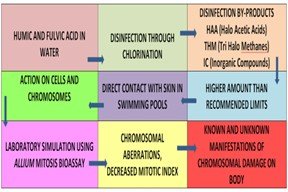
The process of disinfection of water, using chemicals like chlorine, bromine or iodine, leads to formation of certain chemicals called Disinfection By-Products (DBPs). These chemicals were once considered potentially harmless but as their levels are increasing in potable water, concerns over their toxic effects are growing worldwide. Chlorinated DBPs are of highest concern in case of swimming pool waters as they provide greatest exposure to skin, eyes and mouth of the swimmers. This study was therefore planned with an aim to evaluate the cytotoxic effects of DBPs on mitotic chromosomes of Allium cepa roots under controlled laboratory conditions. For this study, Trichloroacetic Acid (a common DBP) was dissolved in water in concentration levels that are common in swimming pool waters. This was used as a medium to grow roots in A. cepa bulbs. The cells of the roots grown in exposure of Trichloroacetic acid (TCAA) were then cytologically analysed. Results showed mitotic abnormalities like micronuclei, bridge formation, fragmentation, stickiness etc. with total abnormalities reaching up to 26.81%. Active Mitotic Index showed a dose dependent reduction with a mito-inhibition of 41.68% at highest treatment dose. Such an assessment of cytotoxic potential of TCAA on plant cell mitosis has rarely been attempted which makes the study novel. This bioassay showed that DPBs definitely have the mutagenic potential even under short term exposure and can become a bigger problem with successive bio-magnification. Hence, it proves the effectiveness of Allium mitosis bioassay in testing cytotoxicity of DBPs.
Downloads
References
Ali, A., Kurzawa-Zegota, M., Najafzadeh, M., Gopalan, R. C., Plewa, M. J., & Anderson, D., (2014). Effect of drinking water disinfection by-products in human peripheral blood lymphocytes and sperm. Mutation Research, 770, 136–143.
Bignold, L. P. (2009). Mechanisms of clastogen-induced chromosomal aberrations: a critical review and description of a model based on failures of tethering of DNA strand ends to strand-breaking enzymes. Mutation Research, 681(2-3), 271-298.
BIS (1990). IS 2316: Methods of preparation of standard solutions for colorimetric and volumetric analysis. Bureau of Indian standards, New Delhi.
BIS (2012). Water testing prameters and specifications. Bureau of Indian Standards, New Delhi.
Bonassi, S., El-Zein, R., Bolognesi, C., & Fenech, M. (2021). Micronuclei frequency in peripheral blood lymphocytes and cancer risk: evidence from human studies. Mutagenesis, 26, 93–100.
Carter, R. A., Allard, S., Croué, J. P., & Joll, C. A., (2019). Occurrence of disinfection by-products in swimming pools and the estimated resulting cytotoxicity. Science of Total Environment, 664, 851–864.
Chowdhury, S., Alhooshani, K., & Karanfil, T. (2014). Disinfection byproducts in swimming pool: occurrences, implications and future needs. Water Research, 53, 68–109.
Cirillo, S., Canistro, D., Vivarelli, F., & Paolini, M. (2016). Effects of chlorinated drinking water on the xenobiotic metabolism in Cyprinus carpio treated with samples from two Italian municipal networks. Environmental Science and Pollution Research, 23, 18777–18788.
Dad, A., Jeong, C. H., Pals, J. A., Wagner, E. D., & Plewa, M. J. (2013). Pyruvate remediation of cell stress and genotoxicity induced by haloacetic acid drinking water disinfection byproducts. Environmental and Molecular Mutagenesis, 54, 629–637.
Daiber, E. J., DeMarini, D. M., Ravuri, S. A., Liberatore, H. K., Cuthbertson, A. A., Klemish, A. T., Byer, J. D., Schmid, J. E., Afifi, M. Z., Blatchley, E. R., &
Richardson, S. D. (2016). Progressive Increase in Disinfection Byproducts and Mutagenicity from Source to Tap to Swimming Pool and Spa Water: Impact of Human Inputs. Environment Science and Technology, 5(13), 6652-62.
Darlington, C. D., & La Cour, L. F. (1976). The Handling of Chromosomes. 6th Edition, George Allene and Unwin Ltd, London.
Dehghani, M. H., Farhang, M., & Zarei, A. (2018). Data on the level of haloacetic acids in indoor swimming pools of Iran: A case study of Tehran. Data in Brief, 19, 326-330.
Epel, D. (1963). The effect of carbon mono oxide inhibition on ATP level and the rate of mitosis in sea urchin eggs. Journal of Cell Biology, 17, 315-317.
Evans, H. J. (1976). Cytological methods for detecting Chemical mutagenesis: In chemical mutagens vol. 4 (ed) Hollaender, A. Plenum Press, NY. 1 – 29.
Fantuzzi, G., Righi, E., Predieri, G., Giacobazzi, P., Mastroianni, K., & Aggazzotti, G. (2010). Prevalence of ocular, respiratory and cutaneous symptoms in indoor swimming pool workers and exposure to disinfection byproducts (DBPs). International Journal of Research in Public Health, 7, 1379-1391.
Hinckley, A. F., Bachand, A. M., & Reif, J. S. (2005). Late pregnancy exposures to disinfection byproducts and growth-related birth outcomes. Environmental Health Perspectives, 113, 1808-1813.
Hu, Y., Tan, L., Zhang, S., Zuo, Y., Han, X., Liu, N., Lu, W., & Liu, A. (2017) Detection of genotoxic effects of drinking water disinfection byproducts using Vicia faba bioassay. Environment Science and Pollution Research, 24, 1509–1517.
Istifli, E. S., Tahir Hüsunet, M., & Ila, H. B. (2019). Cell Division, Cytotoxicity, and the Assays Used in the Detection of Cytotoxicity. InTech Publishers, Turkey. ISBN 978-1-83962-286-1
Jain A. K., & Sarbhoy R. K. (1988). Cytogenetical Studies on the Effect of Some Chlorinated Pesticides. Cytologia, 53, 427–436.
Jayabalan, N., & Rao, G. R. (1987). Gamma Radiation Induced Cytological Abnormalities in Lycopersicon esculentum Mill. Var. Pusa Ruby. Cytologia, 52, 1-4.
Klasterska, I., Natarajn, A. T., & Ramel, C. (1976). An Interpretation of the origin of sub-chromatid aberrations and chromosome stickiness as a category of chromatid aberration. Hereditas, 83, 153–162.
Kogevinas, M., Villanueva, C. M., Font-Ribera, L., Liviac, D., Bustamante, M., Espinoza, F., Nieuwenhuijsen, M. J., Espinosa, A., Fernandez, P., DeMarini, D. M., Grimalt, J. O., Grummt, T., & Marcos R. (2010) Genotoxic effects in swimmers exposed to disinfection by-products in indoor swimming pools. Environmental Health Perspectives, 118(11), 1531–1537.
Lutterbeck, C. A., Kem, D. I., Machado, Ê. L., & Kümmerer, K. (2015). Evaluation of the toxic effects of four anti-cancer drugs in plant bioassays and its potency for screening in the context of waste water reuse for irrigation. Chemosphere, 135, 403–410.
Majer. B. J., Grummt. T., Uhl. M., & Knasmüller. S. (2005). Use of plant bioassays for the detection of genotoxins in the aquatic environment. Acta Hydrochemica et Hydrobiologica, 45–55.
Manasfi, T., De Méo, M., Coulomb, B., Di Giorgio, C., & Boudenne, J. L. (2016). Identification of disinfection by-products in freshwater and seawater swimming pools and evaluation of genotoxicity. Environment International, 88, 94–102.
Pals, J., Attene-Ramos, M. S., Xia, M., Wagner, E. D., & Plewa, M. J. (2013). Human cell toxicogenomic analysis linking reactive oxygen species to the toxicity of monohaloacetic acid drinking water disinfection byproducts. Environmental Science and Technology, 47, 12514–12523.
Pérez-Albaladejo, E., Pinteñoa, R., Aznar-Luquea, M. C, Casadoa, M., Postigob, C., & Porte, C. (2023). Genotoxicity and endocrine disruption potential of haloacetic acids in human placental and lung cells. Science of the Total Environment, 879, 162981.
Plewa, M. J., Wagner, E. D., Metz, D. H., Kashinkunti, R., Jamriska, K., Meyer, M. (2012) Differential toxicity of drinking water disinfected with combinations of ultraviolet radiation and chlorine. Environmental Science Technology, 46(14), 7811–7817.
Richardson, S. D., Plewa, M. J., Wagner, E. D., Schoeny, R., & DeMarini, D. M. (2007). Occurrence, genotoxicity, and carcinogenicity of regulated and emerging disinfection byproducts in drinking water: a review and roadmap for research. Mutation Research/Reviews in Mutation Research, 636(1–3), 178–242
Rook, J. J. (1974). Formation of haloforms during chlorination of natural waters. Journal of Water Treatment and Examination, 23, 234–243.
Schneidernam, M.N., Dewey, W.C., & Highfield, D.P. (1971). Inhibition of DNA synthesis in synchronized Chinese hamster cells treated in G1 with cyclohexamide. Experimental Cell Research, 67,147–149.
Sharma, A. K., & Sharma, A. (1960). Spontaneous and chemically induced chromosome break. Int. Rev. Cytologia, 19, 101 - 136.
Shi, Y., Ma, W., Han, F., Geng, Y., Yu, X., & Wang, H. (2020). Precise exposure assessment revealed the cancer risk and disease burden caused by trihalomethanes and haloacetic acids in Shanghai indoor swimming pool water. Journal of Hazardous Materials, 388, 121810.
Turkoglu, S. (2007). Genotoxicity of Five Food Preservatives Tested on Root Tips of Allium cepa L. Mutation Research, 626, 4-14.
Villanueva, C.M., Cantor, K. P., Grimalt, J. O., Malats, N., Silverman, D., Tardon, A., Garcia-Closas, R., Serra, C., Carrato, A., Castaño-Vinyals, G., Marcos, R., Rothman, N., Real, F. X., Dosemeci, M., & Kogevinas, M. (2007). Bladder cancer and exposure to water disinfection by-products through ingestion, bathing, showering, and swimming in pools. American Journal of Epidimiology, 165, 148–156
Wang, J., Zhang, H., Zheng, X., Liu, R., & Zong, W. (2020). In vitro toxicity and molecular interacting mechanisms of chloroacetic acid to catalase. Ecotoxicology and Environmental Safety, 189, 109981.
WHO (2022). Guidelines for Drinking water Quality, fourth ed. World Head Organization, Geneva, Switzerland.
Downloads
Published
How to Cite
Issue
Section
License
Copyright (c) 2025 Agriculture and Environmental Science Academy

This work is licensed under a Creative Commons Attribution-NonCommercial 4.0 International License.