Economic analysis of maize production in traditional and mechanized farming systems in Nilkantha Municipality, Dhading, Nepal
DOI:
https://doi.org/10.26832/24566632.2025.1002012Keywords:
Cost of production, Economic analysis, Farm mechanization, Maize farming, ProfitabilityAbstract
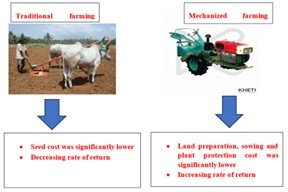
The purpose of this study was to evaluate the economic analysis as costs and profitability of maize production in traditional and mechanized farming systems. For this, a purposive random sampling of 101 maize farmers, comprising 30 using traditional methods and 71 employing mechanized systems was selected for structured household surveys. Cobb-Douglas production function, independent sample t-test, chi-square test, and descriptive statistics was performed using MS Excel and STATA software. Farmers under traditional and mechanized systems produced maize on average on 6.18 and 5.46 ropani, respectively. In mechanized systems, the mini tiller was the main tool used for the land preparation, while urea and farmyard manure (FYM) were the main suppliers of nutrients. Weeding was the most expensive operation in maize production. Traditional farming incurred higher costs for land preparation, planting, and plant protection. The net return per ropani was NRs. 1158.98 (8.47$) for traditional farming and NRs. 1597.44 (11.67$) for mechanized farming. The benefit-cost ratios were 1.42 for traditional and 1.57 for mechanized systems, respectively. Although the difference in returns per area between the two systems was not statistically significant, but mechanization effectively reduced production costs and enhanced profitability, representing a viable approach to improving maize farmers' financial circumstances. Cobb-Douglas production function analysis revealed a coefficient sum of 0.756 for traditional systems and 1.248 for mechanized systems, indicating decreasing and increasing returns to scale, respectively. Therefore, adoption of mechanization for maize production is recommended for cost minimization and profit maximization in Dhading district of Nepal.
Downloads
References
Aurangzeb, M., Nigar, S., & Shah, M. K. (2007). Benefit-cost analysis of the maize crop under mechanized and traditional farming systems in the NWFP. Sarhad Journal of Agriculture, 23(1), 169.
Devkota, K., McDonald, A., Khadka, A., Khadka, L., & Paudel, G. (2015). Decomposing maize yield gaps differentiates entry points for intensification in the rainfed mid-hills of Nepal. Field Crops Research, 179, 81-94. https://doi.org/10.1016/j.fcr.2015.04.013
Devkota, R., Pandey, P., Karki, T. B., Marahatta, S., & Sah, S. K. (2021). Bridging yield gap of winter maize using improved agronomic management practices. Journal of Agriculture and Natural Resources, 4(2), 201-210.
Dhakal, S., Sah, S. K., Amgain, L. P., & Dhakal, K. H. (2022). Maize cultivation: present status, major constraints and farmers' perception at Madichaur, Rolpa. Journal of Agriculture and Forestry University, 125-131.
FAO. (2023). World Food and Agriculture – Statistical Yearbook 2023. https://openknowledge.fao.org/server/api/core/bitstreams/6e04f2b4-82fc-4740-8cd5-9b66f5335239/content
Kandel, S., Poudel, R., Saru, M. T., & Parajuli, T. (2021). Status of farm mechanization and its impact on maize production in Jhapa District, Nepal. Archives of Agriculture and Environmental Science, 6(3), 290-294. https://doi.org/10.26832/24566632.2021.060304
Lamichhane, J., Timsina, K. P., RanaBhat, D. B., & Adhikari, S. (2015). Technology adoption analysis of improved maize technology in western hills of Nepal. Journal of Maize Research and Development, 1(1), 146-152. https://doi.org/10.3126/jmrd.v1i1.14252
Manjulatha, G., Sowjanya, B., & Rajanikanth, E. (2021). Comparative Economics of maize cultivation under conventional and mechanization. International Journal of Environment and Climate Change, 11(12), 113-118. https://doi.org/10.9734/ijecc/2021/v11i1230561
MoALD. (2023). Statistical Information on Nepalese Agriculture. Government of Nepal, Ministry of Agriculture and Livestock Development, Statistics and Analysis Section. https://giwmscdnone.gov.np/media/pdf_upload/MOALD-Statical-Book-Magre-2081-Final_wgfs8ph.pdf
NSO. (2021). National Population and Housing Census 2021. Government of Nepal. https://censusnepal.cbs.gov.np/results/files/result-folder/National%20Report_English.pdf
Pokhrel, S., Dhakal, S. C., & Pandey, S. (2018). Economics of maize seed and grain production in Rolpa. Acta Scientific Agriculture, 2(11), 43-50.
Poudel, U., Kattel, R. R., Gurung, B., Shrestha, S., Paudel, A., & Paudel, A. (2021). Economic analysis of rice (Oryza sativa L.) cultivation in Gorkha district of Nepal. Archives of Agriculture and Environmental Science, 6(4), 489-497. https://doi.org/10.26832/24566632.2021.0604011
Paudyal, K. R., Ransom, J. K., Rajbhandari, N. P., Adhikari, K., Gerpacio, R. V., & Pingali, P. L. (2001). Maize in Nepal: Production systems, constraints, and priorities for research. Nepal Agricultural Research Council (NARC) & International Maize and Wheat Improvement Center (CIMMYT). https://doi.org/10.22004/ag.econ.7652
Pradhan, A., Jayasuriya, H. P., & Mbohwa, C. (2016). Status and potentials of agricultural mechanization in Sunsari District, Nepal. Applied Engineering in Agriculture, 32(6), 759-768. https://doi.org/10.13031/aea.32.10763
Prajneshu, G. (2008). Fitting of Cobb-Douglas production functions: revisited. Agricultural Economics Research Review, 21(2), 289-292.
Ransom, J., Poudyal, K., & Adhikari, K. (2003). Adoption of improved maize varieties in the hills of Nepal. Agricultural Economics, 29(3), 299-305. https://doi.org/10.1016/S0169-5150(03)00057-4
Rehman, T., Khan, M. U., Tayyab, M., Akram, M. W., & Faheem, M. (2016). Current status and overview of farm mechanization in Pakistan – A review. Agricultural Engineering International: The CIGR e-Journal, 18(2), 83-93.
Sapkota, M., Joshi, N., Kattel, R., & Bajracharya, M. (2018). Profitability and resource use efficiency of maize seed production in Palpa district of Nepal. SAARC Journal of Agriculture, 16(1), 157-168. https://doi.org/10.3329/sja.v16i1.37431
Shrestha, S. (2012). Status of agricultural mechanization in Nepal. United Nations Asian and Pacific Center for Agricultural Engineering and Machinery (UNAPCAEM). https://www.un-csam.org/sites/default/files/2021-01/np_1.pdf
Singh, R. S., & Sahni, R. K. (2019). Transformation of Indian agriculture through mechanization. Economic Affairs, 64(2), 297-303. https://doi.org/10.30954/0424-2513.2.2019.4
Subedi, S. (2016). A review on important maize diseases and their management in Nepal. Journal of Maize Research and Development, 1(1), 28-52. https://doi.org/ 10.5281/zenodo.34292
Thapa, R. (2021). A detail eview on status and prospect of maize production in Nepal. Food and Agri Economics Review, 1(1), 52-56. http://doi.org/10.26480/faer.01.2021.52.56
Timsina, K. P., Ghimire, Y. N., & Lamichhane, J. (2016). Maize production in mid hills of Nepal: from food to feed security. Journal of Maize Research and Development, 2(1), 20-29. https://doi.org/10.3126/jmrd.v2i1.16212
Downloads
Published
How to Cite
Issue
Section
License
Copyright (c) 2025 Agriculture and Environmental Science Academy

This work is licensed under a Creative Commons Attribution-NonCommercial 4.0 International License.