Dietary crude protein optimization for enhanced growth performance in indigenous chickens during the starter phase
DOI:
https://doi.org/10.26832/24566632.2025.1002015Keywords:
Feed efficiency, Local chickens, Poultry intensification, Precision feedingAbstract
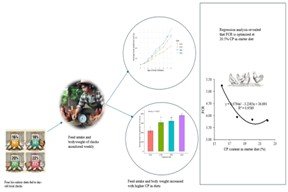
Formulating diets that meet the nutrient requirements of indigenous chickens during the starter phase is essential for optimal growth, feed efficiency, profitability, and sustainability in poultry production. This study aimed to evaluate the growth response of indigenous chickens to varying crude protein (CP) concentrations in starter diets and to determine the optimal CP requirement during this phase. A total of 240 days-old chicks were randomly assigned to four iso-caloric starter diets containing 16%, 18%, 20%, and 22% CP, with three replicates per treatment. The birds were housed in deep-litter floor pens with 20 birds per pen, provided ad libitum access to feed and water, and monitored for eight weeks. Weekly data collection included body weight (BW) and feed intake, from which average daily gain (ADG) and feed conversion ratio (FCR) were calculated. Results showed that increasing dietary CP significantly improved growth performance. Final body weight, feed intake, and ADG increased with higher CP levels, with the 22% CP diet yielding the highest final weight (380.8 g) and ADG (12.3 g/day). However, the lowest performance was observed with the 16% CP diet. Feed intake peaked at 1300.9 g for the 22% CP diet, and FCR decreased with increasing CP content. Regression analysis suggested that FCR was optimized at 20.5% CP. These findings highlight the importance of precise CP formulations to enhance growth efficiency and profitability in intensive indigenous chicken production systems.
Downloads
References
AOAC. (1990). Official Methods of Analysis, 15th ed. In Official Methods of Analysis (15th Editi). Association of Official Analytical Chemists. https://law.resource.org/pub/us/cfr/ibr/002/aoac.methods.1.1990.pdf
Bailey, C. A. (2020). Precision poultry nutrition and feed formulation. In Animal Agriculture (pp. 367–378). Elsevier. https://doi.org/10.1016/B978-0-12-817052-6.00021-5
Bamidele, O., Akinsola, O. M., Yakubu, A., Hassan, W. A., Ogundu, U. E., & Amole, T. A. (2023). Growth performance, survivability and profitability of improved smallholder chicken genetics in Nigeria: A COVID-19 intervention study. Frontiers in Genetics, 13, 1033654. https://doi.org/10.3389/fgene.2022.1033654
Beski, S. S. M., Swick, R. A., & Iji, P. A. (2015). Specialized protein products in broiler chicken nutrition: A review. Animal Nutrition, 1(2), 47–53. https://doi.org/10.1016/j.aninu.2015.05.005
Binda, B. D., Yousif, I. A., Elamin, K. M., & Eltayeb, H. E. (2012). A comparison of performance among exotic meat strains and local chicken ecotypes under Sudan conditions. International Journal of Poultry Science, 11(8), 500–504. https://doi.org/10.3923/ijps.2012.500.504
Kpomasse, C. C., Kouame, Y. A. E., N’nanle, O., Houndonougbo, F. M., Tona, K., & Oke, O. E. (2023). The productivity and resilience of the indigenous chickens in the tropical environments: improvement and future perspectives. Journal of Applied Animal Research, 51(1), 456–469. https://doi.org/10.1080/09712119.2023.2228374
Magala, H., Kugonza, D. R., Kwizera, H., & Kyarisiima, C. C. (2012). Influence of varying dietary energy and protein on growth and carcass characteristics of Ugandan local chickens. Journal of Animal Production Advances, 2(7),
Mpemba, C., Goromela, E., Mtambuki, A., Kafuku, S., Chando, M., Mwanibanza, M., Burilo, A., & Robert, O. (2022). Growth performance and feed utilization potential of horasi chicken ecotype during starter and grower phases. Tanzania Journal of Agricultural Sciences, 21(1), 55–60. https://www.ajol.info/index.php/tjags/article/view/230266
Mujyambere, V., Adomako, K., Olympio, S. O., Ntawubizi, M., Nyinawamwiza, L., Mahoro, J., & Conroy, A. (2022). Local chickens in East African region: Their production and potential. Poultry Science, 101(1), 101547.
https://doi.org/10.1016/j.psj.2021.101547
Muluneh, B., Taye, M., Dessie, T., Salilew-Wondim, D., Kebede, D., Tenagne, A., Yilkal, S., Wassie, T., & Wu, X. (2024). Effect of ecotype and Enteromorpha polysaccharide supplementation on the growth performance of indigenous chickens in Northwest Ethiopia. Tropical Animal Health and Production, 56(8), 1–10. https://doi.org/10.1007/s11250-024-04178-6
Nakkazi, C., Kugonza, D. R., Kayitesi, A., Mulindwa, H. E., & Okot, M. W. (2015). The effect of diet and feeding system on the on-farm performance of local chickens during the early growth phase. Livestock Research for Rural Development, 27(10), 204. http://www.lrrd.cipav.org.co/lrrd27/10/nakka27204.html
Nampijja, Z., Kiggundu, M., Kigozi, A., Lugya, A., Magala, H., Ssepuuya, G., Nakimbugwe, D., Walusimbi, S. S., & Mugerwa, S. (2023). Optimal substitution of black soldier fly larvae for fish in broiler chicken diets. Scientific
African, e01636. https://doi.org/10.1016/j.sciaf.2023.e01636
Oleforuh-Okoleh, V. U., Nte, I. J., & Onyegbule, Q. (2016). Growth performance and haematological traits of Nigerian local chickens fed varied dietary protein levels. Nigerian Journal of Animal Production, 43(2), 332–342.
https://doi.org/10.51791/njap.v43i2.889
Sanusi, A., & Oseni, S. (2020). Nigerian Fulani ecotype chickens: Growth performance under two production systems. Genetics & Biodiversity Journal, 4(1), 14–21. https://doi.org/10.46325/gabj.v4i1.71
Downloads
Published
How to Cite
Issue
Section
License
Copyright (c) 2025 Agriculture and Environmental Science Academy

This work is licensed under a Creative Commons Attribution-NonCommercial 4.0 International License.