Diversity assessment of rice varieties in Khairahani Municipality, Chitwan District, Nepal
DOI:
https://doi.org/10.26832/24566632.2025.1002019Keywords:
Diversity index, Landraces, Hybrid variety, Improved variety, Rice varietal diversityAbstract
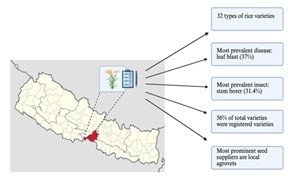
The study aims to assess varietal diversity in the Khairahani municipality of Chitwan district of Nepal. A cross-sectional survey and stratified random sampling were employed, surveying 100 households across all 13 wards. The survey focused on examining the effectiveness of varieties cultivated by farmers. Rice, the main staple crop in the Chitwan district, was found to consist of 19.20% of hybrid seeds, 9.74% of local seeds, and 71.06% of improved seeds. All hybrid seeds surveyed were registered, with 77.42% improved seeds and 20.59% of local seeds. Additionally, Chaite-5 was the most prevalent variety, followed by Sabitri and Hardinath-1 among the improved varieties, while Gorakhnath 509 dominates the hybrid category. The study applied the Shannon-Wiener Index to analyze genetic diversity, evenness, and richness among rice varieties. The diversity index for the rice genotype in Khairahani was 2.87, indicating an effective number of varieties of 17.71, a richness score of 32, and an evenness score of 0.49, suggesting moderate to high rice diversity. Agro-vets are the main suppliers of seeds, which were found to be 47%, 15% from preserved seeds, 49% from both agro-vet and preserved sources, 15% from co-operatives, and 13% from neighbors. The study suggested that registered hybrids varieties are prevalent due to higher yields, and easy accessibility, but local landraces are at risk due to their low production. Therefore, approaches aimed at promoting local rice varieties are essential for protecting genetic diversity in Khairahani municipality, Chitwan district.
Downloads
References
Banjade, D., Dipak, K., Aman, S., & Karuna, S. (2023). Effects of seedling and plant spacing on the system of rice intensification (SRI) for spring rice (Oryza sativa L. Chaite 2). AgroEnvironmental Sustainability, 1(3), 229–235. https://doi.org/10.59983/s2023010304
Banjade, D., Dipak, K., Rubisha, B., & Pratima, R. (2024). Farmers’ perception and adaptation strategies on climate change and variability in rice production in Sarlahi, Nepal. AgroEnvironmental Sustainability, 2(4), 197–204. https://doi.org/10.59983/s2024020405
Bhusal, K., & Neupane, N. (2021). A review of blast disease of rice in Nepal. Journal of Plant Pathology & Microbiology, 12(1), 528. https://doi.org/10.35248/2157-7471.21.12.528
Chandio, A. A., Korhan, K. G., Munir, A., & Yuansheng, J. (2022). Towards sustainable rice production in Asia: The role of climatic factors. Earth Systems and Environment, 6, 1–14. https://doi.org/10.1007/s41748-021-00276-2
Khanal, D., Babita, B., & Dhurba, B. (2024a). Impacts of submergence stress on rice plants and its adaptation: A review. Archives of Agriculture and Environmental Science, 9(3), 626–631. https://doi.org/10.26832/24566632.2024.0903030
Khanal, D., Babita, B., & Dhurba, B. (2024b). A review: Elevated nighttime temperature impacts on rice. International Journal of Plant & Soil Science, 36(8), 437–446. https://doi.org/10.9734/ijpss/2024/v36i84873
Joshi, G., & Bauer, S. (2006). Farmers’ choice of the modern rice varieties in the rainfed ecosystem of Nepal. Journal of Agriculture and Rural Development in the Tropics and Subtropics, 107(2), 129–138.
Joshi, B. K. (2017a). Plant breeding in Nepal: Past, present and future. Journal of Agriculture and Forestry University, 1, 1–333. https://www.researchgate.net/publication/325284412_Plant_breeding_in_Nepal_Past_present_and_future
Joshi, B. K. (2017b). Local germplasm of rice in Nepal: Diversity, characters and uses. Rice science and technology in Nepal. https://www.researchgate.net/publication/321329622_Local_germplasm_of_rice_in_Nepa_Diversity_characters_and_uses
Malla, S., Lal, B., Uttam, R., & Birat, S. (2022). Effect of unseasonal rainfall on rice production in Nepal during the year 2021: A case study. Archives of Agriculture and Environmental Science, 7(2), 294–299. https://doi.org/10.26832/24566632.2022.0702020
MOALD. (2023). Ministry of Agriculture and Livestock Development (MOALD). Statistical information on Nepalese agriculture (2021/22). Planning and Development Cooperation Coordination Division, Government of Nepal. https://giwmscdnone.gov.np/media/app/public/285/posts/1715754883_66.pdf
Nawaz, A., Anees, U. R., Abdul, R., Shakeel, A., Kadambot, H. M. S., & Muhammad, F. (2022). Increasing sustainability for rice production systems. Journal of Cereal Science, 103, 103400. https://doi.org/10.1016/j.jcs.2021.103400
Paudel, M. N. (2013). Rice (Oryza sativa L.) cultivation in the highest elevation of the world. Agronomy Journal of Nepal, 2, 31–41. https://doi.org/10.3126/ajn.v2i0.7519
Sah, S. N., & Bal, K. J. (2020). Production techniques of hybrid rice in Nepal. Production tech of hybrid rice in Nepal, 1-11. https://doi.org/10.13140/RG.2.2.20549.68327
Downloads
Published
How to Cite
Issue
Section
License
Copyright (c) 2025 Agriculture and Environmental Science Academy

This work is licensed under a Creative Commons Attribution-NonCommercial 4.0 International License.