Evaluation of Nano urea on growth and yield parameters of cowpea (Vigna unguiculata) in Chitwan, Nepal
DOI:
https://doi.org/10.26832/24566632.2025.1004018Keywords:
Granular urea, Nano urea, Nitrogen use efficiency, Yield characteristicsAbstract
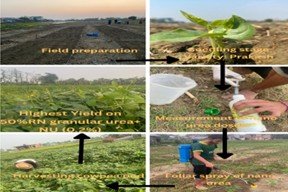
Granular urea has low nitrogen use efficiency and poses environmental risks. As a response, Nano urea is emerging as an innovative substitute. A field experiment conducted at Chitwan, Nepal to explored the effect of Nano urea on growth and yield parameters of cowpea, and its potential to substitute granular urea. The experiment was laid out in Randomized Block Design, with eight treatments and three replications: control, 100% recommended dose of nitrogen (RDN) through granular urea, single and double spray of Nano urea at 0.2% and 0.4%, and combination of 50% of RDN with 0.2% and 0.4% Nano urea. Various growth and yield parameters such as plant height, canopy diameter, leaf area index, number of primary branches, pod yield, pod length, pod diameter, pod per plant were recorded, which were found significantly affected by the treatments. Results revealed that 50% RDN granular urea + NU (0.2%) recorded the highest canopy diameter (97.43 cm), primary branches (5.92) leaf area index (0.38), pod yield (12.59), and pods per plant (30.6), with single spray of 0.2% of Nano urea at flowering stage being the most effective. Therefore, the study demonstrated that Nano urea has potential to substitute 50% of conventional granular urea, contributing to sustainable cowpea production.
Downloads
References
Aghora, T. S., Lal, H., Reddy, B. R., Mohan, N., Mahadevaiah, C., Thangam, P., Dhananajaya, M. V., Patil, N. G., Indraja, G., Dubey, R. K., Rai, N., & Behera, T. K. (2024). Cowpea: Breeding and Genomics. Vegetable Science, 51(01), 1–10. https://doi.org/10.61180/vegsci.2024.v51.i1.01
Beshir, H. M., Tesfaye, B., Bueckert, R., & Tar, B. (2015). Pod quality of snap bean as affected by Nitrogen fixation , cultivar and climate zone under dryland agriculture. African Journal of Agricultural Research, 10(32), 3157–3169. https://doi.org/10.5897/AJAR2015.9888
Dhakal, A. (2020). Present status of grain legumes production in Nepal. Food & Agribusiness Management, 2(1), 06–09. https://doi.org/10.26480/fabm.01.2021.06.09
Dhakal, R., Sitaula, H. P., Acharya, B., Bhusal, S., & Dhakal, S. (2019). Effect of different fertilizers in yield and nodulation of cowpea (Vigna unguiculata) under mulched and un-mulched field condition in Chitwan district, Nepal. Big Data In Agriculture, 1(2), 18–22. https://doi.org/10.26480/bda.02.2019.18.22
Dhawne, M. N., Shamkuwar, G. R., Shamkuwar, S. G., Landge, N. H., Sable, A. D., & Tinpayale, A. D. (2023). Influence of foliar application of nano-urea on morpho-physiological and yield parameters in rice (Oryza sativa L.). Biological Forum-An International Journal, 15(11), 548–553. https://www.researchgate.net/publication/377082549
FAO, Food and Agriculture Organization of the United Nations. (2024). FAOSTAT statistical database: Crops and livestock products. https://www.fao.org/faostat/en/#data/QCL
Rahman, K. (2022). Effects of nitrogen fertilization on crops and their associated insect communities: a global food security perspective. Asian-Australasian Journal of Food Safety and Security, 6(2), 48–56. https://doi.org/https://doi.org/10.3329/aajfss.v6i2.62619
Glibert, P. M., Harrison, J., Heil, C., & Seitzinger, S. (2006). Escalating worldwide use of Urea – A global change contributing to coastal eutrophication. Biogeochemistry, 77(3), 441–463. https://doi.org/10.1007/s10533-005-3070-5
Herniter, I. A., Muñoz-Amatriaín, M., & Close, T. J. (2020). Genetic, textual, and archeological evidence of the historical global spread of cowpea (Vigna unguiculata [L.] Walp.). Legume Science, 2(4), 1–10. https://doi.org/10.1002/leg3.57
Houlton, B. Z., Almaraz, M., Aneja, V., Austin, A. T., Bai, E., Cassman, K. G., Compton, J. E., Davidson, E. A., Erisman, J. W., Galloway, J. N., Gu, B., Yao, G., Martinelli, L. A., Scow, K., Schlesinger, W. H., Tomich, T. P., Wang, C., & Zhang, X. (2019). A world of co-benefits: Solving the global nitrogen challenge. Earth’s Future, 7, 1–8. https://doi.org/10.1029/2019EF001222
Hu, J., & Xianyu, Y. (2021). When nano meets plants: A review on the interplay between nanoparticles and plants. Nano Today, 38, 101143. https://doi.org/10.1016/j.nantod.2021.101143
Kaymak, G., & Acar, Z. (2021). The effects of nitrogen doses and harvest stage in forage cowpea and soybean genotypes on the yield and some features. In Proceedings of the III. International Agricultural, Biological & Life Science Conference (pp. 423–431). Edirne, Turkey. https://www.cabidigitallibrary.org/doi/pdf/10.5555/20220173320
Kumar,Y. (2021). Nanofertilizers and their role in sustainable agriculture. Annals of Plant and Soil Research, 23(3), 238–255. https://doi.org/10.47815/apsr.2021.10067
Kumari, J. J. R., Indu, T., & Singh, R. (2024). Effect of nano urea and spacing on growth and yield of maize article type. International Journal of Research in Agronomy, 7(5), 278–281. https://doi.org/10.33545/2618060x.2024.v7.i5d.692
Mahmoodi, P., Yarnia, M., Rashidi, V., Amirnia, R., & Tarinejhad, A. (2018). Effects of nano and chemical fertilizers on physiological efficiency and essential oil yield of Borago officinalis L. Applied Ecology and Environmental Research, 16(4), 4773–4788. https://doi.org/10.15666/aeer/1604_47734788
Mehta, S., Thakur, A., Kurbah, I., Chauhan, N., & Thakur, R. (2024). Nanotechnology in plant nutrition: Ensuring sustainable agriculture through nanofertilizers. Journal of Plant Nutrition and Soil Science 589-603. https://doi.org/10.1002/jpln.202300288
Nofal, E., Menesy, F., M. Abd El-Hady, W., G. Shehab, E., El-Ramady, H., & Prokisch, J. (2024). Effect of nano-NPK and nano-chitosan fertilizers on the growth and chemical constituents of Philodendron sellum plants. Egyptian Journal of Soil Science, 64(3), 113-1205. https://doi.org/10.21608/ejss.2024.289119.1769
Ojha, A., Singh, R., & Sinha, J. (2023). Effect of nano urea and foliar spray of urea on growth and yield of wheat (Triticum aestivum L.). International Journal of Environment and Climate Change, 13(11), 474–481. https://doi.org/10.9734/ijecc/2023/v13i113190
Pandey, Y., Pun, A., & Mishra, R. (1970). Evaluation of vegetable type cowpea varieties for commercial production in the river basin and low hill areas. Nepal Agriculture Research Journal, 7, 16–20. https://doi.org/10.3126/narj.v7i0.1861
Raja, G., Singh, S., & Joy, D. (2022). Effect of nitrogen and panchagavya on growth and yield of cowpea [Vigna unguiculata L.] under the agro-climatic comditions of prayagraj region. International Journal of Plant & Soil Science, 11(3), 77–83. https://doi.org/10.9734/ijpss/2022/v34i1831057
Rawat, S., Singh Kumar, R., Singh, P., Upadhyay, P., Shekhawat, K., Seema, S., Dash, S., Mondal, K. B., & Shukla, R. (2024). Studies on comparison of nano-urea and prilled urea for enhancing maize (Zea mays) growth and productivity. The Indian Journal of Agricultural Sciences, 94(3), 325–328. https://doi.org/10.56093/ijas.v94i3.143292
Sandeep, S. N., Fathima, P. S., Yogananda, S. B., Suma, R., Shivakumar, K. V, & Sowmyalatha, B. S. (2024). Effect of rice cultivation practices and nitrogen management strategies on growth and yield attributes in rice under
rice-cowpea cropping system. Journal of Experimental International, 46(12), 426–434. https://doi.org/10.9734/jeai/2024/v46i123149
Singh, A., Schöb, C., & Iannetta, P. P. M. (2023). Nitrogen fixation by common beans in crop mixtures is influenced by growth rate of associated species. BMC Plant Biology, 23(1), 1–12. https://doi.org/10.1186/s12870-023-04204-z
Subramani, T., Velmurugan, A., Bommayasamy, N., Swarnam, T. P., Ramakrishna, Y., Jaisankar, I., & Singh, L. (2023). Effect of nano urea on growth, yield and nutrient use efficiency of Okra under tropical island ecosystem. International Journal of Agricultural Sciences, 19, 134–139. https://doi.org/10.15740/has/ijas/19
Tripathi, S. C., Kumar, N., & Venkatesh, K. (2025). Nano urea’s environmental edge and economic efficacy in boosting wheat grain yield across diverse Indian agro-climates. Scientific Reports, 15(1), 3598. https://doi.org/10.1038/s41598-024-83616-9
Wangyal, J. T. (2012). Canopy-size, diameter and height relationship in trees of College of Natural Resources campus. Journal of Renewable Natural Resources Bhutan, 8(1), 103–112. https://www.researchgate.net/publication/344602926
Yarang, M., Manpoong, C., Sharma, A., Raghavan, M., & Devadas, V. S. (2022). Effect of bio-formulations on growth and yield of Pea (Pisum sativum L.). Ecology, Environment and Conservation, 11(9), 1379–1383. https://doi.org/10.53550/eec.2022.v28i03.039
Downloads
Published
How to Cite
Issue
Section
License
Copyright (c) 2025 Agriculture and Environmental Science Academy

This work is licensed under a Creative Commons Attribution-NonCommercial 4.0 International License.