Adoption of circular economy practices in agricultural SMEs: A comparative study of Nepal and the UK
DOI:
https://doi.org/10.26832/24566632.2026.1101014Keywords:
Agricultural SMEs, Circular economy, Mixed method, Resource-based viewAbstract
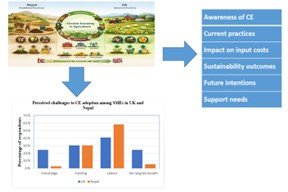
Agricultural small and medium-sized enterprises (SMEs) face mounting pressure to adopt sustainable business models, yet their ability to transition to circular economy (CE) practices differs across institutional and resource contexts. This study addresses the limited understanding of how CE adoption unfolds in agriculture within contrasting national settings by comparing agricultural SMEs in Nepal and the United Kingdom. The purpose is to investigate the processes of establishing CE practices in these firms and determine their effects on sustainability and business performance. A mixed-methods approach was employed, combining survey data with quantitative analysis. The results show significantly higher CE awareness in the UK (61%) than in Nepal (19.4%). The outcome shows marked differences in support systems of the countries (32.7% UK vs 47.2% Nepal). Yet, technical advice was reported to be 47.2% in Nepal and 22.4% in the UK which suggests that support in Nepal is largely advisory in nature and often led by NGOs. The results of this investigation indicate that adoption patterns are determined by institutional frameworks and resource abilities: in Nepal, low levels of awareness and capacity limitations are dominant, whereas in the UK, cynicism and scale issues are predominant. Environmental outcomes are realized earlier and more regularly than the economic or social benefits. This study advances CE diffusion theory by demonstrating that early environmental gains pave the way for weighted outcomes in resource-constrained settings.
Downloads
References
Antonius, R. (2013) Interpreting quantitative data with IBM SPSS statistics. 2nd ed. London: SAGE.
Allsop, D. B., Chelladurai, J. M., Kimball, E. R., Marks, L. D. and Hendricks, J. J. (2022) ‘Qualitative Methods with Nvivo Software: A Practical Guide for Analyzing Qualitative Data’, Psych, 4(2), 142–159. https://doi.org/10.3390/psych4020013
Badran, S., Massoud, M.A., Stephan, R., Elbassuoni, S., Chalak, A., & Abiad, M.G. (2025) Opportunities for circular economy in waste reuse: Insights from social media data mining. Resources, Conservation, and Recycling, 215. https://doi.org/10.1016/j.resconrec.2024.108100
Bhattarai, S.K., Bhattarai, S., KC, C., & GC, A. (2021). Circular Economy and its Prospects in Nepalese Agriculture. Turkish Journal of Agriculture: Food Science and Technology, 9(1), 42–49. https://doi.org/10.24925/turjaf.v9i1.42-49.3652
Campbell, S., Greenwood, M., Prior, S., Shearer, T., Walkem, K., Young, S., Bywaters, D., & Walker, K. (2020). Purposive sampling: complex or simple? Research case examples. Journal of Research in Nursing, 25(8), 652–661. https://doi.org/10.1177/1744987120927206
Cherrington, R., Manolchev, C., Edwards, K., Housni, I., & Alexander, A. (2024). Enabling circular economy practices in regional contexts: Insights from the UK Southwest. International Journal of Entrepreneurship and Innovation, 25(2), 104–115. https://doi.org/10.1177/14657503241236713
Claasen, N., Covic, N. M., Idsardi, E. F., Sandham, L. A., Gildenhuys, A., & Lemke, S. (2015). Applying a transdisciplinary mixed methods research design to explore sustainable diets in rural South Africa. International Journal of Qualitative Methods, 14(2), 69–91. https://doi.org/10.1177/160940691501400207
Dey, P.K., Malesios, C., Chowdhury, S., Saha, K., Budhwar, P., & De, D. (2022). Adoption of circular economy practices in small and medium-sized enterprises: Evidence from Europe. International Journal of Production Economics, 248, 108496. https://doi.org/10.1016/j.ijpe.2022.108496
Figge, F., Thorpe, A. S., & Gutberlet, M. (2023). Definitions of the circular economy: Circularity matters. Ecological Economics, 208. https://doi.org/10.1016/j.ecolecon.2023.107823
Gómez-Garza, R., Güereca, L.P., Padilla-Rivera, A. and Ibarra, A.A. (2024). Barriers and enablers of life cycle assessment in small and medium enterprises: a systematic review. The International Journal of Life Cycle Assessment. https://doi.org/10.1007/s11367-024-02240-5
Glogowska, M. (2011). Paradigms, pragmatism and possibilities: mixed-methods research in speech and language therapy. International Journal of Language & Communication disorders, 46(3), 251–260. https://doi.org/10.3109/13682822.2010.507614
Hina, M., Chauhan, C., Sharma, R. and Dhir, A. (2023). Circular economy business models as pillars of sustainability: Where are we now, and where are we heading? Business Strategy and the Environment, 32(8), 6182–6209. https://doi.org/10.1002/bse.3480
Kirchherr, J., Yang, N.-H.N., Schulze-Spüntrup, F., Heerink, M.J., & Hartley, K. (2023). Conceptualizing the Circular Economy (Revisited): An Analysis of 221 Definitions Resources, Conservation and Recycling, 194. https://doi.org/10.1016/j.resconrec.2023.10700
Losa, R. (2025). Public policies on circular economy: A systematic review. Ecological Economics, 228, 108452. https://doi.org/10.1016/j.ecolecon.2024.108452
Melles, G., Gautam, S., & Shrestha, R. (2025). Circular Economy for Nepal’s Sustainable Development Ambitions. Challenges (Basel), 16(1), 8. https://doi.org/10.3390/challe16010008
Meshram, K.K. (2024). The circular economy, 5R framework, and green organic practices: pillars of sustainable development and zero-waste living. Discover Environment, 2(1). https://doi.org/10.1007/s44274-024-00177-4
Naeem, M., Ozuem, W., Howell, K., & Ranfagni, S. (2023). A Step-by-Step Process of Thematic Analysis to Develop a Conceptual Model in Qualitative Research. International journal of Qualitative Methods, 22. https://doi.org/10.1177/16094069231205789
Rada, E.C. (2023). Circular Economy: Origins, Evolution and Role of MSW. Environmental and Climate Technologies, 27(1), 989–998. https://doi.org/10.2478/rtuect-2023-0072
Rahman, A., & Muktadir, M.G. (2021). SPSS: An Imperative Quantitative Data Analysis Tool for Social Science Research. International Journal of Research and Innovation in Social Science, 5(10), 1–3. https://doi.org/10.47772/ijriss.2021.51012
Rizos, V., Behrens, A., van der Gaast, W., Hofman, E., Ioannou, A., Kafyeke, T., Flamos, A., Rinaldi, R., Papadelis, S., Hirschnitz-Garbers, M., & Topi, C. (2016). Implementation of Circular Economy Business Models by Small and Medium-Sized Enterprises (SMEs): Barriers and Enablers. Sustainability, 8(11), 1212. https://doi.org/10.3390/su8111212
Sandelowski, M. (2014). Unmixing Mixed-Methods Research. Research in nursing & health, 37(1), 3–8. https://doi.org/10.1002/nur.21570.
Upadhayay, S., Alqassimi, O., Khashadourian, E., Sherm, A., & Prajapati, D. (2024). ‘Development in the Circular Economy Concept: Systematic Review in Context of an Umbrella Framework. Sustainability, 16(4). https://doi.org/10.3390/su16041500
Uvarova, I. et al. (2023). The typology of 60R circular economy principles and strategic orientation of their application in business. Journal of Cleaner Production, 409. https://doi.org/10.1016/j.jclepro.2023.137189
Walker, A. M., Opferkuch, K., Roos Lindgreen, E., Raggi, A., Simboli, A., Vermeulen, W. J. V., Caeiro, S., & Salomone, R. (2022). What Is the Relation between Circular Economy and Sustainability? Answers from Frontrunner Companies Engaged with Circular Economy Practices. Circular Economy and Sustainability, 2(2), 731–758. https://doi.org/10.1007/s43615-021-00064-7
Zamawe, F. (2015). The Implication of Using NVivo Software in Qualitative Data Analysis: Evidence-Based Reflections. Malawi Medical Journal, 27(1), 13–15. https://doi.org/10.4314/mmj.v27i1.4
Downloads
Published
How to Cite
Issue
Section
License
Copyright (c) 2026 Agriculture and Environmental Science Academy

This work is licensed under a Creative Commons Attribution-NonCommercial 4.0 International License.