Effect of different casing materials on performance of white button mushroom (Agaricus bisporus) under controlled conditions in Banke district, Nepal
DOI:
https://doi.org/10.26832/24566632.2026.110105Keywords:
Biological efficiency, Casing material, Coco-peat, FYM, GypsumAbstract
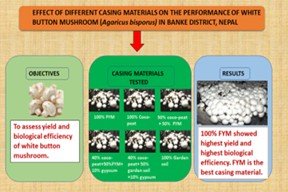
Casing plays a crucial role in the cultivation of white button mushroom (Agaricus bisporus), as it initiates fructification, supports developing sporophores, and acts as a moisture reservoir essential for optimal yield and quality. The present study was conducted to evaluate suitable casing materials for enhanced production of white button mushroom under controlled conditions in Baijanath Rural Municipality, Banke district, Nepal. The experiment was laid out in a completely randomized design with six treatments and four replications under farmers’ field conditions. The treatments comprised six casing formulations: 100% farmyard manure (FYM), 100% coco-peat, 50% coco-peat + 50% FYM (2 years old), 40% coco-peat + 50% FYM (2 years old) + 10% gypsum, 40% coco-peat + 50% garden soil + 10% gypsum, and 100% garden soil. Growth and yield parameters of A. bisporus were recorded and analyzed using R-Studio. Results revealed that casing materials significantly (p ≤ 0.05) influenced days to pin-head formation, days to fruiting, pileus diameter, total yield (three flushes), and biological efficiency, whereas stipe length and stipe diameter were not significantly influenced. Early pin-head formation and fruiting of A. bisporus were observed in 100% FYM, which was statistically at par with 100% coco-peat. The highest pileus diameter, total yield, and biological efficiency were obtained with 100% FYM, followed by 100% garden soil. Based on the findings, 100% FYM is recommended as an effective casing material for maximizing yield and biological efficiency of A. bisporus. However, other casing formulations i.e. 100% garden soil and 100% Coco-peat could also be considered depending on local availability and soil variability.
Downloads
References
Abah, S., & Abah, G. (2010). Antimicrobial and antioxidant potentials of Agaricus bisporus. Advances in Biological Research, 4(5), 277–282.
Atila, F., Owaid, M. N., & Shariati, M. A. (2017). The nutritional and medical benefits of Agaricus bisporus: A review. Journal of Microbiology, Biotechnology and Food Sciences, 7(3), 281–286. https://doi.org/10.15414/jmbfs.2017/18.7.3.281-286
Bhatt, P., S Kushwaha, K. P., & Singh, R. P. (2015). Physico-chemical properties of different casing mixtures and its effect on yield of Agaricus bisporus. http://epubs.icar.org.in/ejournal/index.php/MR/article/view/53595
Colak, M., Baysal, E., Simsek, H., Toker, H., & Yilmaz, F. (2007). Cultivation of Agaricus bisporus on wheat straw and waste tea leaves based composts and locally available casing materials Part III: Dry matter, protein, and carbohydrate contents of Agaricus bisporus. African Journal of Biotechnology, 6(24). https://doi.org/10.5897/AJB2007.000-2455
Dehariya, P., & Jain, A. (2025). Formulating different casing mixtures and implementing them to check their effect on Agaricus bisporus yield. International Journal of Innovative Science and Research Technology (IJISRT), 10, 4, 966-971, https://doi.org/10.38124/ijisrt/25apr548
Dhar, B., Shrivastava, N., & Kumar, J. (2012). Casing layer as related to mushroom yield and quality of Agaricus bisporus in India. In Proceedings of the 18th Congress of the International Society for Mushroom Science (pp. 749–756). China Agriculture Press. Retrieved from: https://www.pubhort.org/isms/18/1/v18_p1_a94.htm
Ghazaleh, M., & Sassine, Y. (2019). Evaluating the potential of composted banana wastes as a local substrate for growing Agaricus bisporus. Journal of Experimental Agriculture International, 39(6), 1–9. https://doi.org/10.9734/jeai/2019/v39i630366
Jarial, R. S., Shandilya, T. R., & Jarial, K. (2005). Casing in mushroom beds-a review. Agricultural Reviews-Agricultural Research Communications Centre India, 26(4),261. https://arccarticles.s3.amazonaws.com/webArticle/articles/ar264003.pdf
Kaur, A., Johl, P. P., & Sodhi, H. S. (2017). Evaluation of casing variables for cultivation of Agaricus bisporus strain U3 in Punjab, India. Journal of Applied and Natural Science, 9(1), 305–310. https://doi.org/10.31018/jans.v9i1.1144
Kerketta, A., Shukla, C., & Singh, H. (2019). Evaluation of different casing materials for growth and yield of button mushroom (Agaricus bisporus (L.) Sing.). Journal of Pharmacognosy and Phytochemistry, 8(3), 207–209. https://www.phytojournal.com/archives/2019/vol8issue4/PartD/8-3-642-387.pdf
Kumar, K., Biswas, S., Husain, A., & Kumar, S. (2020a). Physical parameters of casing materials on yield parameter of white button mushroom [Agaricus bisporus (Lange) Imbach]. International Journal of Chemical Studies, 8(3), 2820–2824. https://doi.org/10.22271/chemi.2020.v8.i1aq.8695
Kumar, K., Biswas, S. K., Husain, A., Baboo, D., & Kumar, S. (2020b). Influence of different casing material on growth parameters and yield of white button mushroom (Agaricus bisporus (Longe. Imboch). Journal of Pharmacognosy and Phytochemistry, 9(1), 902-905. https://www.phytojournal.com/archives/2020/vol9issue1/PartO/9-1-69-821.pdf
Kumar, V., Kumar, P., Singh, J. and Kumar, P. (2021a). Use of sugar mill wastewater for Agaricus bisporus cultivation: prediction models for trace metal uptake and health risk assessment. Environmental Science and Pollution Research, https://doi.org/10.1007/s11356-021-12488-7
Kumar, V., Kumar, P., Singh, J. and Kumar, P. (2021b). Integrated use of treated dairy wastewater and agro-residue for Agaricus bisporus mushroom cultivation: Experimental and kinetics studies. Biocatalysis and Agricultural Biotechnology, https://doi.org/10.1016/j.bcab.2021.101940
Munshi, N. A., Dar, G. H., Ghani, M. Y., Kauser, S., & Mughal, N. (2010). Button mushroom cultivation. Communication and Publication Centre SK University of Agricultural Sciences and Technology SKUAST-K, 1, 1-33. https://www.researchgate.net/publication/236011864_Button_Mushroom_Cultivation
Noble, R., Dobrovin-Pennington, A., Hobbs, P. J., Pederby, J., & Rodger, A. (2003). Volatile C8 compounds and pseudomonads influence primordium formation of Agaricus bisporus. Mycologia, 94(3), 382–391. https://doi.org/10.1080/15572536.2003.11833201
Pardo González, J.E., Juan Valero, J.A.D., & Pardo Giménez, A. (2002). Factors that influence the initiation of fruiting in cultivated mushrooms. II. Microbiological factors. ITEA. Plant Production, 98 (2), 87-94. https://www.aida-itea.org/aida-itea/files/itea/revistas/2002/98V-2/98V-2_01.pdf
Pardo, A., De Juan, A. J., & Pardo, J. (2004). Assessment of different casing materials for use as peat alternatives in mushroom cultivation: Evaluation of quantitative and qualitative production parameters. Spanish Journal of Agricultural Research, 2(2), 267–272. https://doi.org/10.5424/sjar/2004022‑80
Pardo-Giménez, A., Pardo-González, J. E., & Zied, D. C. (2011). Evaluation of harvested mushrooms and viability of Agaricus bisporus growth using casing materials made from spent mushroom substrate. International Journal of Food Science and Technology, 46(4), 787-792. https://doi.org/10.1111/j.1365-2621.2011.02551.x
Rehman, M.K., Ali, M.A., Hussain, A., Khan, W.A., & Khan, A.M. (2016). Effect of different casing materials on the production of button mushroom (Agaricus bisporous L.). Journal of Environmental & Agricultural Sciences, 7, 55-61.
Royse, D. J. (2014). A global perspective on the high five: Agaricus, Pleurotus, Lentinula, Auricularia & Flammulina. Proceedings of the 8th International Conference on Mushroom Biology and Mushroom Products (ICMBMP8), 1–6. http://www.icmbmp.org/proceedings/royse2014.pdf
Sassine, Y.N., Ghora, Y., Kharrat, M., Bohme, M., Abdel Mawgoud, A.M.R. (2005). Waste paper as an alternative for casing soil in mushroom (Agaricus bisporus) production. Journal of Applied Sciences Research 1(3), 277-284. http://www.aensiweb.com/old/jasr/jasr/277-284.pdf
Singh, M., Singh, R., & Chaube, H.S. (2000). Impact of physiochemical properties of casing on yield of Agaricus bisporus (Lange) Imbach. Science and cultivation of Edible fungi, 441-446. Retrieved from https://www.pubhort.org/isms/15/15.htm
Downloads
Published
How to Cite
Issue
Section
License
Copyright (c) 2026 Agriculture and Environmental Science Academy

This work is licensed under a Creative Commons Attribution-NonCommercial 4.0 International License.