Assessing assisted natural succession for tropical rainforest rehabilitation: Evidence from Gunung Halimun Salak National Park, Indonesia
DOI:
https://doi.org/10.26832/24566632.2026.1102014Keywords:
Assisted natural succession, Forest rehabilitation, Natural succession, Tropical rainforestAbstract
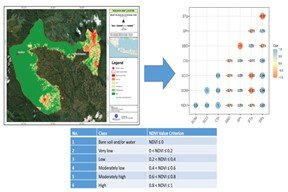
Rehabilitation zone – a tropical rainforest ecosystem in Gunung Halimun Salak National Park (GHSNP) which had been degraded and restored by reforestation as an approach of assisted natural succession (ANS) to accelerate natural succession (NS) for ecosystem recovery. This study aimed to examine the ecological attributes (vegetation density or cover, carbon storage, and soil properties) in areas that have been rehabilitated through the ANS approach via reintroduction of tree species, and to compare these attributes with those found in natural forest areas (core zone) resulted by NS process. Vegetation density or cover based on NDVI, carbon storage, and soil properties of the tropical rainforest in rehabilitation zone were relatively lower than in the core zone as reference ecosystem. Core zone of the national park conserving biodiversity and their habitat with original and natural attributes without human interferences. NDVI value of tropical rainforest in the rehabilitation zone of GHSNP was relatively lower than in the core zone, namely 0.76 and 0.89, respectively. The ANS approach through revegetation on degraded forested areas (rehabilitation zone) affected positively toward the pathway of ecological succession and stimulated forest recovery, particularly on vegetation density and carbon storage. Vegetation density based on NDVI value was positively correlated with other parameters, including soil organic matter, soil C-organic, soil porosity, and soil respiration. Moreover, vegetation density or cover was also positively correlated with carbon storage, particularly in above ground carbon storage. Besides, vegetation density based on NDVI value showed inverse relationship with the soil bulk density and temperature.Downloads
References
Aquino, D. do N., Neto, O. C. da R., Moreira, M. A., Teixeira, A. dos S., & de Andrade, E. M. (2018). Use of remote sensing to identify areas at risk of degradation in the semi-arid region. Revista Ciencia Agronomica, 49(3), 420–429. https://doi.org/10.5935/1806-6690.20180047
Ardiyanto, S. Y., Saraswati, R., & Soponyono, E. (2022). Law enforcement and community participation in combating illegal logging and deforestation in Indonesia. Environment and Ecology Research, 10(4), 450–460. https://doi.org/10.13189/eer.2022.100403
Armita, D., Wahdaniyah, W., Hafsan, H., & Al Amanah, H. (2022). Diagnosis visual masalah unsur hara esensial pada berbagai jenis tanaman. Teknosains: Media Informasi Sains Dan Teknologi, 16(1), 139–150. https://doi.org/https://doi.org/10.24252/teknosains.v16i1.28639
BPS, Badan Pusat Statistik. (2024). Deforestation rate (netto) in Indonesia, inside and outside forest area 2013-2020 (Ha/year), Last Updated Jan, 15th 2024. https://www.bps.go.id/en/statistics-table/1/MjA4MSMx/deforestation-rate--netto--in-indonesia--inside-and-outside-forest-area-2013-2022--ha-year-.html
BSN, Badan Standarisasi Nasional. (2011). Pengukuran dan Perhitungan Cadangan Karbon-Pengukuran Lapangan untuk Penaksiran Cadangan Karbon Berbasis Lahan: SNI 7724:2. Badan Standarisasi Nasional.
Bhaduri, D., Sihi, D., Bhowmik, A., Verma, B. C., Munda, S., & Dari, B. (2022). A review on effective soil health bio-indicators for ecosystem restoration and sustainability. Frontiers in Microbiology, 13(938481), 1–25. https://doi.org/https://doi.org/10.3389/fmicb.2022.938481
Chanlabut, U., & Nahok, B. (2023). Soil carbon stock and soil properties under different land use types of agriculture. Environment and Natural Resources Journal, 21(5), 417–427. https://doi.org/https://doi.org/10.32526/ennrj/21/20230056
Gašparović, B., Vrana, I., Frka, S., Marić Pfannkuchen, D., Vlašiček, I., Djakovac, T., Ivančić, I., Smodlaka Tanković, M., Milinković, A., Flanjak, L., Chaux, F., Novak, T., Medić, N., & Godrijan, J. (2023). Paradox of relatively more phospholipids in phytoplankton in phosphorus limited sea. Limnology and Oceanography, 68(12), 2800–2813. https://doi.org/https://doi.org/10.1002/lno.12464
Giri, M., Munawir, A., Sundawiati, A., Sodahlan, M., Prasetyo, Y., Nugrahareni, H., Kurniawan, H., Rinekso, A., & Rahman, A. (2023). Habitat suitability modeling of javan slow loris (Nycticebus javanicus) in the forest cluster of Gunung Halimun Salak. Jurnal Manajemen Hutan Tropika, 29(2), 119–126. https://doi.org/https://doi.org/10.7226/jtfm.29.2.119
Gunawansa, T., Perera, K., Apan, A., & Hettiarachchi, N. (2022). Application of sentinel-2 satellite data to map forest cover in Southeast Sri Lanka through the random forest classifier. Journal of Advances in Engineering and Technology, 1(1), 1–10. https://doi.org/https://doi.org/10.54389/kyti8887
Hardjowigeno, S. (2010). Ilmu Tanah (7th ed.). Akademika Pressindo.
Harris, N. L., Gibbs, D. A., Baccini, A., Birdsey, R. A., de Bruin, S., Farina, M., Fatoyinbo, L., Hansen, M. C., Herold, M., Houghton, R. A., Potapov, P. V., Suarez, D. R., Roman-Cuesta, R. M. Saatchi, S. S., Slay, C. M., Turubanova, S. A., & Tyukavina, A. (2021). Global maps of twenty-first century forest carbon fluxes. Nature Climate Change, 11(13), 234–240. https://doi.org/https://doi.org/10.1038/s41558-020-00976-6
Hartoyo, A. P. P., Sunkar, A., Ramadani, R., Faluthi, S., & Hidayati, S. (2021). Normalized difference vegetation index (NDVI) analysis for vegetation cover in Leuser Ecosystem Area, Sumatra, Indonesia. Biodiversitas, 22(3), 1160–1171. https://doi.org/https://doi.org/10.13057/biodiv/d220311
Hawkins, H. J., Cargill, R. I. M., van Nuland, M. E., Hagen, S. C., Field, K. J., Sheldrake, M., Soudzilovskaia, N. A., & Kiers, E. T. (2023). Mycorrhizal mycelium as a global carbon pool. Current Biology, 33(11), R560–R573. https://doi.org/https://doi.org/10.1016/j.cub.2023.02.027
Huebner, L., Fadhil Al-Quraishi, A. M., Branch, O., & Gaznayee, H. A. A. (2022). New approaches: use of assisted natural succession in revegetation of inhabited arid drylands as alternative to large-scale afforestation. SN Applied Sciences, 4(3). https://doi.org/https://doi.org/10.1007/s42452-022-04951-y
Indriyani, S., Sari, S. P., Negari, S. I. T., Prambudi, S. A., Nur, A. A. I., Kusumaningrum, L., Indrawan, M., Sunarto, S., Budiharta, S., & Setyawan, A. D. (2024). Short communication: estimation of aboveground biomass and carbon sequestration in KGPAA Mangkunagoro I Grand Forest Park, Central Java, Indonesia. Biodiversitas, 25(5), 2257–2263. https://doi.org/https://doi.org/10.13057/biodiv/d250544
Irawan, A., Peniwidiyanti, Ainurrofiah, Destrianto, H., Kusumah, M., & Apriandana, V. (2023). Floristic Composition and Structure of Vegetation in Gunung Salak Geothermal Power Plant, West Java, Indonesia. Reinwardtia, 22(1), 37–53. https://doi.org/10.55981/reinwardtia.2023.4565
Istomo, Hartoyo, A. P. P., & Azizah, U. (2024). Species composition and tree structure at various altitudes in Gunung Halimun Salak National Park. Journal of Tropical Silviculuture, 15(02), 115–122.
Khairunnisa, S., Pamoengkas, P., & Hartoyo, A. P. P. (2024). Analysis of ndvi and plant vegetation diversity in the traditional zone, Mount Halimun Salak National Park, Bogor. JPSL, 14(1), 109–118. https://doi.org/https://doi.org/10.29244/jpsl.14.1.109-118
Kotroczó, Z., & Fekete, I. (2020). Significance of soil respiration from biological activity in the degradation processes of different types of organic matter. DRC Sustainable Future: Journal of Environment, Agriculture, and Energy, 1(2), 171–179. https://doi.org/https://doi.org/10.37281/drcsf/1.2.10
Kusmana, C., Istomo, Winata, B., & Hilwan, I. (2022). Ekologi Hutan Indonesia. IPB Press.
Lima, M. da C., Delazari, L. S., Filho, L. E., & Antunes, A. P. (2021). Development of a webgis for university campus using an approach based on user-centred design techniques. Boletim de Ciencias Geodesicas, 27(1), 1–14. https://doi.org/https://doi.org/10.1590/s1982-21702021000100002
Meyer, L. H., Heurich, M., Beudert, B., Premier, J., & Pflugmacher, D. (2019). Comparison of landsat-8 and sentinel-2 data for estimation of leaf area index in temperate forests. Remote Sensing, 11(10), 1–16. https://doi.org/https://doi.org/10.3390/rs11101160
Moinet, G. Y. K., Hijbeek, R., van Vuuren, D. P., & Giller, K. E. (2023). Carbon for soils, not soils for carbon. Global Change Biology, 29(9), 2384–2398. https://doi.org/https://doi.org/10.1111/gcb.16570
Mosa, S. A., Istomo, & Hartoyo, A. P. P. (2024). Estimation of vegetation using ndvi and carbon stock in the utilization of Gunung Halimun Salak National Park. IOP Conference Series: Earth and Environmental Science, 1315(2024), 1–11. https://doi.org/https://doi.org/10.1088/1755-1315/1315/1/012041
Naorem, A., Jayaraman, S., Dalal, R. C., Patra, A., Rao, C. S., & Lal, R. (2022). Soil inorganic carbon as a potential sink in carbon storage in dryland soils-a review. Agriculture (Switzerland), 12(8), 1–20. https://doi.org/https://doi.org/10.3390/agriculture12081256
Panagos, P., De Rosa, D., Liakos, L., Labouyrie, M., Borrelli, P., & Ballabio, C. (2024). Soil bulk density assessment in Europe. Agriculture Ecosystems and Environment, 364(2024), 1–14. https://doi.org/https://doi.org/10.1016/j.agee.2024.108907
Papageorgiou, S. N. (2022). On correlation coefficients and their interpretation. Journal of Orthodontics, 49(3), 359–361. https://doi.org/https://doi.org/10.1177/14653125221076142
Paul, K. I., England, J. R., & Roxburgh, S. H. (2022). Carbon dynamics in ttree plantings: how changes in woody biomass impact litter and soil carbon. Forest Ecology and Management, 521(2022), 1–17. https://doi.org/https://doi.org/10.1016/j.foreco.2022.120406
Peggie, D., & Harmonis, H. (2014). Butterflies of Gunung Halimun-Salak National Park, Java, Indonesia, with an overview of the area importance. Treubia, 41(122014), 17–30. https://doi.org/https://doi.org/10.14203/treubia.v41i0.357
Poorter, L., Amissah, L., Bongers, F., Hordijk, I., Kok, J., Laurance, S. G. W., Lohbeck, M., Martínez-Ramos, M., Matsuo, T., Meave, J. A., Muñoz, R., Peña-Claros, M., & van der Sande, M. T. (2023). Successional theories. Biological Reviews, 98(6), 2049–2077. https://doi.org/https://doi.org/10.1111/brv.12995
Qodri, A., V., U. I., Ferdian, P. R., Dwijayanti, E., Rusdianto, Yohanna, Mulyadi, Supriatna, N., T., H. R., Shidiq, F., Encilia, Animalesto, G., Sushadi, P. S., Budi, A. S., Rizal, S., Nurhaman, U., Herlambang, A. E. N., & Nurinsiyah, A. S. (2020). Checklist on fauna diversity Gunung Halimun Salak National Park: Cikaniki-Citalahab. Zoo Indonesia, 29(3), 103–150.
Rapinel, S., Mony, C., Lecoq, L., Clément, B., Thomas, A., & Hubert-Moy, L. (2019). Evaluation of sentinel-2 time-series for mapping floodplain grassland plant communities. Remote Sensing of Environment, 223(2019), 115–129. https://doi.org/https://doi.org/10.1016/j.rse.2019.01.018
Rusdiana, O., Rizki, T. B. A., & Winata, B. (2024). Assessing infiltration rate and soil physical properties at different vegetation densities in the Jasinga Silviculture Teaching Industry (JSTI) area. IOP Conference Series: Earth and Environmental Science, 1315(2024), 1–11. https://doi.org/https://doi.org/10.33369/bjset.v1i1.11200
Sagiarti, T., Okalia, D., & Markina, G. (2020). Analisis C-organik, Nitrogen dan C/N tanah pada lahan agrowisata beken jaya di Kabupaten Kuantan Singingi. Jurnal Agrosains Dan Teknologi, 5(1), 11–18. https://doi.org/https://doi.org/10.24853/jat.5.1.11-18
Satdichanh, M., Dossa, G. G. O., Yan, K., Tomlinson, K. W., Barton, K. E., Crow, S. E., Winowiecki, L., Vågen, T. G., Xu, J., & Harrison, R. D. (2023). Drivers of soil organic carbon stock during tropical forest succession. Journal of Ecology, 111(8), 1722–1734. https://doi.org/https://doi.org/10.1111/1365-2745.14141
Sulton, M. N., Putri, N. R. A., Nugraheni, R. S., Afifah, R. N., Fadilah, R. N., Indrawan, M., Kusumaningrum, L., Sutarno, Sunarto, Sugiyarto, Pradhan, P., & Setyawan, A. D. (2023). Estimating carbon storage using remote sensing in the Selo Resort Forest Area of Mount Merbabu National Park, Central Java, Indonesia. Biodiversitas, 24(11), 6264–6270. https://doi.org/https://doi.org/10.13057/biodiv/d241149
Sun, Y., Wang, X., Zhang, Y., Duan, W., Xia, J., Wu, J., & Deng, T. (2024). Vegetation types can affect soil organic carbon and δ13c by influencing plant inputs in topsoil and microbial residue carbon composition in subsoil. Sustainability, 16(11), 1–14. https://doi.org/https://doi.org/10.3390/su16114538
Thomson, L. (2022). Temperature effects on various soil characteristics and plant growth. Journal of Environmental Chemistry and Toxicology, 6(2), 18–19.
Toková, L., Igaz, D., Horák, J., & Aydin, E. (2020). Effect of biochar application and re‐application on soil bulk density, porosity, saturated hydraulic conductivity, water content and soil water availability in a silty loam haplic luvisol. Agronomy, 10(7), 1–17. https://doi.org/https://doi.org/10.3390/agronomy10071005
Topa, D., Cara, I. G., & Jităreanu, G. (2021). Long term impact of different tillage systems on carbon pools and stocks, soil bulk density, aggregation and nutrients: a field meta-analysis. Catena, 199(2021), 1–8. https://doi.org/https://doi.org/10.1016/j.catena.2020.105102
Wang, Q., Moreno-Martínez, Á., Muñoz-Marí, J., Campos-Taberner, M., & Camps-Valls, G. (2023). Estimation of vegetation traits with kernel NDVI. ISPRS Journal of Photogrammetry and Remote Sensing, 195(2023), 408–417. https://doi.org/https://doi.org/10.1016/j.isprsjprs.2022.12.019
Wasis, B., Maulis, I., & Winata, B. (2024). The fabundance of soil fauna in Gunung Halimun Salak National Park at altitude: 1100-1300 masl. IOP Conference Series: Earth and Environmental Science, 1315(2024), 1–12. https://doi.org/https://doi.org/10.1088/1755-1315/1315/1/012027
Wu, X., Wang, L., An, J., Wang, Y., Song, H., Wu, Y., & Liu, Q. (2022). Relationship between soil organic carbon, soil nutrients, and land use in Linyi City (East China). Sustainability, 14(13585), 1–17. https://doi.org/https://doi.org/10.3390/su142013585
Zaitunah, A., Samsuri, Marbun, Y. M. H., Susilowati, A., Elfiati, D., Syahputra, O. K. H., Arinah, H., Rangkuti, A. B., Rambey, R., Harahap, M. M., Ulfa, M., Iswanto, A. H., Sucipto, T., Hakim, L., Azhar, I., & Manurung, H. (2021). Vegetation density analysis using normalized difference vegetation index in East Jakarta, Indonesia. IOP Conference Series: Earth and Environmental Science, 912(1). https://doi.org/10.1088/1755-1315/912/1/012053
Zhang, Z., Dong, X., Tian, J., & Tian, Q. (2022). Stand density estimation based on fractional vegetation coverage from sentinel-2 satellite imagery. International Journal of Applied Earth Observations and Geoinformation, 108(2022), 1–8. https://doi.org/https://doi.org/http://dx.doi.org/10.1016/j.jag.2022.102760
Downloads
Published
How to Cite
Issue
Section
License
Copyright (c) 2026 Agriculture and Environmental Science Academy

This work is licensed under a Creative Commons Attribution-NonCommercial 4.0 International License.