Economic and environmental assessment of food wastage in Gauradaha municipality, Nepal
DOI:
https://doi.org/10.26832/24566632.2026.110104Keywords:
Agricultural, Emissions, Food Security, Household food waste, SustainabilityAbstract
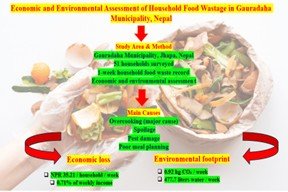
Household food waste presents a growing challenge to both economic security and environmental sustainability, particularly in rural agricultural regions. This study evaluated the economic and environmental implications of food waste at household level in Gauradaha Municipality, Jhapa district, Nepal. Based on a structured survey of 51 households using a self-administered questionnaire, the research examined factors influencing food waste generation and its associated costs. Data were analyzed using MS Excel and RStudio. One-way ANOVA, Pearson correlation, and proportions were analyzed in R to examine the effects of gender, education, and family size on waste generation, whereas MS Excel was used to assess the quantity of economic and environmental impacts. Economic valuation revealed that household food waste results in a loss of approximately NRS 35.21 (0.24 USD) per household per week, equivalent to less than 1% of annual household income. Environmentally, each household's food wastage contributes an estimated 0.92 kg of CO₂ emissions and consumes nearly 477.70 liters of water. Among food categories, cereals were identified as having the highest economic and environmental impact. Furthermore, overcooking emerged as the leading cause of waste, with refrigeration being the most commonly used storage method, yet no measures of value addition, processing and sustainable storage methods were practiced effectively, which reflects changing lifestyles, urbanization, and time constraints. These findings underscore the urgent need for targeted strategies that address food waste behaviour, promote efficient storage practices, and reduce the broader sustainability burdens at the household level in rural Nepal.Downloads
References
Abid, J., Tariq, M., Khan, A., & Ud Din, M. (2025). Wasting Less, Saving More: The Social Impact of Food Storage Behaviours in Peshawar Households. Social Science Review Archives, 3(2), 771–785. https://doi.org/10.70670/sra.v3i2.665
Adelodun, B., Kim, S. H., Odey, G., & Choi, K.S. (2021). Assessment of environmental and economic aspects of household food waste using a new Environmental Economic Footprint (EN-EC) index: A case study of Daegu, South Korea. Science of The Total Environment, 776, 145928. https://doi.org/10.1016/j.scitotenv.2021.145928
Afriyie, E., Gatzweiler, F., Zurek, M., Asem, F. E., Ahiakpa, J. K., Okpattah, B., Aidoo, E. K., & Zhu, Y.G. (2022). Determinants of Household-Level Food Storage Practices and Outcomes on Food Safety and Security in Accra, Ghana. Foods, 11(20), 3266. https://doi.org/10.3390/foods11203266
Ana Giménez, A. G., Florencia Alcaire, F. A., Agustina Vitola, A. V., María Rosa Curutchet, M. R. C., & Gastón Ares, G. A. (2022). Exploring the economic and environmental effects of food waste in Uruguayan households. Enterprise Development & Microfinance, 33(4), 1–23. https://doi.org/10.3362/1755-1986.22 00061
Ariyamuthu, R., Rupa Albert, V., & Je, S. (2022). An Overview of Food Preservation Using Conventional and Modern Methods. Journal of Food and Nutrition Sciences, 10(3), 70. https://doi.org/10.11648/j.jfns.20221003.13
Baral, B. (2023). The relation between food and culture | The Annapurna Express. The Annapurna Express. https://theannapurnaexpress.com/story/43569/
Baral, B. (2024). The tradition of preserving food in Nepal | The Annapurna Express. The Annapurna Express. https://theannapurnaexpress.com/story/47448/
Baykoca, B., & Yılmaz, S. (2025). Understanding food loss patterns across developed and developing countries using a GDP, growth rate, and health expenditure-based typology. Scientific Reports, 15(1), 27597. https://doi.org/10.1038/s41598-025-13156-3
Beretta, C., Stoessel, F., Baier, U., & Hellweg, S. (2013). Quantifying food losses and the potential for reduction in Switzerland. Waste Management, 33(3), 764–773. https://doi.org/10.1016/j.wasman.2012.11.007
Bista, D., Amgain, L., & Shrestha, S. (2013). Food security scenario, challenges, and agronomic research directions of Nepal. Agronomy Journal of Nepal, 3, 42 52. https://doi.org/10.3126/ajn.v3i0.8985
Bouras, H., & Jammali, D. (2022). Mode of consumption and food waste: Determinants and challenges for Tunisian consumers. International Journal of Innovation and Applied Studies, 37(3), 461–475.
Cederberg, C., & Sonesson, U. (2011). Global food losses and food waste: Extent, causes and prevention; study conducted for the International Congress Save Food, at Interpack 2011, [16 - 17 May], Düsseldorf, Germany (J. Gustavsson, Ed.). International Congress Save Food, Rome. Food and Agriculture Organisation of the United Nations. https://www.fao.org/4/mb060e/mb060e.pdf
Chalak, A., Abou-Daher, C., Chaaban, J., & Abiad, M. G. (2016). The global economic and regulatory determinants of household food waste generation: A cross-country analysis. Waste Management, 48, 418–422. https://doi.org/10.1016/j.wasman.2015.11.040
Chaokromthong, K., & Sintao, N. (2021). Sample size estimation using Yamane, Cochran, Krejcie, Morgan and Green formulas and Cohen's statistical power analysis by G*Power and comparisons. Apheit International Journal of Interdisciplinary Social Sciences and Technology, 10(2), 76–86. https://so04.tci-thaijo.org/index.php/ATI/article/view/254253/173847
Chemjong, B., & KC, Y. (2020). Food Security in Nepal: A Review. Rupantaran: A Multidisciplinary Journal, 4(1), 31–43. https://doi.org/10.3126/rupantaran.v4i1.34015
Collins, A., & Hoover, D. (2024). Additional Research on Household Food Waste. Www.nrdc.org. https://www.nrdc.org/bio/andrea-collins/additional-research-household-food-waste
FAO, Food and Agriculture Organisation. (2019). The state of food and agriculture 2019: Moving forward on food loss and waste reduction. https://doi.org/10.4060/ca6030en
FAO, Food and Agriculture Organization. (2013). Food wastage footprint: Impacts on natural resources. https://www.fao.org/4/i3347e/i3347e.pdf
Garnett, T. (2011). Where are the best opportunities for reducing greenhouse gas emissions in the food system (including the food chain)?. Food Policy, 36, S23-S32. https://doi.org/10.1016/j.foodpol.2010.10.010
Hoang, H. K., & Meyers, W. H. (2015). Price stabilisation and impacts of trade liberalisation in the Southeast Asian rice market. Food Policy, 57, https://doi.org/10.1016/j.foodpol.2015.07.009 26–39
Hoekstra, A. Y., & Chapagain, A. K. (2006). Water footprints of nations: Water use by people as a function of their consumption pattern. Water Resources Management, 21(1), 35–48. https://doi.org/10.1007/978-1-4020-5591-1_3
IPCC, Intergovernmental Panel On Climate Change. (2023). Climate Change 2021 – The Physical Science Basis: Working Group I Contribution to the Sixth Assessment Report of the Intergovernmental Panel on Climate Change (1st ed.). Cambridge University Press. https://doi.org/10.1017/9781009157896
James, C., Onarinde, B. A., & James, S. J. (2016). The Use and Performance of Household Refrigerators: A Review. Comprehensive Reviews in Food Science and Food Safety, 16(1), 160–179. https://doi.org/10.1111/1541-4337.12242
Khanal, B., & Maharjan, K. K. (2024). Estimation of Greenhouse Gas Emission from Municipal Solid Waste Management Techniques—A Case of Rampur Municipality, Palpa District, Nepal. Journal of Environment Sciences, 10, https://doi.org/10.3126/jes.v10i1.66965 34–45
Kummu, M., De Moel, H., Porkka, M., Siebert, S., Varis, O., & Ward, P. J. (2012). Lost food, wasted resources: Global food supply chain losses and their impacts on freshwater, cropland, and fertiliser use. Science of The Total Environment, 438, 477–489. https://doi.org/10.1016/j.scitotenv.2012.08.092
Lipinski, B., Hanson, C., Waite, R., Searchinger, T., & Lomax, J. (2016). Reducing food loss and waste. World Resources Institute. https://www.wri.org/research/reducing-food loss-and-waste
Muth, M. K., Birney, C., Cuéllar, A., Finn, S. M., Freeman, M., Galloway, J. N., Gee, I., Gephart, J., Jones, K., Low, L., Meyer, E., Read, Q., Smith, T., Weitz, K., & Zoubek, S. (2019). A systems approach to assessing environmental and economic effects of food loss and waste interventions in the United States. Science of The Total Environment, 685, 1240–1254. https://doi.org/10.1016/j.scitotenv.2019.06.230
NSO, National Statistics Office. (2021). 12th National Population and Housing Census 2021. Government of Nepal. https://cbs.gov.np
NSO, National Statistics Office. (2024). Nepal Living Standards Survey IV 2022/23: Household income and expenditure report. Government of Nepal. https://cbs.gov.np
Oria, M., & Schneeman, B. O. (2020). Drivers of Food Waste at the Consumer Level and Implications for Intervention Design. In www.ncbi.nlm.nih.gov. National Academies Press (US). https://www.ncbi.nlm.nih.gov/books/NBK564034/
Parfitt, J., Barthel, M., & Macnaughton, S. (2010). Food waste within food supply chains: Quantification and potential for change to 2050. Philosophical Transactions of the Royal Society B: Biological Sciences, 365(1554), 3065–3081. https://doi.org/10.1098/rstb.2010.0126
Poore, J., & Nemecek, T. (2018). Reducing food’s environmental impacts through producers and consumers. Science, 360(6392), 987–992. https://doi.org/10.1126/science.aaq0216
Rooijen, M. A. van, Gerdessen, J. C., Claassen, G. D. H., & Leeuw, S. L. J. M. de. (2024). Optimising household food waste: The impact of meal planning, package sizes, and performance indicators. Resources, Conservation and Recycling, 205(107559), 107559–107559. https://doi.org/10.1016/j.resconrec.2024.107559
UNESCO, United Nations Educational, Scientific and Cultural Organization. (2020). The United Nations world water development report 2020: Water and climate change. UNESCO. https://unesdoc.unesco.org/ark:/48223/pf0000372985
Yahia, E. M., & Mourad, M. (2020). Food waste at the consumer level. Preventing Food Losses and Waste to Achieve Food Security and Sustainability, 341–366. https://doi.org/10.19103/as.2019.0053.14
Downloads
Published
How to Cite
Issue
Section
License
Copyright (c) 2026 Agriculture and Environmental Science Academy

This work is licensed under a Creative Commons Attribution-NonCommercial 4.0 International License.